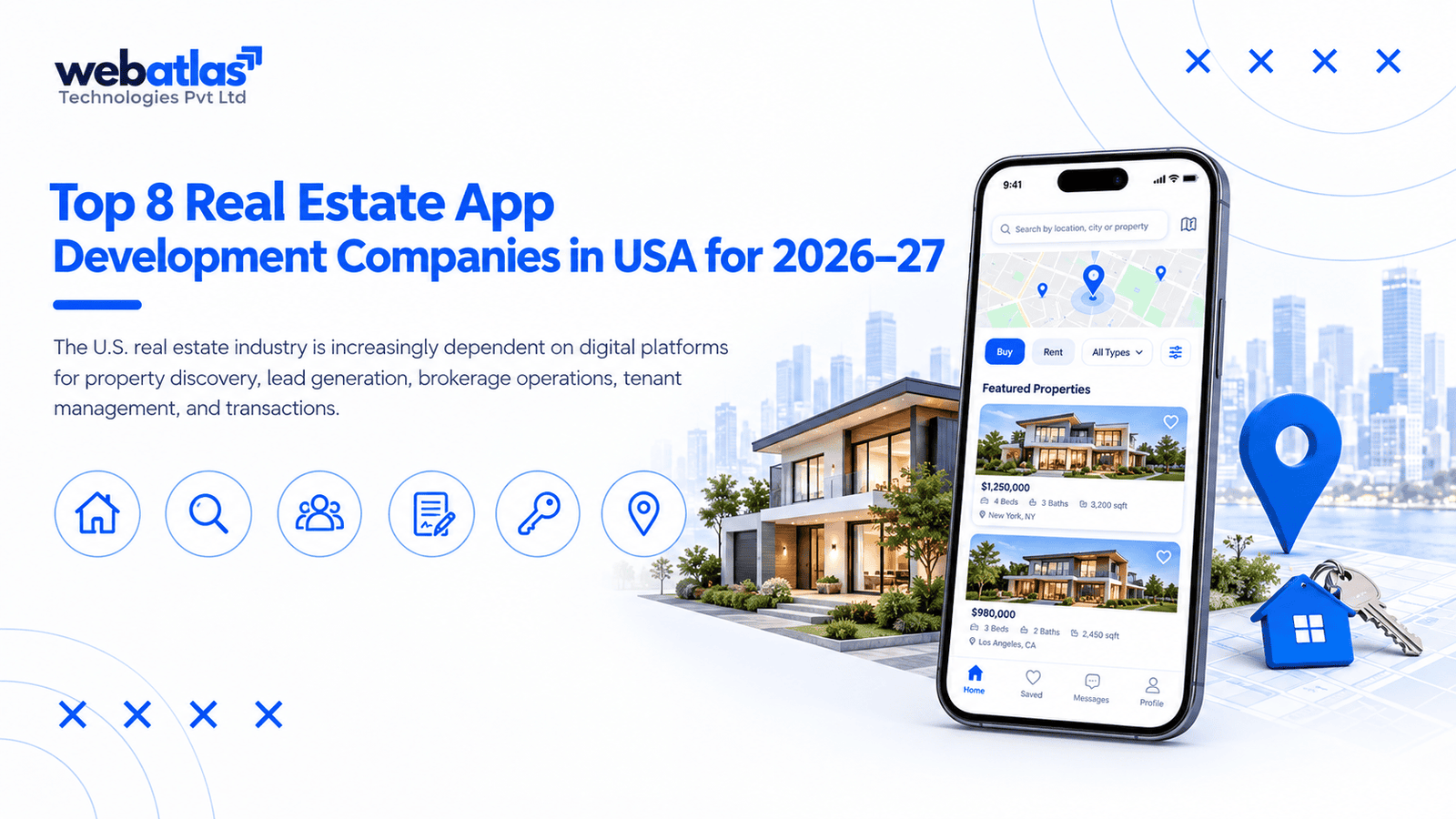
The U.S. real estate industry is becoming increasingly dependent on digital platforms for property discovery, lead generation, brokerage operations, tenant management, and transactions. Buyers now expect fast property searches, accurate listings, map-based discovery, virtual tours, instant communication, and personalized recommendations from real estate applications.
For real estate companies, developing an app is therefore not just about creating property listing screens. A successful platform may require MLS/IDX integrations, secure user accounts, advanced search, maps, CRM connectivity, AI-based recommendations, analytics, payment systems, appointment scheduling, and scalable cloud infrastructure.
With so many software development companies offering real estate technology services, selecting the right development partner can be challenging. This guide covers 8 real estate app development companies in the USA for 2026–27, based on their real estate/PropTech capabilities, technical expertise, publicly documented experience, scalability, and relevant solutions.
Editorial note: The order below is a curated list for informational purposes and should not be treated as an objective industry ranking. Company capabilities, pricing, team size, and services can change over time.
Real Estate App Development Companies at a Glance
| Company | Founded | Headquarters | Real Estate Focus | Key Capabilities | Company Size* |
| WebAtlas Tech | — | USA / Global | Real Estate Apps & Platforms | Mobile, Web, AI, CRM, Virtual Tours | 50–100 |
| LITSLINK | 2014 | Palo Alto, CA | MLS, Brokerage & PropTech | MLS, IDX/VOW, AI, CRM, Analytics | 201–500 |
| Ascendix Technologies | 1996 | Dallas, TX | Commercial Real Estate | CRE CRM, Custom Software, AI | 51–200 |
| Saritasa | 2005 | Newport Beach, CA | Real Estate Software | Mobile, Web, AR/VR, Cloud | 51–200 |
| Taazaa | 2007 | Hudson, OH | PropTech & Property Management | AI, Automation, Mobile, Cloud | 201–500 |
| Intellectsoft | 2007 | New York, NY | Enterprise Real Estate Solutions | Mobile, AI, Cloud, Enterprise Software | 51–200 |
| TechAhead | 2009 | Agoura Hills, CA | Mobile & Digital Platforms | Mobile, AI, Cloud, Custom Software | 250–300 |
| Fingent | 2003 | New York, NY | PropTech & Real Estate | MLS, IDX, CRM, Property Management | 501–1,000 |
*Company-size figures are based on currently available company/LinkedIn information and may change.
1. Webatlas Tech
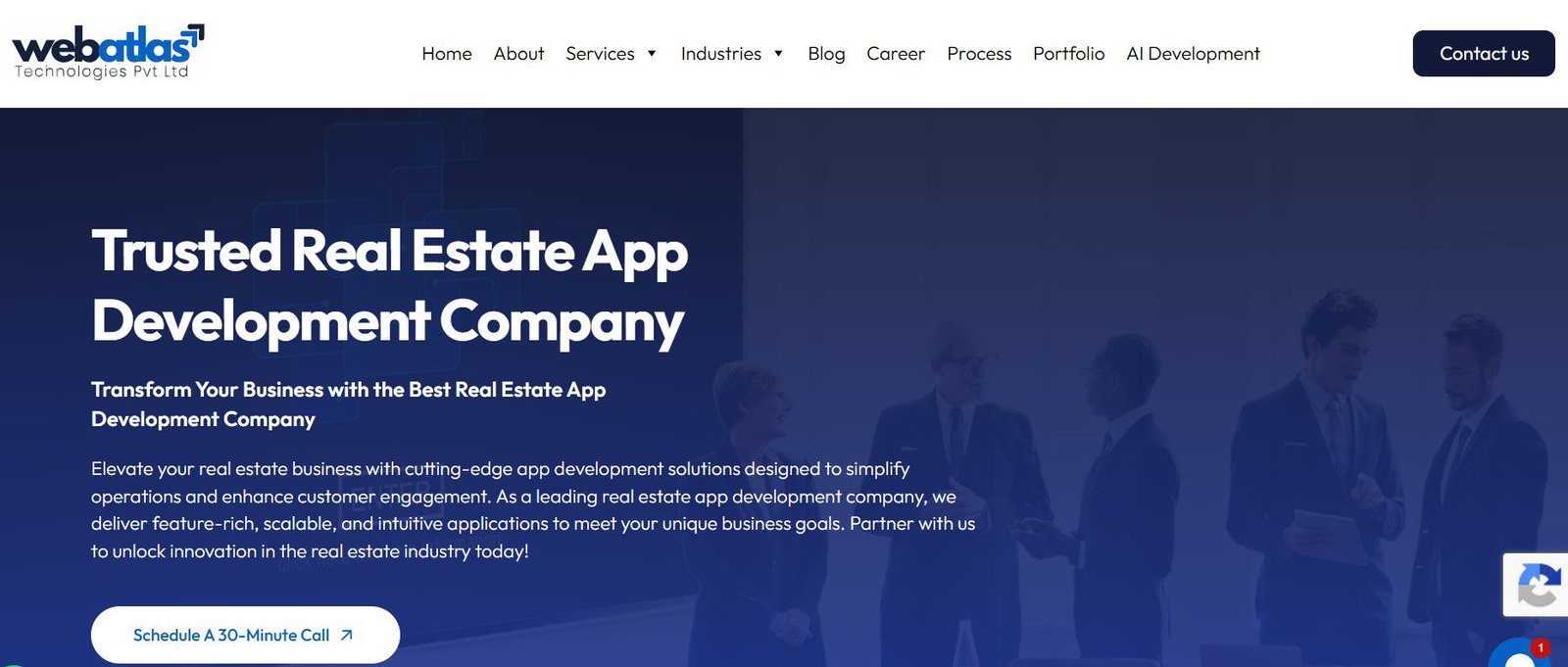
Webatlas Tech is a digital product engineering company providing custom real estate apps, mobile applications, AI-powered solutions, and scalable digital platforms for real estate businesses.
Company Overview
Webatlas Tech develops customized real estate applications designed around property discovery, lead generation, agent workflows, and business operations. Its real estate solutions can include property listings with images and videos, advanced search, virtual tours, location-based discovery, property viewing bookings, and lead management.
The company can build solutions for different real estate use cases, including property listing platforms, real estate marketplaces, property management applications, and custom business platforms. Its broader development capabilities cover mobile and web applications, UI/UX design, custom software, SaaS products, APIs, and AI-based solutions.
For property-focused applications, features such as map-based search, property filters, agent profiles, CRM integration, notifications, calculators, and communication tools can be incorporated depending on the business model. Webatlas Tech also highlights AI applications for areas such as property valuation, lead management, and market trend analysis.
The company can be considered by startups, real estate agencies, property businesses, and organizations looking to develop a customized digital platform rather than relying entirely on off-the-shelf software.
Additional Details
- Company Name – Webatlas Tech
- Website: www.webatlastech.com
- Company Size: 50–100 Employees
- Email: info@webatlas.tech
- Phone: +91 82880 72228
2. LITSLINK
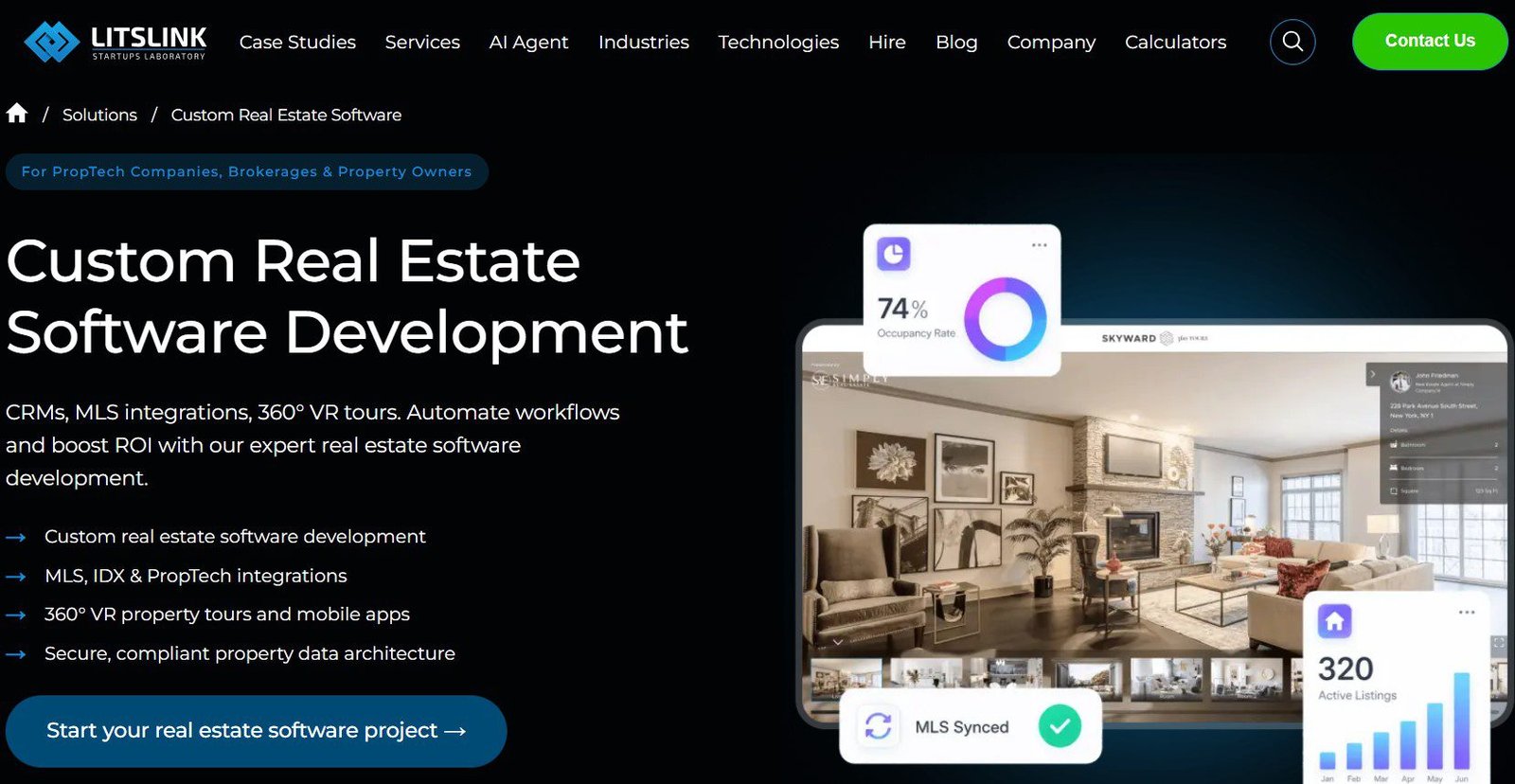
LITSLINK is a U.S.-based custom software development company offering real estate, MLS, AI, mobile, web, and cloud development services for businesses and startups.
Company Overview
LITSLINK has dedicated real estate MLS software capabilities covering listing databases, member management, data synchronization, IDX/VOW integrations, transaction management, analytics, and AI-powered real estate solutions. Its current real estate offering specifically addresses high-volume listing data and RESO-aligned architecture.
The company works on custom MLS platforms for associations, brokerages, and property networks. Its documented capabilities include listing database architecture, real-time data synchronization, member and role management, advanced property search, CRM integrations, transaction management, and audit trails.
LITSLINK also works with IDX and VOW feeds and describes support for RESO Web API and Data Dictionary standards. This can be particularly relevant for organizations that need structured property data to move between MLS systems, brokerage platforms, portals, and other connected applications.
Beyond core MLS development, the company offers AI-powered search, predictive analytics, automated valuation models, market intelligence dashboards, cloud migration, modernization, and ongoing maintenance. Its LinkedIn profile currently lists 201–500 employees, with headquarters in Palo Alto, California, and a founding year of 2014.
Additional Details
- Company Name: LITSLINK
- Website: www.litslink.com
- Company Size: 201–500 employees
3. Ascendix Technologies
Ascendix Technologies is a Dallas-based technology company specializing in commercial real estate software, CRM, custom applications, data solutions, and AI.
Company Overview
Ascendix Technologies was founded in Dallas in 1996 and has built a long-standing focus around commercial real estate technology. The company has evolved from CRM consulting into a technology provider offering commercial real estate products, custom software, integrations, and AI solutions.
Its real estate expertise is particularly focused on commercial real estate workflows. The company develops and supports solutions related to CRM, property data, lead and property management, reporting, search, and business process automation.
Ascendix has also developed its own commercial real estate products, including AscendixRE and Ascendix Search, along with other tools for property listings, collaboration, reporting, and commercial real estate workflows. Its public company profile lists commercial real estate CRM and software among its specialties.
With its long history in CRE technology, Ascendix can be relevant for commercial real estate organizations that require specialized CRM, property data, custom applications, Salesforce solutions, or AI-enabled workflows rather than a general-purpose property marketplace.
Additional Details
- Company Name: Ascendix Technologies
- Website: www.ascendix.com
- Company Size: 51–200 employees
4. Saritasa
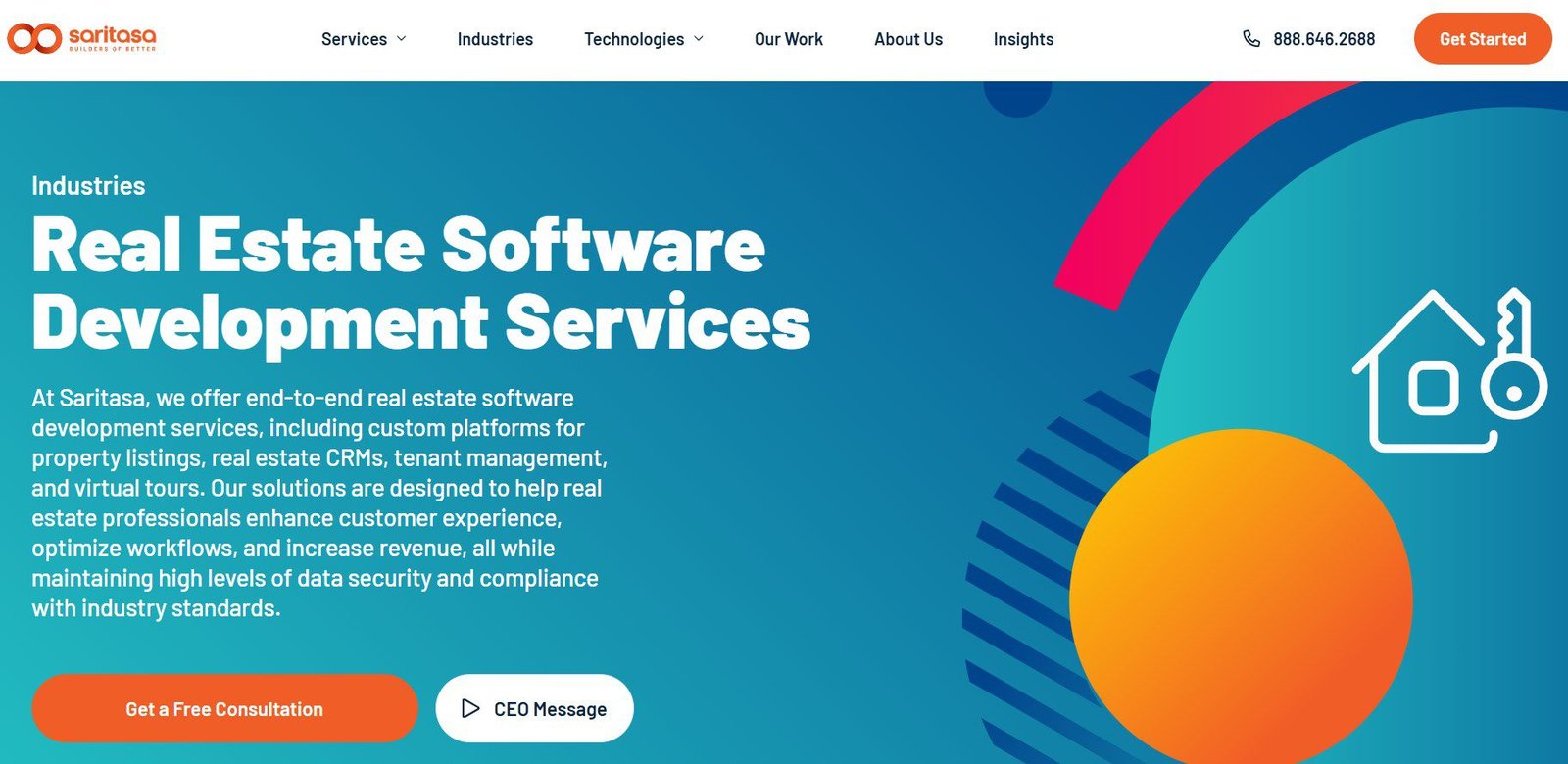
Saritasa is a U.S.-based custom software development company providing mobile applications, web platforms, custom software, cloud solutions, and emerging technology services.
Company Overview
Saritasa provides custom technology solutions across multiple industries, including real estate. Its capabilities cover mobile app development, web development, custom software, UI/UX, cloud solutions, DevOps, and emerging technologies such as AR and VR.
For real estate businesses, these capabilities can support applications such as property platforms, customer portals, business workflow systems, mobile applications, and digital experiences. AR and VR capabilities can also be relevant to real estate products that use immersive property visualization or virtual experiences.
The company states that it has been in business for 20 years, with 1,769 successful projects and 206 team members. Its LinkedIn profile lists the company as founded in 2005 with headquarters in Newport Beach, California.
Saritasa may be relevant for real estate organizations looking for a custom technology partner that can combine application development with cloud, design, workflow automation, and emerging technologies.
Additional Details
- Company Name: Saritasa
- Website: www.saritasa.com
- Company Size: 51–200 employees
5. Taazaa
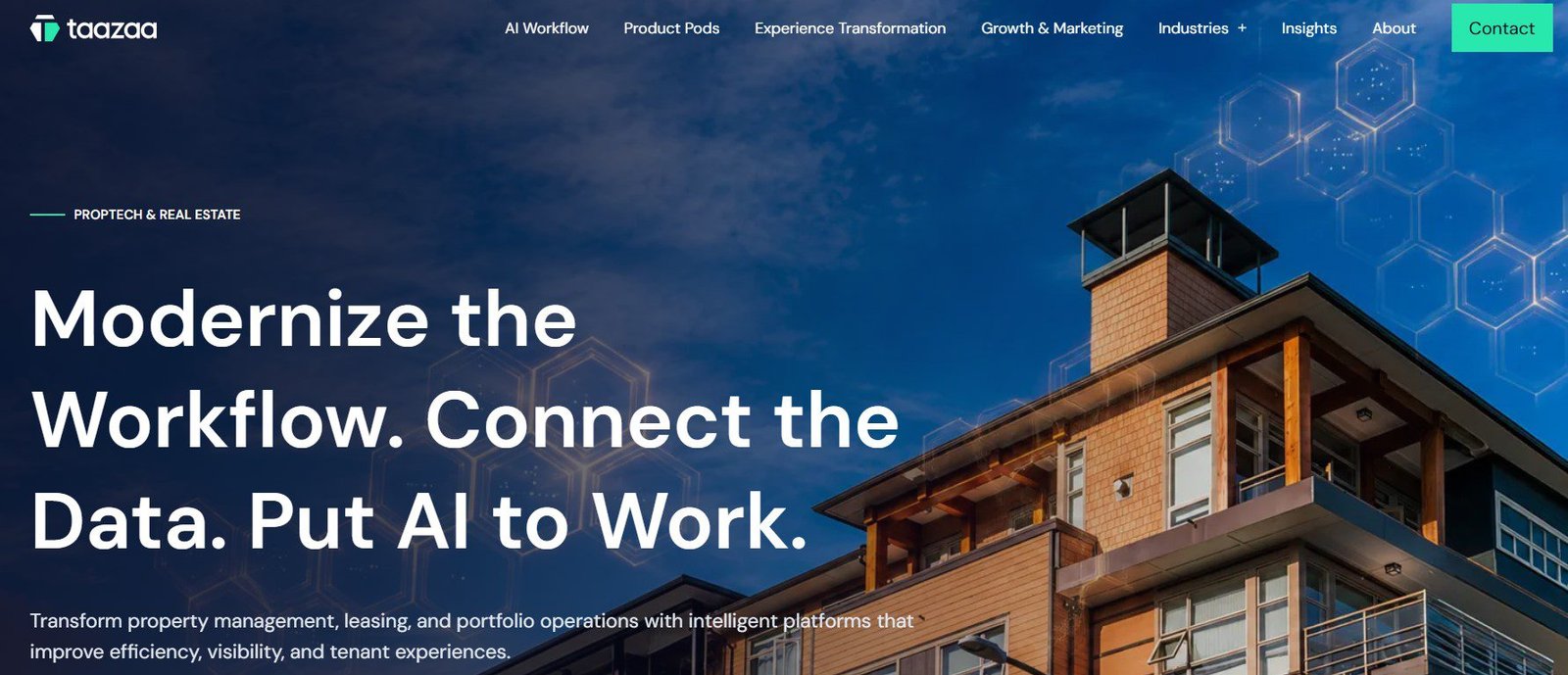
Taazaa is a U.S.-based product engineering and custom software company providing AI, mobile, web, cloud, and digital transformation solutions for real estate and other industries.
Company Overview
Taazaa has a dedicated PropTech and real estate practice focused on property management, leasing, portfolio operations, tenant experiences, and connected real estate platforms. The company describes its approach around replacing fragmented workflows with intelligent platforms that connect property operations, finance, maintenance, compliance, and reporting.
Its real estate solutions include property management platforms, tenant portals, building management systems, investment and asset management, construction management, CRM, mobile PropTech applications, and custom real estate solutions.
AI and automation are also part of its current real estate offering. Taazaa highlights use cases involving property inspections, workflow automation, tenant management, leasing, and operational processes. Its PropTech page also lists SOC 2 Type II and ISO 27001 certifications.
Taazaa was founded in 2007 and currently lists its headquarters in Hudson, Ohio. LinkedIn lists its company size as 201–500 employees.
Additional Details
- Company Name: Taazaa
- Website: www.taazaa.com
- Company Size: 201–500 employees
6. Intellectsoft
Intellectsoft is a New York-based digital transformation and software engineering company providing custom software, mobile applications, AI, cloud, and enterprise technology solutions.
Company Overview
Intellectsoft has been providing software engineering and digital transformation services since 2007. Its technology capabilities include custom software, mobile applications, enterprise solutions, AI, cloud computing, data platforms, product design, QA, and DevOps.
For real estate businesses, these capabilities can be applied to customer-facing property applications, real estate portals, property management platforms, CRM systems, analytics dashboards, communication tools, and workflow automation.
The company follows an end-to-end approach covering ideation, product development, delivery, and ongoing support. This can be useful for organizations that need to develop a new digital product while also integrating it with existing enterprise systems.
Intellectsoft’s current LinkedIn profile lists 51–200 employees, headquarters in New York, and a founding year of 2007. The company also states that it has more than 150 engineers across 10 offices.
Additional Details
- Company Name: Intellectsoft
- Website: www.intellectsoft.net
- Company Size: 51–200 employees
7. TechAhead
TechAhead is a U.S.-based software development company specializing in mobile applications, AI, cloud engineering, custom software, and enterprise digital platforms.
Company Overview
TechAhead has been developing digital products since 2009, with capabilities covering mobile and web applications, AI, cloud engineering, data analytics, and enterprise software. The company currently states that it has delivered more than 2,500 platforms, products, and enterprise systems and served more than 1,200 enterprises and high-growth companies.
For real estate businesses, these capabilities can support property search applications, customer-facing mobile platforms, personalized recommendations, digital portals, analytics, workflow automation, and other custom solutions.
Mobile development is a significant part of the company’s offering, making it relevant for real estate businesses that want to provide buyers, sellers, agents, tenants, or property managers with dedicated mobile experiences.
TechAhead’s current FAQ lists approximately 250–300 professionals, headquarters in Agoura Hills, California, and delivery centers in Noida and Dubai.
Additional Details
- Company Name: TechAhead
- Website: www.techaheadcorp.com
- Company Size: 250–300 professionals
8. Fingent
Fingent is a New York-based custom software development company offering PropTech, real estate applications, enterprise software, AI, cloud, and digital transformation services.
Company Overview
Fingent has a dedicated PropTech practice covering residential, commercial, industrial, and raw-land real estate. Its solutions include property management, MLS, IDX, real estate CRM, valuation software, lease management, brokerage management, 3D visualization, 360° virtual tours, tenant engagement, and real estate ERP.
The company also develops mobile and web applications for property search, booking, customer portals, communication, and property management. Its IDX offering includes real-time MLS data access, customized search and filtering, lead generation, virtual tours, analytics, and property listing updates.
Fingent also highlights AI use cases such as smart property recommendations, AI-powered virtual staging, automated rent prediction, predictive vacancy management, and intelligent lease renewals.
Founded in 2003, Fingent is headquartered in New York and currently reports more than 450 professionals and 700+ completed projects. LinkedIn lists its company size as 501–1,000 employees.
Additional Details
- Company Name: Fingent
- Website: www.fingent.com
- Company Size: 501–1,000 employees
Key Features to Include in a Real Estate App
Choosing a development company is only one part of building a real estate application. The functionality of the application should match the needs of buyers, sellers, agents, brokers, property managers, investors, or tenants.
Some of the most important features include:
1. User Registration and Profiles
Users should be able to create accounts using email, phone numbers, or supported social login options. Different user roles can be created for buyers, sellers, agents, brokers, landlords, tenants, and administrators.
2. Property Listings
A property listing should provide essential information such as:
- Property images
- Videos
- Price
- Location
- Property type
- Number of bedrooms and bathrooms
- Area
- Amenities
- Description
- Agent information
- Availability/status
3. Advanced Search and Filters
Users should be able to search properties based on:
- Location
- Price range
- Property type
- Bedrooms
- Bathrooms
- Area
- Amenities
- Property status
- Listing date
4. Map-Based Property Search
Map integration allows users to discover properties based on geographic location. More advanced platforms can support radius search, map boundaries, clustering, nearby amenities, and location-based recommendations.
5. Favorites and Saved Searches
Users can save properties and create searches that notify them when matching properties are added or updated.
6. Agent and Broker Profiles
Agent profiles can include:
- Name
- Photo
- Contact information
- Specialization
- Listings
- Reviews
- Experience
- Availability
7. Property Viewing Booking
Users can request or schedule property visits directly through the application.
8. Chat and Communication
In-app messaging, push notifications, email, and other communication features can help users connect with agents and property managers.
9. Mortgage or Loan Calculator
A mortgage or EMI calculator can help users estimate affordability based on property price, down payment, interest rate, and loan duration.
10. Virtual Tours
360° tours, videos, and interactive property experiences allow users to explore properties remotely.
11. CRM Integration
CRM integration helps agents and real estate businesses manage inquiries, leads, follow-ups, and customer interactions.
12. Analytics Dashboard
Administrators can track:
- Property views
- Search activity
- Leads
- Saved properties
- Agent inquiries
- User registrations
- Conversion rates
- Popular locations
MLS vs. IDX vs. RESO: What Real Estate Apps Need to Know
One of the most important technical considerations for a U.S. real estate application is property-data integration.
These terms are related but serve different purposes.
What Is MLS?
MLS (Multiple Listing Service) is a system used by real estate professionals to share property listing information within a defined market or organization.
An application that needs MLS data must consider the specific MLS provider, access requirements, licensing, data fields, update mechanisms, and usage restrictions.
What Is IDX?
IDX (Internet Data Exchange) generally refers to technology and rules that allow eligible real estate professionals to display MLS listing data on websites and other consumer-facing experiences.
For example, an application might use IDX integration to display current property listings while allowing users to search, filter, and view property details.
What Is RESO?
RESO (Real Estate Standards Organization) develops data standards designed to improve interoperability between real estate technology systems.
Modern real estate platforms may use RESO Web API and Data Dictionary standards to structure and exchange property data.
LITSLINK, for example, currently documents RESO Web API/Data Dictionary-aligned MLS architecture, while Fingent documents MLS and IDX integration capabilities.
Why This Matters
MLS/IDX/RESO integration is more complicated than simply connecting an API.
A development team may need to handle:
- Listing synchronization
- Data normalization
- Duplicate records
- Listing status changes
- Price changes
- Media updates
- Feed failures
- Access permissions
- Data licensing
- Search performance
- Historical changes
- Audit logs
The exact requirements depend on the MLS, business model, geographic market, and intended application.
AI in Real Estate Apps
AI is increasingly being used to improve property discovery, automate repetitive workflows, and generate insights from real estate data.
Potential AI applications include:
AI Property Recommendations
The application can analyze user searches, saved properties, location preferences, price ranges, and browsing behavior to recommend relevant properties.
AI Property Valuation
AI and analytics can assist with estimating property values using historical data, market information, property characteristics, and other available datasets.
AI Chatbots
A real estate chatbot can answer questions about listings, availability, property features, appointment scheduling, and basic customer inquiries.
Lead Qualification
AI can help categorize leads based on user activity and identify prospects that may require faster follow-up.
Predictive Analytics
Real estate companies can use analytics to study:
- Market trends
- Property demand
- Rental prices
- Vacancy rates
- Lead behavior
- Investment opportunities
AI-Powered Virtual Staging
AI can help generate different interior design concepts for an empty property, giving prospective buyers an idea of how a space could look.
The important consideration is that AI should solve a defined business problem rather than being added simply as a marketing feature.
Security Considerations for Real Estate Apps
Real estate applications can process personal information, financial information, property documents, contracts, and customer communication. Security therefore needs to be considered during architecture and development.
Important measures can include:
- Secure authentication
- Role-based access control
- Encryption in transit and at rest
- Secure API authentication
- Database protection
- Secure document storage
- Audit logs
- Backup and recovery
- Vulnerability testing
- Secure payment processing
- Monitoring and incident response
Applications handling financial or payment information should also use appropriate payment providers and follow applicable security requirements.
For MLS-based platforms, access control is especially important because different users may have different rights to view, manage, or distribute listing data.
Real Estate App Development Cost in the USA
The cost of developing a real estate app depends heavily on the type of application and the level of functionality required.
A current 2026 cost guide published by WebAtlas Tech places real estate app development broadly between $15,000 and $300,000+, with the final cost influenced by app type, integrations, platforms, design complexity, and data requirements.
| Real Estate App Type | Estimated Development Cost | Typical Timeline |
| Basic Property Listing MVP | $15,000–$40,000 | 2–4 months |
| Rental Property App | $25,000–$60,000 | 3–5 months |
| Agent/Broker App | $30,000–$75,000 | 3–5 months |
| Mid-Level Real Estate Marketplace | $40,000–$110,000 | 4–7 months |
| Advanced Real Estate Platform | $110,000–$300,000+ | 6–12+ months |
These are planning estimates rather than fixed market prices. A project with a basic listing database will have very different requirements from a multi-market platform with MLS/IDX integrations, AI, virtual tours, CRM, analytics, and multiple user roles.
For a deeper breakdown, businesses can also review the Real Estate App Development Cost in 2026 guide from WebAtlas Tech. Real Estate App Development Cost in 2026
Factors That Affect Real Estate App Development Cost
1. App Type
A property listing application generally requires less development effort than a full property management or brokerage platform.
2. Number of Platforms
Developing for iOS, Android, and web can increase the overall scope.
3. UI/UX Complexity
Advanced map interfaces, property visualization, virtual tours, animations, and personalized dashboards require additional design and development effort.
4. MLS/IDX Integration
MLS and IDX integration can significantly increase complexity because of data structures, access requirements, synchronization, and third-party rules.
5. Third-Party Integrations
Costs can increase when integrating:
- Maps
- Payment gateways
- CRM systems
- Analytics platforms
- Communication services
- Mortgage APIs
- Property data providers
- E-signature platforms
6. AI Features
AI-powered recommendations, valuation, chatbots, predictive analytics, and automated workflows require additional data, backend architecture, testing, and ongoing model/API costs.
7. Security Requirements
Applications handling sensitive customer, financial, or property information may require additional security architecture and testing.
8. Maintenance
Post-launch expenses can include:
- Bug fixing
- Security updates
- OS compatibility
- API changes
- Cloud infrastructure
- Database optimization
- New features
- Third-party integration updates
Hidden and Ongoing Costs to Consider
The initial development budget is not the only expense associated with a real estate application.
Businesses should also plan for:
MLS or Data Licensing
Depending on the business model and MLS, there may be fees or licensing requirements for accessing and displaying property data.
Cloud Infrastructure
The cost can increase as the number of users, images, videos, property records, searches, and transactions grows.
Third-Party APIs
Maps, messaging, payment processing, AI services, property data, and other APIs may charge based on usage.
App Store Fees
Applications distributed through mobile app stores may be subject to applicable developer account and platform fees.
Maintenance
The platform will need ongoing updates as operating systems, APIs, security standards, and business requirements change.
Marketing
A technically strong application still needs an acquisition strategy. Businesses should budget separately for SEO, paid advertising, social media, content, partnerships, and lead generation.
How to Choose the Right Real Estate App Development Company
Before signing a development contract, evaluate potential partners against your actual requirements.
1. Check Real Estate Experience
A company that understands real estate workflows can often identify requirements that a general software developer may overlook.
2. Review Relevant Projects
Look for projects involving:
- Property listings
- Property management
- MLS/IDX
- Brokerage
- CRM
- Tenant management
- Virtual tours
- Real estate analytics
3. Evaluate Integration Experience
If your platform requires MLS, IDX, CRM, payment, mapping, or property-data integrations, ask the development company about its experience with those systems.
4. Review Technical Capabilities
Evaluate expertise across:
- Mobile development
- Web development
- Backend development
- Cloud
- APIs
- AI
- Databases
- Security
- DevOps
5. Ask About Scalability
A platform that works for 5,000 listings may need a different architecture when it grows to hundreds of thousands or millions of records.
6. Understand Ownership
Before development begins, clarify ownership of:
- Source code
- Designs
- Databases
- APIs
- Documentation
- Intellectual property
7. Ask About Post-Launch Support
Find out whether the company provides maintenance, monitoring, security updates, bug fixes, and future development.
Common Mistakes to Avoid When Developing a Real Estate App
-
Building Too Many Features in the First Version
An MVP should focus on the core user problem rather than trying to replicate every feature offered by large property platforms.
-
Ignoring Data Quality
Incorrect, duplicate, outdated, or missing property information can quickly damage user trust.
-
Treating MLS Integration as a Simple API Connection
MLS integration can involve data standards, access restrictions, synchronization, permissions, and licensing considerations.
-
Designing Only for Buyers
A real estate platform may need separate experiences for buyers, sellers, agents, brokers, landlords, tenants, and administrators.
-
Ignoring Mobile UX
Property searches frequently involve location-based and mobile interactions. Search, maps, images, filters, and communication should therefore be designed carefully for smaller screens.
-
Adding AI Without a Business Purpose
AI should have a measurable purpose such as better property recommendations, automated lead qualification, valuation support, or operational automation.
-
Forgetting Post-Launch Costs
Real estate apps require continuous maintenance as data sources, APIs, operating systems, security requirements, and business processes evolve.
Key KPIs to Track After Launch
Launching the app is only the beginning. Real estate businesses should monitor performance through measurable KPIs.
Important metrics can include:
- Number of active users
- Property searches
- Property views
- Saved properties
- Search-to-view conversion
- View-to-inquiry conversion
- Number of leads
- Agent response time
- Appointment bookings
- User retention
- Lead conversion rate
- Cost per lead
- Popular property locations
- Most-used filters
- Agent performance
- Listing engagement
These metrics can help identify which parts of the application are delivering value and which areas need improvement.
Frequently Asked Questions
- What is a real estate app development company?
A real estate app development company designs and builds mobile or web applications for property businesses. These applications can support property listings, search, maps, CRM, property management, tenant services, brokerage workflows, and other real estate operations.
- How much does it cost to develop a real estate app in the USA?
A real estate application can cost approximately $15,000 to $300,000+, depending on its features, platforms, integrations, design complexity, data requirements, and scalability needs.
- How long does it take to build a real estate app?
A basic real estate MVP may take around 2–4 months, while more advanced platforms with MLS/IDX integrations, AI, CRM, analytics, and multiple user roles can take significantly longer.
- What is the difference between MLS and IDX?
MLS is a property listing database/system used by real estate professionals, while IDX generally refers to technology and rules for displaying eligible MLS listing data through consumer-facing real estate websites or applications.
- Does a real estate app need MLS integration?
Not necessarily. A business may use its own property database, third-party property APIs, or another data source. MLS integration becomes relevant when the business needs access to MLS listing data and has the required permissions and agreements.
- What features should a real estate app have?
Common features include property listings, advanced search, maps, filters, user accounts, favorites, agent profiles, property viewing bookings, notifications, chat, CRM integration, analytics, and virtual tours.
- Can AI be integrated into a real estate application?
Yes. AI can support property recommendations, chatbots, lead qualification, valuation assistance, predictive analytics, virtual staging, tenant management, and workflow automation.
- Can a real estate app include virtual tours?
Yes. Applications can integrate photos, videos, 360° tours, 3D visualization, and other immersive property experiences.
- How can a real estate app generate revenue?
Common monetization models include:
- Featured property listings
- Agent subscriptions
- Brokerage subscriptions
- Lead-generation fees
- Premium property promotion
- Transaction fees
- Advertising
- Premium analytics
- Property-management subscriptions
The most appropriate model depends on the target users and business structure.
- What should I ask a real estate app development company before hiring them?
Ask about relevant real estate projects, MLS/IDX experience, technology capabilities, security, integrations, scalability, development methodology, post-launch support, ownership of source code, estimated timeline, and total development cost.
Conclusion
Real estate applications have evolved beyond simple property listing directories. Modern platforms can combine property discovery, maps, virtual tours, CRM, MLS/IDX data, AI, analytics, communication, scheduling, and property-management workflows into a single digital ecosystem.
The 8 companies covered in this list Webatlas Tech, LITSLINK, Ascendix Technologies, Saritasa, Taazaa, Intellectsoft, TechAhead, and Fingent—represent different areas of real estate technology expertise. Some have dedicated MLS or PropTech capabilities, while others provide broader custom software, mobile, AI, cloud, or enterprise development services.
The right development partner ultimately depends on your specific application type, target users, required integrations, budget, security requirements, and long-term growth plans. Before starting development, clearly define the MVP, data requirements, integrations, scalability expectations, and post-launch support requirements.
A well-planned real estate application can then provide a stronger foundation for property discovery, lead generation, customer engagement, and operational efficiency in the increasingly digital U.S. real estate market.