
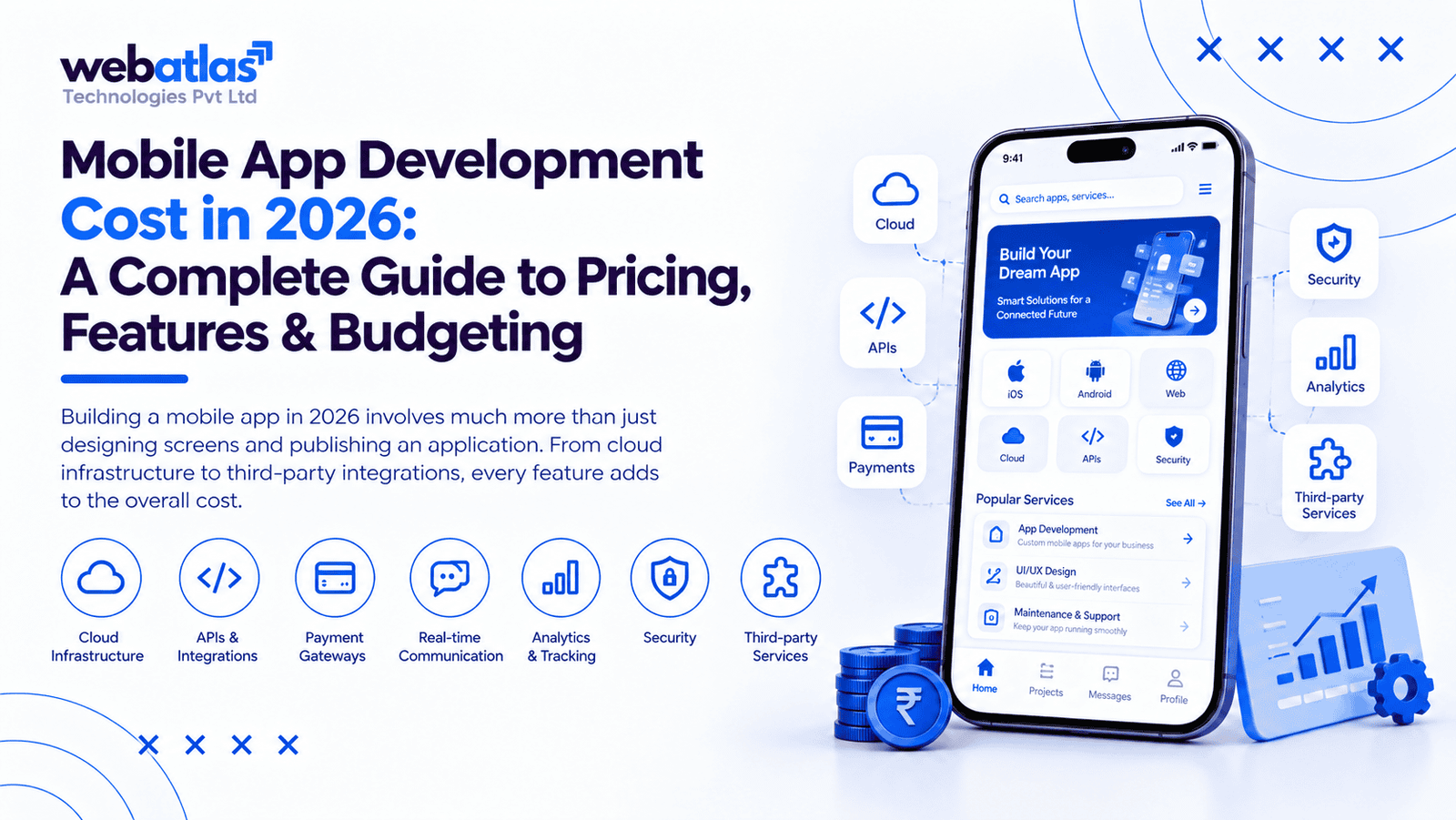
Building a mobile app in 2026 involves much more than designing screens and publishing an application. Modern apps may require cloud infrastructure, APIs, payment gateways, real-time communication, analytics, security, third-party integrations, and AI-powered functionality.
So, how much does mobile app development cost in 2026?
The answer depends on what you are building. A basic utility app can require a relatively small investment, while a multi-platform fintech, healthcare, marketplace, or AI-powered application can require a significantly larger budget.
As a general planning benchmark:
| App Complexity | Estimated Cost | Typical Timeline |
| Simple | 5,000–20,000+ | 1–3 months |
| Medium | 20,000–60,000+ | 3–6 months |
| Complex | 60,000–150,000+ | 5–9 months |
| Enterprise / Advanced | 150,000–500,000+ | 9–18+ months |
These figures are indicative rather than fixed prices. Your actual cost depends on features, user roles, platforms, technology, backend requirements, integrations, design complexity, security, development team, and post-launch requirements.
This guide explains how mobile app development costs are calculated in 2026, what different app types may cost, how AI affects budgets, what expenses businesses often overlook, and how to create a realistic app development budget before starting the project.
How Much Does Mobile App Development Cost in 2026?
There is no universal price for developing a mobile app.
A five-screen business application and a marketplace with multiple user roles, payments, real-time tracking, chat, and an admin dashboard may both be classified as mobile apps, but their development requirements are completely different.
A useful starting point is to categorize applications based on complexity.
Simple Mobile Apps
These usually have limited functionality and fewer screens. Examples include:
- Business information apps
- Basic utility applications
- Content-based applications
- Simple calculators
- Basic appointment applications
Estimated cost: 5,000–20,000+
Medium-Complexity Apps
These may include user accounts, APIs, payments, dashboards, databases, notifications, and more complex workflows.
Examples include:
- eCommerce apps
- Fitness applications
- Education platforms
- Basic marketplaces
- Booking applications
Estimated cost: 20,000–60,000+
Complex Mobile Apps
These generally involve multiple user roles, advanced backend systems, real-time functionality, sophisticated integrations, or security requirements.
Examples include:
- Fintech applications
- Healthcare platforms
- Ride-booking applications
- Social media platforms
- Advanced marketplaces
- AI-powered applications
Estimated cost: 60,000–150,000+
Enterprise Applications
Enterprise-grade products can involve complex integrations, advanced security, large-scale infrastructure, analytics, compliance requirements, and thousands or millions of potential users.
Estimated cost: 150,000–500,000+
These figures should be used for initial budgeting rather than as a development quotation.
For a detailed project estimate, businesses should first define their required features, platforms, user roles, integrations, and expected scale.
Mobile App Development Cost by App Type
The type of mobile application you want to build has a major impact on development cost.
| App Type | Approximate Development Cost |
| Business / Informational App | 5,000–20,000 |
| Utility App | 5,000–25,000 |
| eCommerce App | 20,000–60,000+ |
| Food Delivery App | 30,000–80,000+ |
| Taxi / Ride-Booking App | 30,000–90,000+ |
| Healthcare App | 30,000–100,000+ |
| Dating App | 30,000–100,000+ |
| Real Estate App | 25,000–80,000+ |
| Social Media App | 40,000–120,000+ |
| Fintech App | 50,000–150,000+ |
| AI-Powered App | 30,000–150,000+ |
| Enterprise App | 100,000–500,000+ |
These ranges vary because applications within the same category can have very different requirements.
For example, a basic eCommerce app with product browsing and checkout will require less development than a large marketplace supporting sellers, buyers, delivery providers, subscriptions, promotions, recommendations, and multiple payment options.
Similarly, a food delivery platform may require:
- Customer application
- Restaurant/vendor application
- Delivery partner application
- Admin dashboard
- Payment gateway
- Maps and location services
- Real-time order tracking
- Push notifications
- Reviews and ratings
This makes food delivery app development substantially different from building a basic single-user application.
Healthcare applications can also involve additional authentication, privacy, appointment management, patient records, integrations, and security considerations, making healthcare app development another specialized category.
The key takeaway is simple:
App category alone does not determine the cost. The functionality behind the business model does.
What Actually Goes Into a Mobile App Development Budget?
A development quotation is usually made up of multiple activities rather than one single development charge.
Discovery and Requirements
Before coding starts, the team needs to understand:
- Business objectives
- Target audience
- User journeys
- Required features
- Monetization model
- Technical requirements
- Third-party integrations
- Security requirements
- Future scalability
Clear requirements help reduce unnecessary changes later.
UI/UX Design
The design phase can include:
- User flows
- Wireframes
- Prototypes
- Visual design
- Design systems
- Usability considerations
For complex applications, investing in UI/UX design and development before coding can help identify usability issues early.
Mobile Development
This covers the actual application interface and functionality, including:
- Screens
- Navigation
- Forms
- User interactions
- Device functionality
- Notifications
- Local data handling
Backend Development
The backend may include:
- APIs
- Databases
- Authentication
- Business logic
- User management
- Payment processing
- Cloud infrastructure
- Analytics
- Security
This is one of the areas that businesses sometimes underestimate when calculating mobile app costs.
Testing and Quality Assurance
Testing may include:
- Functional testing
- Device testing
- API testing
- Performance testing
- Security testing
- Usability testing
- Regression testing
Deployment
The project may also involve:
- App Store submission
- Google Play submission
- Production configuration
- Analytics
- Crash monitoring
- Release management
Therefore, when comparing development quotes, always check what is actually included in the scope.
Mobile App Development Cost by Features
Features have a direct impact on development effort.
| Feature | Relative Cost Impact |
| Email / Phone Authentication | Low |
| Social Login | Low–Medium |
| Push Notifications | Low–Medium |
| User Profiles | Low–Medium |
| Payment Gateway | Medium |
| Subscription System | Medium–High |
| Maps & Location | Medium–High |
| Real-Time Chat | High |
| Video Calling | High |
| Live Tracking | High |
| Multi-Role System | High |
| Advanced Analytics | Medium–High |
| AI Chatbot | Medium–High |
| Recommendation Engine | High |
| Computer Vision | High |
| Custom Machine Learning | Very High |
However, a feature’s name does not tell you its complete cost.
For example, a basic chat feature could simply allow text messages between two users.
A more advanced communication system could require:
- Real-time messaging
- Group conversations
- Media sharing
- Voice messages
- Message notifications
- Message synchronization
- Moderation
- Reporting
- Message storage
The development effort is completely different.
The same principle applies to payments, maps, search, AI, notifications, and analytics.
Before requesting a quote, businesses should therefore describe what the feature needs to do, not just provide a feature name.
A Sample Mobile App Development Cost Breakdown
Instead of looking only at the final project price, it is useful to understand how the budget may be distributed.
For a medium-complexity application, an indicative distribution could look like this:
| Development Area | Approximate Share |
| Discovery & Requirements | 5–10% |
| UI/UX Design | 10–15% |
| Mobile Development | 25–35% |
| Backend & APIs | 20–30% |
| Third-Party Integrations | 5–10% |
| Testing & QA | 10–15% |
| Deployment | 2–5% |
| Project Management | 5–10% |
The actual percentages can change significantly depending on the product.
Example: Food Delivery App
Imagine a business wants to build a food delivery platform.
The customer application could require:
- Registration
- Restaurant discovery
- Search
- Menu browsing
- Cart
- Checkout
- Payment
- Order tracking
- Ratings
The restaurant side could require:
- Restaurant profile
- Menu management
- Order management
- Availability management
- Sales reports
The delivery side could require:
- Driver registration
- Order assignment
- Navigation
- Delivery status
- Earnings
The admin panel could require:
- User management
- Restaurant management
- Driver management
- Order management
- Promotions
- Reports
This example demonstrates why saying “a food delivery app costs $30,000” without defining its scope can be misleading.
A better question is:
Which version of the food delivery app are you building?
How AI Features Affect Mobile App Development Cost in 2026
AI has become an important part of mobile product development in 2026.
Businesses are incorporating:
- AI chatbots
- AI-powered search
- Personalized recommendations
- Voice assistants
- Image recognition
- Document processing
- Predictive analytics
- Generative AI
- Automated workflows
However, adding AI to an application does not always mean building an AI model from scratch.
AI API Integration
A business can integrate an existing AI model through an API.
Development may focus on:
- API integration
- Prompt engineering
- User interface
- Data processing
- Security
- Usage controls
- Monitoring
This is generally less complex than creating a proprietary machine-learning system.
Custom AI Development
A custom AI solution may require:
- Proprietary datasets
- Data preparation
- Model training
- Model evaluation
- Specialized infrastructure
- Model monitoring
This can substantially increase development costs.
Businesses should also account for recurring AI expenses.
These may depend on:
- Number of users
- API calls
- Model type
- Processing volume
- Storage
- Infrastructure
Businesses considering AI functionality can explore AI development services to determine whether an API-based solution, custom model, or hybrid approach fits their product requirements.
The important point is that the cost of AI is not necessarily limited to development. AI can also introduce ongoing operational expenses.
Native vs Cross-Platform: Which Approach Costs More?
Technology selection can affect development time, initial cost, performance, and future maintenance.
Native Development
Native applications are developed specifically for a platform.
For example:
- Swift / SwiftUI for iOS
- Kotlin for Android
Native development can provide strong access to platform-specific functionality and performance.
However, building separate iOS and Android applications can require additional development effort.
Cross-Platform Development
Frameworks such as:
- Flutter
- React Native
allow teams to share significant portions of code between platforms.
Webatlas Tech provides both native and cross-platform mobile development solutions, including Flutter and React Native. This can be useful for businesses that need to consider both development speed and multi-platform coverage.
For businesses evaluating IT consulting services, technology selection should be based on product requirements rather than choosing a framework simply because it appears cheaper.
| Requirement | Potentially Suitable Approach |
| Single-platform product | Native |
| Fast MVP | Cross-platform |
| Android + iOS | Cross-platform |
| Heavy platform-specific functionality | Native |
| Shared application logic | Cross-platform |
| Specialized device capabilities | Native |
Cross-platform development can reduce duplicated development effort, but it does not automatically make every application cheaper.
The correct approach depends on the product’s functionality, performance requirements, roadmap, and target platforms.
MVP vs Full Product: How Much Should You Build First?
One of the most practical ways to control mobile app development costs is to avoid building every planned feature in the first version.
Instead, businesses can start with a Minimum Viable Product (MVP).
An MVP contains the core functionality required to test the product idea with real users.
Example
Suppose you want to build a marketplace.
A complete version could include:
- Advanced search
- AI recommendations
- Multiple payment options
- Loyalty program
- Referral system
- Live chat
- Video calling
- Advanced analytics
- Promotional tools
An MVP might initially include:
- Registration
- Listings
- Search
- Basic checkout
- Order management
- Admin dashboard
This approach allows the business to validate demand before making larger investments.
MVP vs Full Product
| Factor | MVP | Full Product |
| Initial Cost | Lower | Higher |
| Development Time | Shorter | Longer |
| Features | Core | Comprehensive |
| Market Validation | Earlier | Later |
| Expansion | Iterative | More complete |
For businesses planning a new application, MVP software development can be a practical way to launch the essential product, collect feedback, and prioritize future features.
The goal should not be to create the cheapest possible application.
The goal is to build the smallest useful product that can validate the business idea.
Hidden Mobile App Costs You Should Budget For
The development quotation is not necessarily the complete cost of owning an application.
Hosting and Cloud Infrastructure
Cloud costs may increase as:
- User numbers grow
- Traffic increases
- Data storage expands
- Media usage increases
- API requests increase
Third-Party Services
Your application may rely on services for:
- Maps
- SMS
- Payments
- Analytics
- Cloud storage
- AI APIs
- Communication
Some services are usage-based, meaning costs can increase as the application becomes more successful.
App Store Costs
Apple’s Developer Program currently costs $99 per membership year, while Google’s Android Developer Console has a $25 one-time registration fee for its full-distribution account. These fees are relatively small compared with development but should still be included in your launch budget.
Maintenance
Post-launch maintenance may include:
- Operating system updates
- Security patches
- Bug fixes
- Dependency updates
- Performance optimization
- App Store compliance changes
- Infrastructure monitoring
A common budgeting benchmark is to reserve approximately 15–25% of the original development cost annually for maintenance, although the actual amount depends on the application’s complexity and support requirements.
Feature Expansion
Real users often identify new requirements after launch.
Therefore, your long-term budget should include room for:
- New features
- UI improvements
- Performance optimization
- Security upgrades
- New integrations
What Should Your First-Year Mobile App Budget Look Like?
A better way to plan your finances is to separate development cost from first-year ownership cost.
Initial Development
This may include:
- Discovery
- UI/UX
- Mobile development
- Backend
- APIs
- Integrations
- Testing
- Deployment
First-Year Operating Costs
These may include:
- Cloud hosting
- Third-party APIs
- AI usage
- Maintenance
- Monitoring
- Security
- Bug fixes
- Minor enhancements
- Store-related expenses
For example, if the initial development cost is $50,000, the business should not automatically assume that $50,000 is the complete first-year technology budget.
The total first-year investment may be higher once infrastructure, maintenance, third-party services, and additional improvements are considered.
This is one of the most important distinctions businesses should make when preparing a mobile app budget.
How to Compare Mobile App Development Quotes
Suppose three companies provide you with these quotes:
- Company A: $25,000
- Company B: $40,000
- Company C: $55,000
The price alone does not tell you which proposal covers the same scope.
Before comparing quotes, ask each company the same questions.
Scope
- Which features are included?
- How many user roles are included?
- Are both Android and iOS included?
- Is the backend included?
- Is the admin panel included?
Design
- Is UI/UX design included?
- Are wireframes included?
- Is a prototype included?
- How many design revisions are included?
Development
- Which technology will be used?
- Is the application native or cross-platform?
- Are APIs included?
- Are third-party integrations included?
Testing
- Is QA included?
- Which devices will be tested?
- Is performance testing included?
- Is security testing included?
Deployment
- Is App Store submission included?
- Is Google Play submission included?
- Is production configuration included?
Post-Launch Support
- How long is bug-fix support provided?
- Is maintenance included?
- What happens when iOS or Android changes?
- Are future feature updates included?
Ownership
This is often overlooked.
Ask:
- Who owns the source code?
- Who owns the design files?
- Who controls the cloud accounts?
- Who owns the developer accounts?
- Is technical documentation provided?
A development quotation should therefore be compared based on scope, deliverables, ownership, support, and long-term requirements—not just the headline price.
How to Reduce Mobile App Development Costs Without Reducing Quality
Reducing development cost does not mean removing testing, security, or important engineering practices.
Instead, focus on reducing unnecessary development effort.
Define Requirements Before Development
Clearly document:
- Business goals
- Target users
- Features
- User journeys
- Integrations
- Technical requirements
Clear requirements help minimize expensive changes during development.
Prioritize Features
Divide your requirements into:
Must Have — Essential for launch
Should Have — Important but can follow
Could Have — Future enhancements
This makes it easier to control the first release.
Choose the Right Technology
Don’t select a framework only because it has a lower initial cost.
Consider:
- Performance
- Scalability
- Development speed
- Team expertise
- Maintenance
- Product requirements
Use Existing Services Where Appropriate
Established services can be used for:
- Payments
- Authentication
- Maps
- Notifications
- Analytics
- AI
- Communication
This can prevent unnecessary development of functionality that already exists.
Design Before Coding
Wireframes and prototypes can identify usability issues before significant development resources are invested.
Build in Phases
A phased approach could look like:
Phase 1 → MVP
Phase 2 → User feedback and optimization
Phase 3 → Advanced features
Phase 4 → Scaling and automation
This gives businesses greater control over spending while keeping the product roadmap flexible.
Why Choose Webatlas Tech for Mobile App Development?
Selecting a mobile app development partner is about more than finding developers who can write code. The team should understand the business model, user experience, technical architecture, scalability requirements, and long-term product roadmap.
Webatlas Tech provides mobile app development services covering custom mobile applications, native development, cross-platform solutions, IoT-enabled applications, AR/VR solutions, and other specialized mobile products.
The development approach can be aligned with the requirements of the individual project instead of applying the same technology or process to every application.
Product Discovery and Planning
Webatlas Tech can help define:
- Business objectives
- Target users
- Core features
- User journeys
- Technical requirements
- Product roadmap
This creates a clearer foundation before development begins.
UI/UX Design
The team can work on:
- User flows
- Wireframes
- Prototypes
- Visual interfaces
- Usability
A structured design process helps businesses identify potential usability problems before development.
Native and Cross-Platform Development
Depending on project requirements, Webatlas Tech works with native and cross-platform technologies, including Flutter and React Native.
This gives businesses flexibility when deciding how their Android and iOS applications should be developed.
Backend and API Development
Mobile applications often require more than the frontend interface.
Webatlas Tech can support:
- Backend systems
- APIs
- Databases
- Authentication
- Third-party integrations
- Cloud infrastructure
- Business logic
Testing and Quality Assurance
Testing can cover functionality, devices, integrations, performance, and other requirements before deployment.
MVP Development
For startups and businesses validating a new product idea, Webatlas Tech can also support MVP software development, allowing businesses to launch essential functionality first and expand the product based on market feedback.
Post-Launch Development
Mobile applications require ongoing attention after launch.
Support may include:
- Bug fixes
- Performance optimization
- OS compatibility
- Security updates
- Feature enhancements
- Technical improvements
The objective is not simply to launch an application but to create a product that can evolve as the business and user requirements grow.
Frequently Asked Questions
- How much does it cost to develop a mobile app in 2026?
A simple mobile app may cost around 5,000–20,000+, while medium-complexity apps may cost approximately 20,000–60,000+. Complex and enterprise applications can reach 100,000–500,000 or more depending on features, integrations, security, and scale.
- How much does it cost to develop a mobile app in India in 2026?
The cost varies widely based on the project. Simple applications may start from a few lakh rupees, while complex platforms can cost ₹25 lakh, ₹50 lakh, or more. Team structure, scope, technology, integrations, and security requirements all affect the final cost.
- Is Flutter cheaper than native app development?
Flutter can reduce duplicated development effort when building applications for multiple platforms because much of the code can be shared. However, the final cost depends on the application’s features and the amount of platform-specific development required.
- How much does an AI-powered mobile app cost?
An AI-powered application can range from tens of thousands of dollars to well over $100,000 depending on the type of AI functionality. Integrating an existing AI API is generally different in complexity and cost from developing and training a custom AI model.
- How much does mobile app maintenance cost?
Maintenance varies according to application complexity, infrastructure, traffic, integrations, and support requirements. A common planning benchmark is approximately 15–25% of the initial development cost annually, although actual requirements can vary.
- Should I build an MVP or a complete app?
If you are launching a new product and want to validate the business idea, an MVP can help you start with core functionality and gather feedback before investing in a larger feature set.
- Does backend development increase mobile app development costs?
Yes. Applications requiring authentication, databases, APIs, payments, real-time functionality, dashboards, or complex business logic require backend development in addition to the mobile application.
- What is the biggest factor affecting mobile app development cost?
There is no single factor that determines every project’s price. Feature complexity, number of user roles, backend requirements, platform selection, integrations, security, design, and development team structure can all significantly influence cost.
- How can I get an accurate mobile app development estimate?
Start by documenting your business objectives, target users, required features, platforms, user roles, integrations, and expected scale. A development team can then convert those requirements into a detailed scope and estimate.
Final Takeaway
Mobile app development cost in 2026 cannot be reduced to a single number.
A basic application may require a relatively small investment, while an AI-powered, multi-platform, multi-role, enterprise application can require hundreds of thousands of dollars.
The most reliable way to estimate your budget is to consider:
Features + User Roles + Platform + UI/UX + Backend + Integrations + Security + Testing + Deployment + Maintenance
More importantly, separate your initial development budget from your first-year ownership budget.
If you are validating a new idea, an MVP can help control the initial investment. If your product already has validated demand, greater investment in scalability, security, performance, integrations, and advanced features may be appropriate.
When comparing development companies, don’t look only at the lowest quotation. Compare the complete scope, technology, deliverables, ownership, testing, support, and future development requirements.
A well-planned mobile app budget is not simply about spending less.
It is about investing in the features and technology that create meaningful value for your users and business.
Let’s Turn Your Idea Into Reality for Your Next Project?
Book a FREE consultation with our experts and get the right roadmap for your project.
Tell Us About Your Project
Fill in your details and our experts will get back to you within one business day.