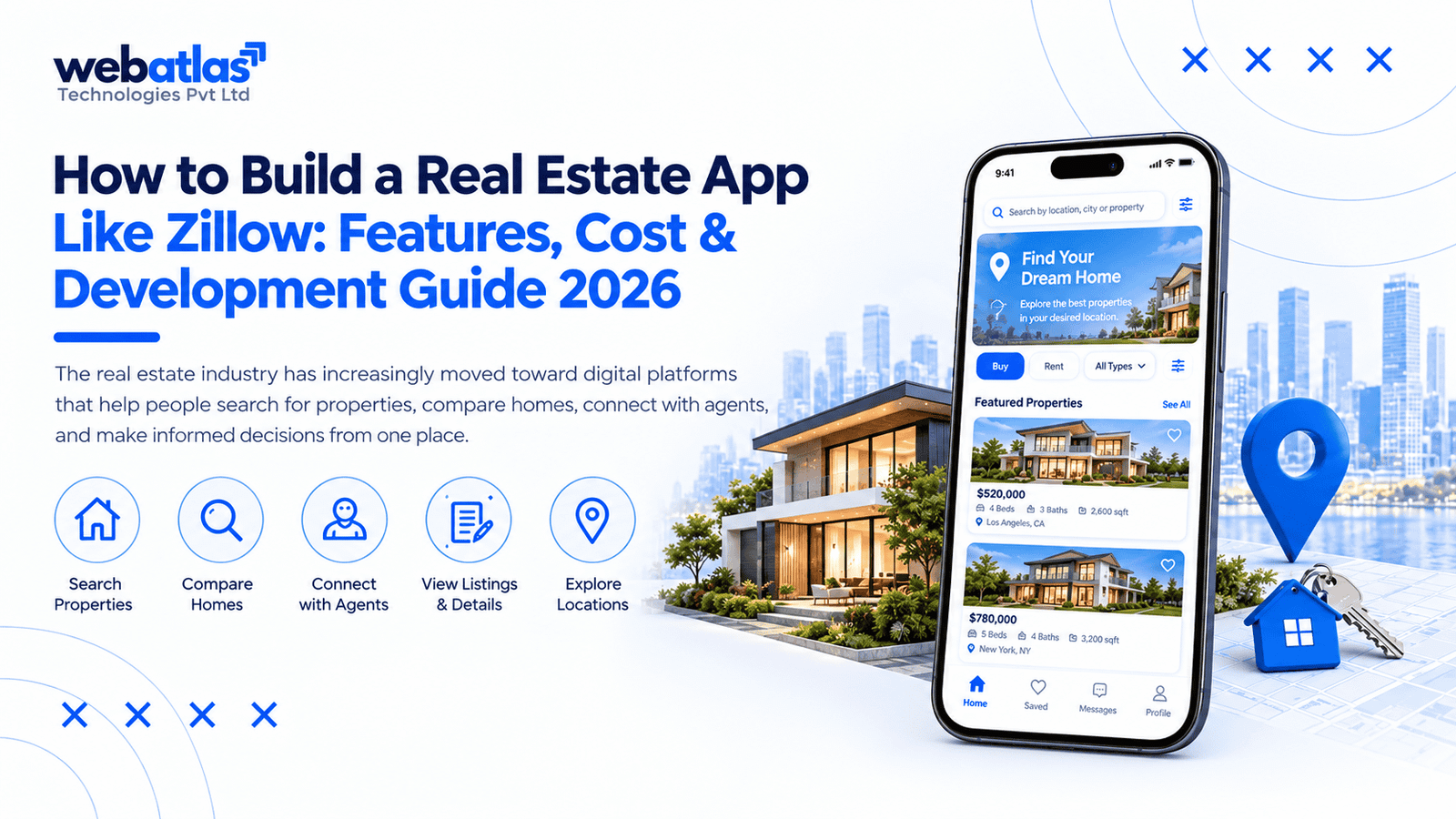
The real estate industry has increasingly moved toward digital platforms that help people search for properties, compare homes, connect with agents, and make informed decisions from one place. Zillow is one of the most recognizable examples of this model, bringing property search, buying, renting, selling, financing, and professional services into a connected marketplace.
For businesses planning to enter the proptech market, building an app like Zillow can be an opportunity to create a specialized property marketplace for a city, region, country, or specific real estate segment. However, a Zillow-like platform involves much more than creating property listings and search filters. Property data, MLS integrations, maps, automated valuation, personalization, security, and scalable infrastructure all play important roles.
This guide explains how to build a real estate app like Zillow, including its essential features, advanced capabilities, data architecture, development process, technology stack, estimated cost, monetization strategies, and challenges.
What Is Zillow and How Does a Zillow-Like App Work?
Zillow is a digital real estate marketplace that allows consumers to search for homes, explore property information, research neighborhoods, connect with real estate professionals, and access other housing-related services. Its platform connects consumers with agents, housing providers, lenders, and other professionals across different stages of the housing journey.
At a basic level, a Zillow-like application works through several connected layers:
Property Data → Search & Discovery → Property Details → User Interaction → Agent/Seller Connection → Lead Generation
A user may search for homes based on location, price, property type, bedrooms, amenities, and other preferences. The platform then presents relevant listings through search results and map-based interfaces.
Behind this experience is a much more complex infrastructure. Property information may come from MLS feeds, brokers, agents, property owners, public records, or third-party data providers. The platform must organize this information, keep listings updated, provide fast search results, and present data consistently.
Modern Zillow also extends beyond traditional property search, incorporating AI-powered search and personalization, 3D experiences, financing tools, rental services, and professional workflows.
For businesses planning a similar product, the objective should not necessarily be to copy every Zillow feature. Instead, the platform should be designed around the target market, property-data availability, user requirements, and business model.
For organizations planning such a platform, working with a specialized real estate app development company can help align the product architecture with real estate-specific requirements.
What Makes a Zillow-Like App Different From a Regular Real Estate App?
A basic real estate app may allow users to browse property listings and contact sellers or agents. A Zillow-like platform goes much further.
The biggest difference is the combination of property data, search technology, marketplace functionality, location intelligence, and personalization.
A sophisticated platform may need to manage:
- Large property databases
- MLS and other real estate data sources
- Property data normalization
- Duplicate listing detection
- Advanced filters and search
- Map-based discovery
- Property valuation
- Personalized recommendations
- Agent and seller dashboards
- Lead management
- Notifications and saved searches
- Analytics and reporting
- Scalable cloud infrastructure
This means that building a Zillow-like application is not simply a matter of designing an attractive property-search interface. The underlying data and technology infrastructure can be just as important as the user-facing application.
A useful approach is to think of the product as a data-driven real estate marketplace, rather than only a property listing app.
Essential Features to Build a Real Estate App Like Zillow
The features of a Zillow-like application should be planned according to the needs of different users.
Features for Buyers and Renters
User Registration and Login:
Allow users to create accounts using email, phone, or supported social authentication methods.
Property Search:
Users should be able to search properties using location, price, property type, bedrooms, bathrooms, square footage, and other criteria.
Advanced Filters:
Filters can help users narrow down listings based on amenities, property status, price range, home type, lot size, and other relevant attributes.
Map-Based Search:
Users should be able to explore properties geographically and move between map and list views.
Property Details:
Each listing should provide relevant information such as price, photos, specifications, location, property description, and listing status.
Favorites and Saved Searches:
Users can save properties and searches for future reference.
Property Comparison:
A comparison feature can help users evaluate multiple properties based on price, size, location, amenities, and other criteria.
Notifications:
Users can receive alerts about new listings, price changes, saved-search matches, or other relevant updates.
Agent Contact and Messaging:
Buyers and renters should be able to contact agents or property representatives directly.
Mortgage Calculator:
A calculator can provide an initial estimate of monthly payments based on price, down payment, interest rate, and loan term.
Features for Sellers and Landlords
- Property listing creation
- Photo and video uploads
- Listing management
- Property information editing
- Inquiry management
- Listing performance analytics
- Lead notifications
- Listing status management
Features for Real Estate Agents
- Professional profile
- Property management
- Lead management
- Buyer communication
- Messaging
- Appointment management
- Listing analytics
- Performance reports
Features for Administrators
The admin panel should provide control over users, properties, listings, content, payments, reports, data sources, and moderation.
This role-based approach makes the platform easier to manage while ensuring that each user receives the tools relevant to their responsibilities.
Advanced Features That Can Give a Zillow-Like App a Competitive Edge
Once the core marketplace is working, advanced technology can improve discovery, personalization, and engagement.
AI-Powered Property Recommendations
Machine-learning systems can analyze search behavior, saved properties, preferred locations, budgets, and other signals to recommend relevant listings.
Natural-Language Property Search
Instead of relying only on filters, users can search conversationally for requirements such as a three-bedroom home near a particular location with a specific budget and preferred amenities.
Zillow announced its AI Mode in 2026, connecting conversational housing search with live listings and actions such as scheduling tours and connecting with agents.
Automated Property Valuation
An AI/ML-powered valuation system can estimate property values using historical data, comparable properties, location information, and other market signals.
Virtual and 3D Tours
Interactive property experiences can help users explore homes remotely and reduce the need for an initial physical visit.
Smart Alerts
Instead of only notifying users about new listings, the system can alert them about price reductions, matching properties, market changes, or other events based on their preferences.
Neighborhood and Market Insights
The platform can provide information about nearby amenities, market activity, pricing trends, and other relevant location-based information.
These capabilities can be developed progressively rather than being included in the first release.
For businesses planning advanced real estate features, AI development services can support recommendation engines, intelligent search, predictive analytics, and automated valuation solutions.
Property Data, MLS/IDX/RESO Integration & Data Management
Property data is one of the most important parts of a Zillow-like platform, and it is also one of the areas that requires careful planning.
A real estate platform can potentially receive property information through:
- MLS data feeds
- IDX-related integrations
- RESO Web API services
- Brokers and agents
- Property owners
- Third-party property data providers
- Public records where legally available
The RESO Web API is a standardized method for exchanging real estate data using modern web technologies. RESO itself does not provide MLS data; access is obtained through MLS organizations or other data providers, subject to their access and licensing requirements.
Why Data Normalization Matters
Property data can arrive from different sources using different field names, formats, and structures. A platform therefore needs a consistent internal data model.
For example, one source may use:
Beds = 3
while another may use:
Bedrooms = 3
The platform needs to map these values into a consistent structure.
RESO’s Data Dictionary provides standardized definitions for real estate data fields while allowing local markets to support additional fields.
Other Data Challenges
A Zillow-like application may also need systems for:
- Duplicate listing detection
- Data validation
- Listing status updates
- Image management
- Location normalization
- Data synchronization
- Outdated listing detection
- Source attribution
Therefore, MLS/RESO integration should be considered part of the product architecture rather than treated as a simple plug-in.
How to Build a Zestimate-Like Property Valuation System
Zillow’s Zestimate is an automated estimate of a home’s market value. Zillow says its valuation model incorporates public records, MLS data, user-submitted details, physical property characteristics, historical information, and on-market data, using statistical and machine-learning models. Zillow also emphasizes that a Zestimate is not an appraisal.
A business building a similar capability needs several layers.
1. Data Collection
Gather relevant property, transaction, location, and market data from permitted sources.
2. Data Cleaning
Remove errors, resolve inconsistent values, identify duplicates, and standardize property information.
3. Feature Engineering
Relevant variables may include:
- Property size
- Number of bedrooms
- Number of bathrooms
- Property type
- Location
- Historical transactions
- Comparable properties
- Market conditions
- Property improvements
4. Model Development
Machine-learning models can identify relationships between property characteristics and market values.
5. Valuation Output
Instead of treating the result as a guaranteed price, the platform can present an estimated value or range together with appropriate context.
6. Continuous Improvement
Models should be monitored and updated as new market data becomes available.
The most important takeaway is that an automated valuation system depends on high-quality data, appropriate models, geographic coverage, and continuous validation. AI alone does not guarantee accurate property valuations.
How to Build a Real Estate App Like Zillow: Step-by-Step Development Process
Step 1: Define the Target Market
Determine whether the platform will serve a city, state, country, property segment, or specific user group.
Step 2: Identify Users and Business Goals
Define the needs of buyers, renters, sellers, landlords, agents, brokers, and administrators.
Step 3: Plan the Property Data Strategy
Determine where listings and property information will come from and what data permissions or integrations are required.
Step 4: Define the MVP
Start with essential functionality such as registration, property listings, search, filters, maps, favorites, contact options, and administration.
Step 5: Design the UX/UI
Create a simple property-discovery experience with clear navigation, fast search, useful filters, and easy-to-understand property information.
Step 6: Plan the Architecture
Design the backend, database, APIs, search infrastructure, cloud environment, authentication, storage, and analytics systems.
Step 7: Develop the Application
Build the web and/or mobile applications, backend services, database, APIs, and admin dashboard.
Step 8: Integrate Maps and Property Data
Connect required map services, MLS/data feeds, property APIs, notifications, and other third-party services.
Step 9: Add Advanced Capabilities
After validating the MVP, introduce AI recommendations, automated valuation, advanced analytics, virtual tours, and other features.
Step 10: Test the Platform
Testing should cover functionality, performance, security, usability, API integrations, search accuracy, and different devices.
Step 11: Launch in a Focused Market
Launching in one geographic market can make it easier to build inventory, attract agents, monitor performance, and refine the product.
Step 12: Scale Based on Usage
After launch, analyze search behavior, listing engagement, leads, retention, and technical performance before expanding to additional markets.
Technology Stack for a Zillow-Like Real Estate App
The technology stack should be selected according to the application’s scale, features, data requirements, and future expansion plans.
| Technology Area | Possible Technologies |
| Mobile Development | Flutter, React Native, Native iOS/Android |
| Web Frontend | React, Next.js |
| Backend | Node.js, Python, Java |
| Database | PostgreSQL, MongoDB |
| Search | Elasticsearch, OpenSearch |
| Maps | Google Maps Platform, Mapbox |
| Cloud | AWS, Azure, Google Cloud |
| AI/ML | Python, TensorFlow, PyTorch |
| Notifications | Firebase |
| Analytics | GA4, Mixpanel |
A large real estate marketplace may need more than a conventional database because property discovery involves search, filtering, geospatial queries, image storage, and potentially large volumes of records.
The architecture should therefore be designed for scalability from the beginning, even if the initial MVP is relatively small.
If the product requires a highly customized backend, data architecture, or business workflow, custom software development can be considered instead of relying entirely on off-the-shelf solutions.
How Much Does It Cost to Build an App Like Zillow?
The cost of developing a Zillow-like application depends heavily on the scope of the product. A small MVP and a large property marketplace can have very different development requirements.
Basic Real Estate MVP
A basic version may include:
- User registration
- Property listings
- Search and filters
- Maps
- Property details
- Favorites
- Contact agent
- Admin panel
This approach focuses on validating the marketplace before investing in advanced functionality.
Mid-Level Platform
A more advanced version can add:
- Agent dashboards
- Messaging
- Notifications
- Advanced search
- Property-data integrations
- Analytics
- Mortgage tools
- Listing management
Advanced Zillow-Like Platform
A large-scale platform may require:
- Multiple property-data integrations
- Large property databases
- Advanced search infrastructure
- AI recommendations
- Automated valuation
- Predictive analytics
- Virtual/3D experiences
- High-performance cloud architecture
- Advanced analytics and reporting
Factors That Affect Development Cost
The final budget depends on:
- Number of features
- Web and mobile platforms
- UX/UI complexity
- Development team location and expertise
- Third-party APIs
- MLS/data integrations
- AI/ML requirements
- Cloud infrastructure
- Security requirements
- Testing
- Maintenance and support
For this reason, businesses should define the MVP and data strategy before requesting a development estimate.
How Does a Zillow-Like App Make Money?
A Zillow-like marketplace can use multiple revenue streams depending on its target users and business model.
Agent Lead Generation
Agents or brokerages can pay to receive qualified leads from potential buyers or sellers.
Featured Listings
Property owners or agents can pay to increase the visibility of selected listings.
Premium Agent Subscriptions
Agents can pay for additional tools, analytics, lead-management capabilities, or enhanced profiles.
Advertising
Relevant businesses can advertise products or services to users actively searching for property.
Premium Analytics
Professional users may pay for market insights, property analytics, or advanced reporting.
Financial and Mortgage Referrals
The platform can potentially generate revenue through relevant financial service partnerships where permitted.
Property Management Tools
Landlords and property managers may pay for software that helps manage listings, leads, applications, or other workflows.
Zillow describes its business as a two-sided marketplace connecting consumers with real estate professionals, housing providers, lenders, and related services while keeping home search free for consumers.
Key Challenges, Security & Scalability Considerations
Building a real estate marketplace comes with challenges beyond application development.
Property Data Accuracy
Listings can become outdated, duplicated, incomplete, or inconsistent. Automated validation and synchronization processes are therefore important.
MLS and Data Access
Access to real estate data depends on the relevant MLS or data provider’s terms, permissions, technical requirements, and licensing arrangements. RESO provides standards, but it does not itself provide MLS data or credentials.
Search Performance
Large property databases require optimized search and indexing systems to deliver fast results.
Security
The platform should protect:
- User accounts
- Personal information
- Authentication credentials
- Payment information
- API credentials
- Agent and seller data
Role-based access control, secure authentication, encryption, monitoring, and regular security testing should be considered during development.
Fraudulent or Low-Quality Listings
A marketplace may need verification mechanisms, reporting tools, moderation workflows, and automated detection systems to reduce spam or suspicious listings.
Scalability
As inventory and traffic increase, the platform may need scalable cloud infrastructure, optimized databases, search clusters, content delivery, image storage, caching, and monitoring.
Planning these considerations early can reduce the need for expensive architectural changes later.
Why Choose Webatlas Tech to Build a Real Estate App Like Zillow?
Building a Zillow-like application requires more than standard mobile or web development. The development partner should understand marketplace workflows, property discovery, integrations, scalable architecture, and emerging technologies such as AI.
Webatlas Tech can help businesses plan and develop customized real estate applications around their specific market and business requirements.
The development approach can cover:
- Real estate marketplace development
- Web and mobile application development
- Custom backend architecture
- API and third-party integrations
- AI-powered features
- Property search and location-based functionality
- Admin dashboards
- Scalable cloud infrastructure
- Testing and post-launch support
Rather than attempting to replicate every Zillow feature from day one, the development strategy can focus on launching a practical MVP, validating the business model, and progressively adding advanced capabilities.
Businesses can also explore real estate app development services to plan a customized platform based on their target audience, property-data requirements, and growth goals.
Conclusion
Building a real estate app like Zillow requires a combination of intuitive property discovery, reliable data, advanced search, location technology, marketplace functionality, and scalable infrastructure.
The most practical approach is to begin with an MVP that addresses the core needs of buyers, renters, agents, sellers, and administrators. Once the platform is validated, advanced capabilities such as AI-powered recommendations, automated property valuation, virtual tours, predictive analytics, and personalized search can be introduced.
Property data should receive particular attention because MLS integrations, data normalization, listing freshness, licensing, and synchronization can have a major impact on the quality of the platform.
Ultimately, the goal should not be to copy Zillow feature by feature. A successful real estate application should combine proven marketplace concepts with a differentiated user experience, a reliable data strategy, and a scalable technology foundation.
Frequently Asked Questions
- How much does it cost to build an app like Zillow?
The cost depends on the features, platforms, integrations, AI capabilities, development team, security requirements, and scalability needs. A focused MVP will require considerably less investment than a large-scale Zillow-like marketplace.
- How long does it take to build a Zillow-like app?
A basic MVP can be developed faster than a full-scale marketplace. The timeline depends on the number of platforms, features, integrations, property-data requirements, testing, and customization involved.
- What features should a Zillow-like app have?
Core features typically include property listings, search, filters, maps, property details, favorites, saved searches, notifications, agent contact, messaging, and administration. Advanced platforms can add AI recommendations, valuation, virtual tours, and analytics.
- How does Zillow get property data?
Zillow uses multiple data sources and technologies. Its Zestimate, for example, incorporates public records, MLS data, and user-submitted home details.
- Can I integrate MLS data into my real estate app?
Yes, depending on the relevant MLS’s access requirements, licensing policies, technical infrastructure, and permissions. RESO provides standards for real estate data exchange, while access to actual MLS data comes from the relevant MLS or data provider.
- How can I add AI-powered property valuation?
You can develop an automated valuation model using property characteristics, historical transactions, comparable properties, location data, and other relevant market signals. The model should be continuously evaluated and updated as new data becomes available.
- What technology stack is suitable for a Zillow-like app?
A suitable stack may include React or Next.js for the web frontend, Flutter or React Native for mobile, Node.js/Python/Java for backend services, PostgreSQL or MongoDB for data storage, Elasticsearch/OpenSearch for search, and AWS, Azure, or Google Cloud for infrastructure.
- Can I build a Zillow-like app for a specific city or country?
Yes. Starting with a specific geographic market can be a practical strategy because the platform can focus on local property data, users, agents, regulations, and inventory before expanding to additional markets.