Building a SaaS product from scratch involves much more than developing a web application and putting it online. A successful SaaS product needs a validated business idea, a clearly defined target audience, a focused MVP, scalable architecture, secure user management, subscription billing, reliable infrastructure, and a continuous product-improvement process.
For founders and businesses, the challenge is deciding what to build, what to postpone, what to buy, and what needs to be developed specifically for the product.
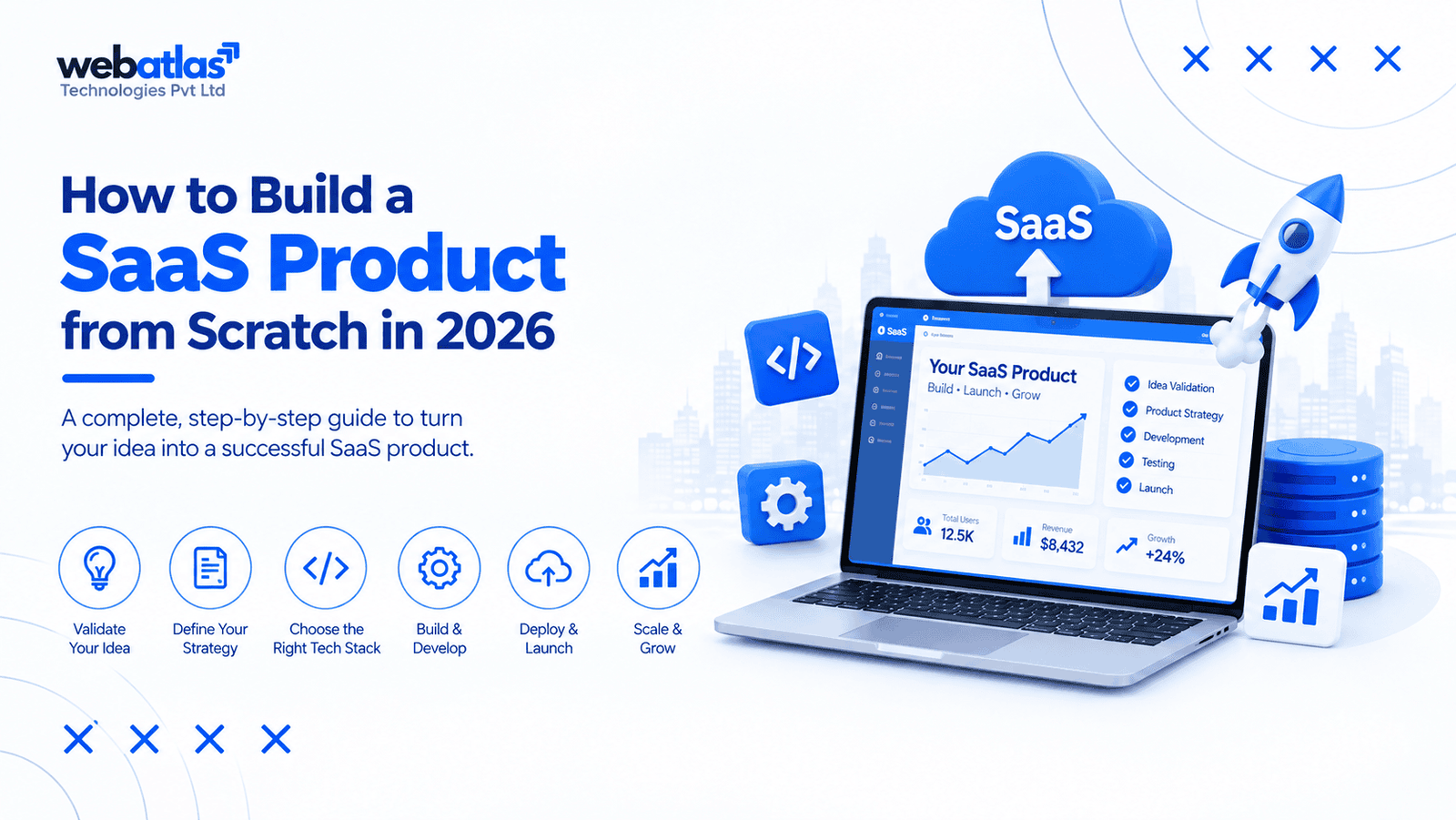
This guide explains how to build a SaaS product from scratch, from validating the initial idea to launching, measuring performance, and scaling the product.
What Is a SaaS Product and How Does It Work?
Software as a Service (SaaS) is a software delivery model where users access an application through the internet instead of installing and maintaining it locally.
Popular SaaS products include project management platforms, CRM systems, accounting software, communication tools, marketing platforms, HR applications, and analytics solutions.
A typical SaaS product includes:
- User registration and authentication
- Subscription or pricing plans
- A web-based application
- Cloud infrastructure
- Centralized data storage
- User or organization management
- Billing and payment processing
- Product analytics
- Security and access controls
- Ongoing updates and maintenance
How a SaaS Product Works
A simplified SaaS flow looks like this:
User → Sign Up → Select Plan → Access Application → Use Features → Data Stored in Cloud → Subscription/Billing → Analytics → Product Improvements
Unlike traditional software, SaaS products are continuously updated by the provider. Users generally access the latest version without manually installing updates.
This makes SaaS particularly suitable for products that need recurring revenue, centralized management, frequent feature updates, and cloud-based access.
Validate Your SaaS Idea Before Development
One of the most expensive SaaS mistakes is starting development before confirming that the problem is worth solving.
Before writing code, determine whether your target customers actually experience the problem and whether they would consider paying for a solution.
Start With the Problem
Instead of asking:
“What SaaS product should I build?”
Ask:
“What recurring problem can I solve better, faster, or more efficiently?”
Identify:
- Who experiences the problem?
- How frequently does it occur?
- How are customers solving it today?
- What makes existing solutions inconvenient?
- What does the problem cost the customer?
- Would customers pay for a better solution?
Research the Market
Study:
- Direct competitors
- Alternative solutions
- Pricing models
- Customer complaints
- Product reviews
- Feature gaps
- Target industries
- Existing demand
Competitor research should not only tell you what competitors offer. It should reveal what users still struggle with.
Validate Before Building
Useful validation methods include:
- Customer interviews
- Surveys
- Landing pages
- Waitlists
- Prototype testing
- Pre-orders
- Demo requests
- Manual or concierge versions of the service
The objective is not to prove that everyone will buy your product. The objective is to collect enough evidence to justify building an MVP.
Define Your SaaS Product Strategy and MVP
Once the problem has been validated, define exactly what the first version of your SaaS product needs to accomplish.
Your MVP should solve the core customer problem, not attempt to reproduce every feature offered by established competitors.
Define the Core User Journey
Map the most important workflow:
Sign Up → Onboarding → Core Action → Result → Payment/Upgrade → Continued Usage
For example, a project-management SaaS might focus its MVP on:
- Creating a workspace
- Inviting team members
- Creating projects
- Creating tasks
- Assigning tasks
- Tracking progress
Advanced reporting, complex automation, AI assistants, and extensive integrations can come later.
Build Now vs. Build Later
| Build in the MVP | Build Later |
| User authentication | Advanced authentication options |
| Core product workflow | Complex automation |
| Basic dashboard | Advanced analytics |
| Essential billing | Complex pricing models |
| Basic notifications | Extensive notification controls |
| Core account settings | Advanced administration |
| Essential security | Enterprise-grade custom controls |
| Basic analytics | Advanced predictive analytics |
This approach reduces development complexity while allowing you to test the actual product concept.
Should AI Be Included in the MVP?
AI can be valuable when it directly improves the core user workflow.
For example:
- Automated recommendations
- Content generation
- Data summarization
- Intelligent search
- Classification
- Predictive insights
However, AI should not be added simply because it is a current trend. If it does not solve an important customer problem, it can increase development cost and complexity without improving product-market fit.
For businesses looking to validate an idea quickly, MVP Software Development can help structure the first version around essential functionality.
Design the SaaS User Experience
A SaaS product can have strong technology and still fail if users cannot understand how to use it.
The UX process should focus on making the most important workflows simple.
Key SaaS UX Areas
- Registration
- Login
- Onboarding
- Dashboard
- Navigation
- Core workflow
- Account management
- Billing
- Notifications
- Help and support
Design the Onboarding Experience Carefully
A new user should quickly understand:
- What the product does
- What they need to do first
- How to reach the first meaningful outcome
- Which features matter initially
A complicated onboarding process can increase abandonment before users experience the product’s value.
Prototype Before Development
Create wireframes and interactive prototypes before investing heavily in development.
This allows teams to identify:
- Navigation problems
- Unnecessary screens
- Confusing workflows
- Missing actions
- UX friction
before those problems become expensive development changes.
Choose the Right SaaS Technology Stack
Technology decisions should be based on product requirements rather than simply selecting the latest framework.
Your technology stack typically includes:
| Layer | Common Options |
| Frontend | React, Next.js, Vue, Angular |
| Backend | Node.js, Python, Java, .NET, PHP |
| Database | PostgreSQL, MySQL, MongoDB |
| Cloud | AWS, Azure, Google Cloud |
| APIs | REST, GraphQL |
| Payments | Stripe, PayPal and similar providers |
| Analytics | Product and web analytics platforms |
| DevOps | Docker, CI/CD and cloud tooling |
The right stack depends on:
- Product complexity
- Expected traffic
- Team expertise
- Security requirements
- Integration requirements
- Development speed
- Long-term scalability
- Budget
Build vs. Buy vs. Integrate
Not every SaaS component needs to be built internally.
| Requirement | Possible Approach |
| Payment processing | Integrate a payment provider |
| Email delivery | Use an email service |
| Authentication | Use an authentication solution or build based on requirements |
| Video processing | Use a specialized API/service |
| Analytics | Integrate an analytics platform |
| Unique business workflow | Custom development |
| Core product logic | Usually custom development |
A useful rule is:
Buy or integrate commodity functionality. Build what creates your competitive advantage.
This can reduce development time while allowing the team to focus resources on the product’s core value.
Plan SaaS Architecture and Multi-Tenancy
SaaS architecture needs to support multiple customers while keeping data secure, reliable, and manageable.
One of the most important decisions is how customer data will be separated.
Common Multi-Tenant Models
Shared Database, Shared Schema
Multiple customers use the same database and tables, with tenant identifiers separating their data.
Shared Database, Separate Schema
Customers share the database infrastructure but use separate schemas.
Separate Database
Each customer has an independent database.
Each model has different implications for:
- Cost
- Security
- Maintenance
- Scalability
- Data isolation
- Enterprise requirements
There is no single architecture that is correct for every SaaS product.
Important Architecture Decisions
Before development, determine:
- How tenants will be identified
- How tenant data will be isolated
- How permissions will work
- How the system will handle increasing traffic
- How backups will be managed
- How failures will be monitored
- How new services will be introduced
- How customer data will be exported or migrated
A SaaS architecture should be designed around current requirements plus realistic future growth, rather than overengineering the system from day one.
Develop the SaaS MVP
Once product requirements, UX, technology, and architecture are defined, development can begin.
A typical SaaS development process includes:
Step 1: Set Up the Development Environment
Configure:
- Code repositories
- Development environments
- Database
- Cloud infrastructure
- CI/CD pipeline
- Development and staging environments
Step 2: Develop Authentication and User Management
Implement:
- Registration
- Login
- Password management
- Email verification
- Roles
- Permissions
- Session management
Step 3: Build the Core Product
Focus development on the primary user workflow identified during validation.
Avoid spending the majority of the MVP timeline on secondary features.
Step 4: Add Billing
Depending on the business model, implement:
- Subscription plans
- Free trials
- Recurring payments
- Upgrades and downgrades
- Invoices
- Payment failure handling
- Subscription cancellation
Step 5: Add Notifications and Integrations
Only integrate services that are important for the initial user experience.
Examples include:
- SMS
- Calendar
- CRM
- Payment systems
- Communication tools
- Third-party APIs
Step 6: Add Analytics
Track important user actions from the beginning so you can understand how customers interact with the product after launch.
Implement Security, Testing, and Deployment
Security should be considered throughout development rather than added immediately before launch.
Essential SaaS Security Practices
Depending on the product, consider:
- HTTPS
- Secure password handling
- Role-based access control
- Input validation
- Encryption
- API security
- Secure session management
- Data backups
- Audit logging
- Rate limiting
- Vulnerability monitoring
Multi-tenant applications require particular attention to authorization because users must never be able to access another customer’s data.
Test the Product
Testing should cover:
- Functional testing
- Integration testing
- API testing
- Security testing
- Performance testing
- Cross-browser testing
- Mobile responsiveness
- User acceptance testing
Prepare for Deployment
Before launch, verify:
- Production environment
- Database backups
- Domain and SSL
- Monitoring
- Error tracking
- Logging
- Deployment process
- Rollback strategy
A successful deployment is not simply putting the application online. The team should also know how to monitor and recover the system if something goes wrong.
Launch Your SaaS Product and Get Initial Users
Launching the product is the beginning of product validation, not the end of development.
Start with a controlled launch instead of immediately trying to acquire thousands of users.
Use Early Users to Validate the Product
Track:
- Where users drop off
- Which features they use
- How long onboarding takes
- What users repeatedly ask for
- Which features create the most value
- Why users cancel or stop using the product
Focus on the First Meaningful Outcome
Your goal should be to help new users reach the product’s primary value as quickly as possible.
For example:
Sign Up → Setup → First Successful Result → Repeat Usage
This is more useful than simply measuring how many people created accounts.
Gather Qualitative Feedback
Combine analytics with:
- Customer interviews
- Support conversations
- Feedback forms
- Product surveys
- User testing
Numbers tell you what happened. Customer feedback can help explain why it happened.
Track SaaS Metrics After Launch
Once the product is live, analytics should guide product decisions.
Important SaaS metrics include:
| Metric | What It Helps Measure |
| MRR | Recurring revenue |
| ARR | Annual recurring revenue |
| CAC | Customer acquisition cost |
| LTV | Customer lifetime value |
| Churn Rate | Customer loss |
| Activation Rate | Users reaching meaningful value |
| Retention Rate | Users continuing to use the product |
| Conversion Rate | Visitors/users becoming customers |
| DAU/MAU | Product engagement |
Do not track every possible metric.
Start with metrics that answer important business questions.
For example:
Are users reaching the core value?
Track activation.
Are customers continuing to use the product?
Track retention.
Are customers leaving?
Track churn.
Is the business generating sustainable recurring revenue?
Track MRR and related revenue metrics.
SaaS Development Cost and Timeline
The cost and timeline for building a SaaS product vary significantly depending on scope.
Factors that influence cost include:
- Number of features
- UI/UX complexity
- Technology stack
- Integrations
- User roles
- Multi-tenancy architecture
- Security requirements
- Billing complexity
- AI functionality
- Development team location
- Testing requirements
- Infrastructure requirements
Typical Development Stages
| Stage | Main Activities |
| Discovery | Research, requirements and validation |
| UX/UI | Wireframes, prototypes and interface design |
| MVP Development | Core product functionality |
| Testing | Functional, security and performance testing |
| Deployment | Cloud setup and production release |
| Post-Launch | Monitoring, improvements and scaling |
A simple SaaS MVP may take significantly less time than a complex enterprise SaaS platform with advanced integrations, AI capabilities, analytics, and administrative controls.
Therefore, avoid estimating cost based only on the number of screens. The underlying business logic and technical complexity have a much larger impact on the final development effort.
Scale and Improve Your SaaS Product After Launch
Launching an MVP does not mean development stops.
A SaaS product should follow a continuous improvement cycle:
Launch → Measure → Learn → Improve → Retain → Scale
Stage 1: Measure
Use analytics to understand user behavior.
Stage 2: Learn
Combine product data with customer feedback.
Stage 3: Improve
Fix friction points and improve features that influence activation and retention.
Stage 4: Retain
Improve onboarding, product value, support, reliability, and customer experience.
Stage 5: Scale
Once the product demonstrates sustainable demand, invest in:
- Infrastructure scaling
- Performance optimization
- Advanced security
- Automation
- New integrations
- Additional pricing plans
- Enterprise features
- Internationalization
- Advanced analytics
Do Not Scale Too Early
Scaling infrastructure before the product has enough users or revenue can increase unnecessary costs.
The better approach is to identify actual bottlenecks and scale the parts of the system that require additional capacity.
Common SaaS Development Mistakes to Avoid
1. Building Too Many Features
A large feature list can delay validation.
Better approach: Build the smallest version capable of solving the core problem.
2. Skipping Customer Validation
A technically impressive product can still fail if customers do not need it.
Better approach: Validate the problem before development.
3. Copying Competitors
Matching every competitor feature does not create differentiation.
Better approach: Identify underserved customer needs.
4. Overengineering the MVP
Complex architecture can increase cost and development time.
Better approach: Build for realistic growth without solving hypothetical problems.
5. Ignoring Multi-Tenant Security
Poor tenant isolation can expose sensitive customer information.
Better approach: Design tenant isolation and authorization into the architecture.
6. Treating Billing as an Afterthought
Subscription management can become complicated when added late.
Better approach: Plan pricing, billing, trials, upgrades, downgrades, and cancellations early.
7. Ignoring Product Analytics
Without analytics, teams may make decisions based mainly on assumptions.
Better approach: Track meaningful user behavior from the beginning.
8. Adding AI Without a Clear Use Case
AI does not automatically make a SaaS product better.
Better approach: Use AI where it creates measurable customer value.
9. Scaling Before Validation
Investing heavily in infrastructure before proving demand can increase costs unnecessarily.
Better approach: Scale based on actual product usage and technical bottlenecks.
Why Choose Webatlas Tech for SaaS Product Development?
Webatlas Tech helps businesses turn SaaS ideas into functional, scalable digital products. The development approach can cover product planning, UI/UX design, MVP development, SaaS architecture, application development, testing, deployment, and ongoing improvements.
The focus should be on building the right product scope first, validating the core workflow, and creating an architecture that can evolve as the product gains users.
For businesses planning a SaaS platform, the development process can be structured around business objectives, target users, technical requirements, security needs, and long-term scalability.
SaaS Product Development Roadmap at a Glance
Idea → Validation → Product Strategy → MVP Planning → UX/UI → Technology Selection → Architecture → Development → Testing → Deployment → Launch → Measurement → Improvement → Scaling
The most important principle is to avoid treating SaaS development as a one-time project.
A successful SaaS product evolves continuously based on customer behavior, feedback, business performance, and technical requirements.
Frequently Asked Questions
- How much does it cost to build a SaaS product?
The cost depends on product complexity, features, architecture, integrations, security requirements, team structure, and development location. A basic MVP can cost considerably less than a complex enterprise SaaS platform.
- How long does it take to build a SaaS product?
A simple MVP may take a few months, while more complex SaaS platforms can require significantly longer development cycles. The timeline depends primarily on scope and technical complexity.
- What should be included in a SaaS MVP?
A SaaS MVP should include the minimum functionality required to solve the primary customer problem. Common components include authentication, the core workflow, basic account management, essential billing, and analytics.
- Should I build or buy SaaS features?
Use third-party services for common functionality such as payments, email delivery, analytics, or other commodity capabilities when appropriate. Custom-build features that represent the core value or competitive advantage of your product.
- What technology is best for SaaS development?
There is no universal best technology stack. The right choice depends on product requirements, scalability, security, integrations, team expertise, development speed, and budget.
- Do all SaaS applications need multi-tenancy?
SaaS applications generally need a strategy for managing multiple customers, but the technical implementation can vary. Shared databases, separate schemas, and separate databases are possible approaches.
- Should AI be included in a SaaS MVP?
AI should be included when it solves an important customer problem or improves the core workflow. It should not be added simply to make the product appear more advanced.
- What metrics should a SaaS startup track?
Important metrics can include activation, retention, churn, MRR, CAC, LTV, conversion rate, and product engagement. The most useful metrics depend on the SaaS business model.
- When should a SaaS product be scaled?
Scale the product when user growth, traffic, performance problems, infrastructure limitations, or business requirements justify it. Scaling should be driven by actual requirements rather than assumptions.
- Can an existing application be converted into a SaaS product?
Yes. Existing software can potentially be transformed into a SaaS product by introducing cloud infrastructure, multi-tenant capabilities, subscription billing, centralized management, user access controls, security improvements, and other SaaS-specific functionality.
- How can I reduce SaaS development costs?
Start with a focused MVP, validate the idea early, prioritize essential features, use proven third-party services where appropriate, avoid unnecessary custom functionality, and scale infrastructure according to actual demand.
- What is the first step in building a SaaS product?
The first step is to clearly define and validate the customer problem. Before investing heavily in development, confirm that the target users experience the problem and that your proposed solution provides meaningful value.