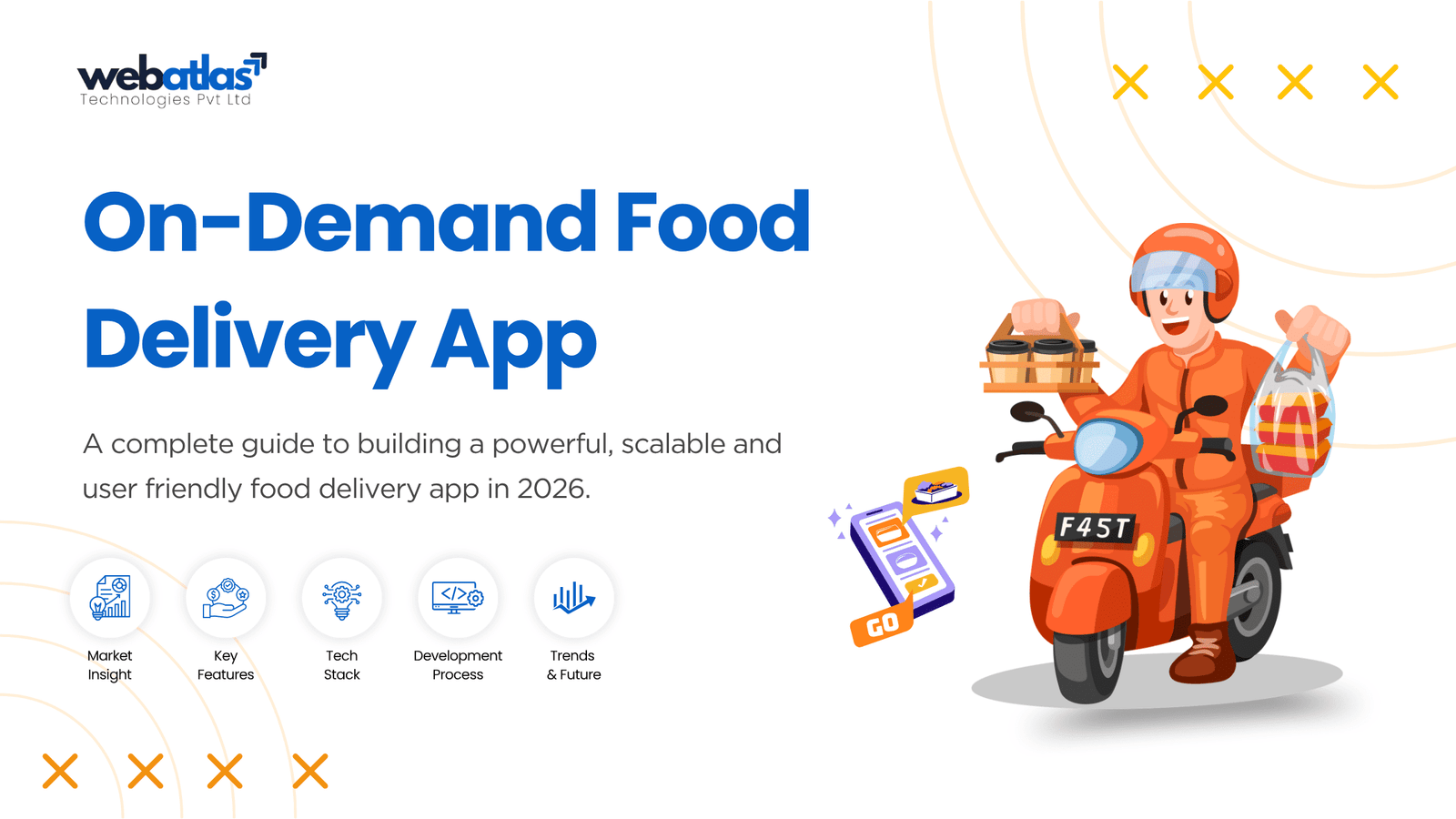
Imagine a customer craving your signature biryani at 10 PM. They pick up their phone, open your app, place an order in under two minutes, and get it delivered hot to their door — without a third-party platform taking a 25–30% commission cut.
That’s the power of On-Demand Food Delivery App Development — and it’s no longer a luxury reserved for big chains. In 2025, restaurants of every size are building their own delivery apps to own their customer relationships, boost revenue, and compete head-to-head with the aggregators.
If you run a restaurant and you’re wondering how to build a food delivery app, what it costs, and what features you actually need, you’re in the right place. This guide covers everything — plainly and practically.
Why Restaurant Owners Are Investing in Their Own Delivery App
The global online food delivery market is projected to cross $1.65 trillion by 2027. But here’s what the headline number doesn’t tell you: restaurants listed on Swiggy, Zomato, or DoorDash often hand over nearly a third of every order in commissions.
Building your own app changes the math entirely.
Key benefits of a custom food delivery app for your restaurant:
- Zero commission per order — you keep every rupee/dollar
- Direct customer relationships — your data, your loyalty program
- Custom branding — your look, your feel, not a generic marketplace
- Better margins — even modest order volumes quickly justify the investment
- Real-time analytics — know what’s selling, when, and to whom
The upfront cost of development is a one-time investment. The savings on commissions compound every single month.
What Is On-Demand Food Delivery App Development?
On-Demand Food Delivery App Development is the process of designing, building, and launching a mobile (and/or web) application that allows your customers to browse your menu, place orders, make payments, and track deliveries — all in real time.
Unlike listing your restaurant on an aggregator platform, a custom-built app is entirely yours. Your brand, your data, your rules.
A standard food delivery app solution has three interconnected panels:
- Customer App — for placing and tracking orders
- Restaurant/Admin Panel — for managing orders, menus, and operations
- Delivery Driver App — for managing pickups and drop-offs
Must-Have Features of a Food Delivery App
Getting the feature set right is one of the most important decisions you’ll make. Build too little and the app frustrates customers. Overbuild and you waste budget. Here’s a practical breakdown:
Customer-Facing Features
- User registration & social login (Google, Apple, Facebook)
- Smart menu browsing with filters, categories, and search
- Real-time order tracking with map integration
- Multiple payment options — cards, UPI, wallets, cash on delivery
- Order history and reorder with a single tap
- Push notifications for order updates, offers, and reminders
- Ratings and reviews for orders and delivery
- Loyalty points and promo codes
- Scheduled orders — place now, deliver later
Restaurant/Admin Panel Features
- Order management dashboard — accept, reject, or modify orders
- Menu management — update items, prices, and availability in real time
- Revenue analytics and reports
- Customer data and insights
- Discount and coupon management
- Zone-based delivery configuration
Delivery Driver App Features
- Order pickup alerts and acceptance
- GPS navigation for optimized routes
- Earnings dashboard
- Proof of delivery (photo or OTP)
- Availability toggle (online/offline)
On-Demand Food Delivery App Development Process: Step by Step
Building an app isn’t just about writing code. A reliable On-Demand Food Delivery App Development company will follow a structured process to reduce risk and deliver a product that actually works for your business.
Step 1: Discovery & Requirement Analysis
Before a single line of code is written, the development team maps out your business goals, target audience, geography, and core workflows. This phase produces a detailed project scope and feature list.
Duration: 1–2 weeks
Step 2: UI/UX Design
Your app’s design isn’t decoration — it directly affects conversions. Designers create wireframes and interactive prototypes, focusing on intuitive navigation, fast checkout, and mobile-first layouts.
Duration: 2–3 weeks
Step 3: Frontend & Backend Development
This is the core build phase. Frontend developers create the screens customers and drivers see. Backend developers build the server, database, APIs, and business logic that power everything from real-time tracking to payment processing.
Duration: 8–14 weeks (depending on complexity)
Step 4: Third-Party Integrations
A fully functional food delivery app connects with:
- Payment gateways (Razorpay, Stripe, PayU, etc.)
- Maps & GPS (Google Maps API)
- SMS/notification services (Twilio, Firebase)
- Analytics tools (Mixpanel, Firebase Analytics)
Step 5: Quality Assurance & Testing
Every screen, every flow, and every edge case is tested — on multiple devices and OS versions. Load testing ensures the app handles peak-hour traffic without breaking.
Duration: 2–3 weeks
Step 6: Deployment & Launch
The app is submitted to the Google Play Store and Apple App Store. Backend servers are deployed and configured for production. A soft launch with a limited audience is recommended before full rollout.
Step 7: Post-Launch Support & Updates
The best On-Demand Food Delivery App services include ongoing support — bug fixes, performance monitoring, feature additions, and OS compatibility updates.
How Much Does On-Demand Food Delivery App Development Cost?
This is the question every restaurant owner asks first — and understandably so. Here’s an honest breakdown:
Cost Factors
- Number of platforms — iOS only, Android only, or both?
- Design complexity — standard UI vs. custom branded experience
- Feature set — MVP (minimal) vs. full-featured
- Backend complexity — real-time tracking, AI recommendations, etc.
- Development location — US/UK teams vs. India-based teams
Estimated Cost Ranges (2025)
| Development Type | Estimated Cost (USD) |
|---|---|
| MVP / Basic App (single platform) | $8,000 – $15,000 |
| Mid-Level App (both platforms) | $15,000 – $35,000 |
| Advanced / Feature-Rich App | $35,000 – $80,000+ |
| Monthly Maintenance | $500 – $2,000/month |
India-based development companies typically offer 40–60% lower rates compared to US or UK agencies — without compromising significantly on quality, making them a popular choice for restaurant owners globally.
Why Choose Webatlas Tech as Your On-Demand Food Delivery App Development Company?
Building a successful food delivery app requires more than just coding. You need a technology partner that understands your business goals, user behavior, and market trends. At Webatlas Tech, we focus on delivering scalable, user-friendly, and high-performing food delivery solutions designed for restaurants and food businesses.
Here’s why businesses choose us:
Industry-Focused Expertise
Our team has hands-on experience in developing on-demand solutions tailored for restaurants, cloud kitchens, and food delivery businesses.
Custom App Development Solutions
We create fully App Development that align with your business model, branding, and customer requirements.
Modern Technology Stack
We use the latest technologies and frameworks to build secure, fast, and scalable applications for Android, iOS, and web platforms.
User-Centric UI/UX Design
Our designs focus on smooth navigation and seamless experiences that help increase engagement and customer retention.
Scalable Architecture
Whether you are starting with one restaurant or planning to expand into multiple locations, our solutions are built to grow with your business.
Real-Time Features & Integrations
From live order tracking and payment gateways to notifications and analytics tools, we integrate essential features that improve operational efficiency.
Dedicated Support & Maintenance
Our relationship does not end after launch. We provide continuous support, updates, and maintenance to ensure your app performs smoothly.
Cost-Effective Development Approach
We deliver high-quality development services while maintaining transparent pricing and keeping your business goals in focus.
Technology Stack Typically Used
| Layer | Technologies |
|---|---|
| Mobile (Frontend) | React Native, Flutter |
| Web Admin Panel | React.js, Angular |
| Backend | Node.js, Python (Django) |
| Database | MongoDB, PostgreSQL |
| Real-time features | WebSockets, Firebase |
| Cloud Hosting | AWS, Google Cloud |
| Maps | Google Maps API |
| Payments | Stripe, Razorpay |
Common Mistakes Restaurant Owners Make When Building a Food App
Avoid these pitfalls that can derail your project or blow your budget:
- Trying to build everything at once — Start with an MVP. Launch, learn, then add features.
- Underestimating ongoing costs — Hosting, maintenance, and updates are recurring.
- Skipping user testing — Real customer feedback before launch saves costly rework.
- Ignoring app store guidelines — Apple and Google have strict rules; non-compliance causes rejection delays.
- Choosing a vendor based on price alone — The cheapest quote often produces the most expensive problems.
Conclusion: It’s Time to Build Your Own App
The restaurant industry has changed permanently. Customers expect digital convenience — and they expect it on your terms, not just through a third-party platform that owns the relationship.
On-Demand Food Delivery App Development is one of the smartest investments a restaurant owner can make right now. You reduce commission dependency, build direct loyalty with customers, and gain full visibility into your business data.
The process is more accessible than ever. With the right development partner, you can have a production-ready app in 3–4 months — and start recovering your commission losses from day one.
Ready to build your restaurant’s own delivery app? Connect with an experienced On-Demand Food Delivery App Development company today for a free consultation and cost estimate tailored to your specific needs.
Frequently Asked Questions (FAQs)
1. How long does it take to develop a food delivery app?
A basic MVP typically takes 10–14 weeks. A full-featured app with both iOS and Android versions, real-time tracking, and a web admin panel usually takes 16–24 weeks, depending on the team’s size and the complexity of features.
2. Can I build a food delivery app just for my own restaurant, or is it only for aggregator-style platforms?
Absolutely — a custom app can be built exclusively for your restaurant. It can feature your branding, your menu, your loyalty program, and a direct payment system. You don’t need to offer it to other restaurants. Many single-location and multi-branch restaurants are doing exactly this.
3. What is the minimum cost to develop a food delivery app in India?
Working with an India-based On-Demand Food Delivery App Development company, a functional MVP with basic features can start at approximately ₹5–10 lakhs ($8,000–$15,000 USD). Costs scale up with features, platforms, and customization requirements.
4. Do I need separate apps for customers, restaurant staff, and delivery drivers?
Yes, a complete On-Demand Food Delivery App solution typically includes three components: a customer-facing app, an admin/restaurant management panel, and a driver app. All three are interconnected through the same backend system.
5. What ongoing costs should I budget for after the app launches?
Expect to budget for cloud server hosting ($50–$300/month depending on scale), app store developer accounts ($25–$99/year), third-party API costs (maps, SMS, payments), and a maintenance retainer with your development company ($500–$2,000/month).
6. Is it better to build a native app or a cross-platform app for food delivery?
For most restaurant owners, cross-platform frameworks like React Native or Flutter offer the best balance — they run on both iOS and Android from a single codebase, reducing development cost by 30–40% while still delivering a near-native user experience. Native development makes sense only if you anticipate very high scale or need very platform-specific features.