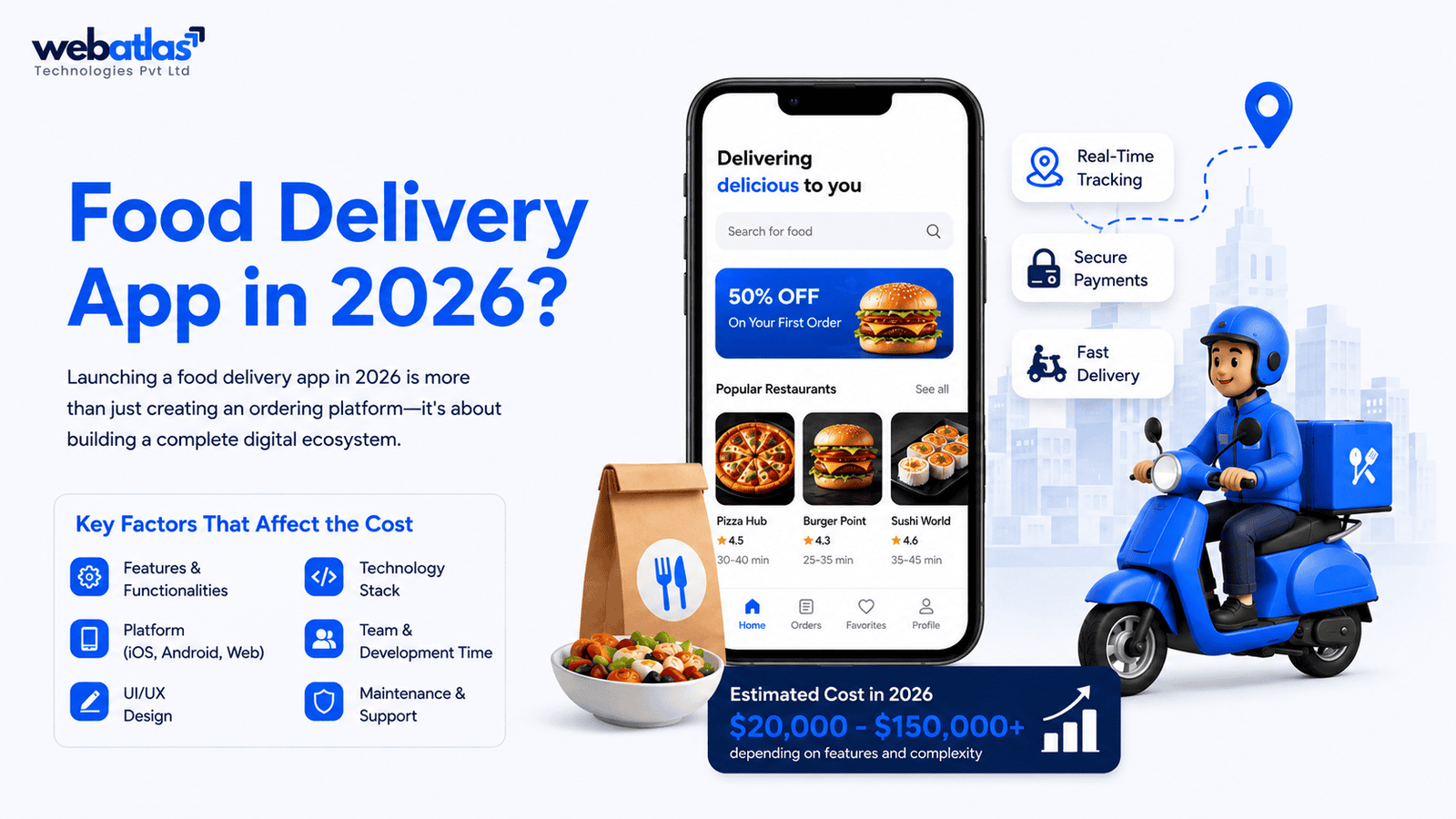
Launching a food delivery app in 2026 is no longer just about creating another online ordering platform it’s about building a digital ecosystem that connects customers, restaurants, delivery partners, and business operations in real time. As consumer expectations continue to evolve, businesses are investing in platforms that deliver convenience, personalization, and operational efficiency while creating new revenue opportunities.
One of the first questions every entrepreneur, restaurant chain, or investor asks is:
“How much does it cost to build a food delivery app?”
The answer isn’t as straightforward as a fixed number.
A custom food delivery application built for the U.S. market can range from $40,000 for a lean MVP to $350,000+ for an enterprise-grade marketplace. The investment depends on factors such as your business model, number of user roles, platform strategy, integrations, scalability requirements, and long-term product vision.
Unfortunately, many online guides simplify this discussion by offering broad price ranges without explaining why costs vary so significantly. That often leaves business owners comparing proposals from development companies without understanding what they’re actually paying for.
This guide takes a different approach.
Instead of presenting a list of features and arbitrary price estimates, we’ll explain the business and technical decisions that influence development costs. You’ll learn where your budget is invested, which features are essential for launch, how to avoid unnecessary expenses, and how to build a platform that can grow alongside your business.
Whether you’re planning to launch a branded restaurant app, a multi-vendor marketplace, or an AI-powered delivery platform, this guide will help you make informed decisions before investing in development.
Businesses investing in custom mobile app development often achieve greater control over branding, customer engagement, and long-term scalability than businesses relying solely on third-party platforms.
Why Do Development Costs Vary So Much?
Imagine two businesses approach the same software development company.
The first is a local pizza chain looking to launch its own branded ordering app for customers in one city.
The second is a startup planning to build the next DoorDash, complete with restaurant onboarding, driver management, AI-powered recommendations, dynamic pricing, and nationwide expansion.
Both projects fall under the category of “food delivery apps,” yet their development requirements are entirely different.
The first project focuses on simplifying online ordering for a single brand.
The second requires building a sophisticated digital marketplace capable of handling thousands of restaurants, millions of transactions, real-time logistics, and complex business operations.
This is why comparing development quotes based solely on the final price can be misleading. Two companies may provide estimates that differ by more than $100,000 not because one is overpriced, but because they are planning for completely different levels of functionality, scalability, and future growth.
Understanding these differences is essential before evaluating development proposals or deciding on a budget.
A Food Delivery App Is More Than Just a Mobile App
One of the most common misconceptions is that a food delivery platform consists of a single mobile application. In reality, modern delivery businesses operate through a connected ecosystem of applications, dashboards, and backend services.
A typical platform includes:
- A customer application for browsing restaurants, placing orders, and tracking deliveries.
- A restaurant dashboard for managing menus, incoming orders, pricing, and business performance.
- A delivery partner application for accepting orders, navigation, earnings, and delivery updates.
- An administrative portal for overseeing operations, users, payments, reports, and platform management.
- A secure backend that synchronizes every interaction in real time.
Each component serves a different purpose, but together they create a seamless experience for everyone involved in the ordering process.
When businesses underestimate this complexity, they often underestimate the investment required to build a reliable and scalable platform.
The Biggest Mistake Businesses Make When Budgeting
Many first-time founders begin by asking:
“How much does it cost to build an app like Uber Eats?”
While understandable, this question often leads to unrealistic expectations.
Companies like Uber Eats, DoorDash, and Grubhub have invested years of product development, continuous feature enhancements, sophisticated infrastructure, and large engineering teams to build the platforms we see today.
Attempting to replicate every feature from day one is neither practical nor necessary.
A smarter approach is to identify the core functionality required to launch successfully, validate the business model, and expand the platform based on real customer feedback.
This phased strategy not only reduces initial investment but also minimizes development risk and allows businesses to prioritize features that deliver measurable value.
Think of Development as Building a Business, Not Just an App
The most successful food delivery app development platforms are designed with long-term growth in mind.
Every decision from choosing the technology stack to defining the user experience should support future scalability, operational efficiency, and customer retention.
For example:
- Will your platform support multiple restaurant partners in the future?
- Do you plan to expand into multiple cities?
- Will you introduce subscription programs or loyalty rewards?
- Do you expect to integrate AI-powered recommendations?
- Could grocery or pharmacy delivery become part of your roadmap?
Answering these questions early influences architectural decisions that can save significant redevelopment costs later.
In our experience, businesses that invest time in product strategy before development are better positioned to launch faster, scale efficiently, and maximize return on investment.
The 7 Factors That Actually Determine Food Delivery App Development Costs
Before requesting development proposals, it’s important to understand that you’re not paying for an app you’re investing in a digital business platform.
Choosing the right architecture is one of the most important decisions in any custom software development project. The biggest misconception among founders is believing that food delivery apps have a standard price. In reality, two businesses building seemingly similar applications can receive estimates that differ by over $100,000. The reason isn’t inconsistent pricing it’s the difference in product vision, architecture, scalability, and business requirements.
Think of building a food delivery platform the same way you would build a restaurant. Two restaurants may both serve pizza, but one is a neighborhood takeaway while the other is a nationwide franchise with automated kitchens, delivery logistics, loyalty programs, and data-driven operations. Naturally, their investments are very different.
The same principle applies to software development.
Let’s explore the seven factors that have the greatest impact on development costs.
1. Your Business Model Shapes Everything
The first decision isn’t about technology it’s about how your business will operate.
Every food delivery platform follows a different business model, and each one requires unique workflows, user roles, and backend functionality.
For example, a single restaurant app is designed to help one business manage online orders and customer relationships. A marketplace platform, on the other hand, must support multiple restaurants, commission management, restaurant onboarding, vendor verification, delivery assignment, and centralized administration.
Instead of asking:
“How much does a food delivery app cost?”
Ask yourself:
“What type of food delivery business am I building?”
Common Business Models
| Business Model | Best For | Typical Investment |
| Single Restaurant | Independent restaurants | $50K–90K |
| Multi-Restaurant Marketplace | Startups | $90K–180K |
| Cloud Kitchen Platform | Virtual brands | $90K–170K |
| Enterprise Marketplace | Large businesses | $200K–350K+ |
Expert Insight
One mistake we often see is startups attempting to build an enterprise marketplace from day one. While it may seem like a future-proof strategy, it often leads to longer development cycles, higher costs, and delayed market entry. Instead, many businesses begin with MVP software development to validate their idea, gather real user feedback, and refine their platform before investing in a full-scale marketplace. This phased approach reduces risk, accelerates time to market, and delivers a stronger return on investment.
2. Complexity Matters More Than the Number of Features
Many businesses compare proposals by counting features.
That’s the wrong approach.
Two applications may both include “real-time tracking,” yet the engineering effort can vary significantly.
For example:
A basic tracking system may simply display a driver’s location using a mapping API.
A more advanced implementation could include:
- Live route optimization
- Estimated arrival predictions
- Traffic-aware routing
- Multiple delivery stops
- Customer notifications
- Driver performance analytics
To the end user, these may appear as one feature. Behind the scenes, they involve very different levels of engineering.
Instead of focusing on how many features your app includes, evaluate how sophisticated each feature needs to be.
3. Scalability Is an Investment – Not an Expense
One of the biggest differences between an MVP and an enterprise platform isn’t the interface it’s the architecture.
Imagine launching your app in Chicago with plans to expand into ten more cities within the next two years.
If your application wasn’t designed for growth, every expansion could require significant redevelopment.
A scalable platform is built to support:
- Higher user traffic
- Additional restaurant partners
- Multiple cities or regions
- Larger order volumes
- New business services
- Future integrations
While scalable architecture increases initial development effort, it often reduces long-term redevelopment costs and minimizes operational disruptions as the business grows.
Think long-term: It’s more cost-effective to prepare for expansion early than rebuild your platform after achieving product-market fit.
4. Integrations Can Significantly Influence Your Budget
Modern food delivery platforms rarely operate in isolation.
They depend on multiple third-party services to deliver a seamless customer experience.
Typical integrations include:
- Payment gateways
- Mapping and navigation services
- Push notifications
- SMS verification
- Email automation
- Restaurant POS systems
- CRM platforms
- Customer support software
- Marketing automation tools
Each integration introduces additional development, testing, security considerations, and ongoing maintenance.
The more external systems your platform communicates with, the more complex the project becomes.
Rather than integrating everything at launch, prioritize the services that provide immediate business value and add others as your platform evolves.
5. AI Is No Longer Optional – But It Doesn’t Have to Be Immediate
Artificial intelligence is transforming how food delivery businesses operate.
From personalized recommendations to intelligent customer support, AI development services enable businesses to enhance user experiences, streamline operations, and improve customer retention through intelligent automation.
However, one common misconception is that every startup needs advanced AI capabilities from day one.
In reality, the most successful businesses adopt AI gradually, introducing new capabilities as their platform grows and customer needs evolve.
For example:
Launch Phase
- AI chatbot
- Personalized recommendations
- Smart search
Growth Phase
- Route optimization
- Customer segmentation
- Marketing automation
Scale Phase
- Demand forecasting
- Dynamic pricing
- Predictive analytics
This phased approach allows businesses to realize the benefits of AI without delaying product launch or significantly increasing the initial investment.
6. Your Technology Decisions Affect Long-Term Costs
Choosing a technology stack isn’t just a technical decision it has long-term business implications.
A technology stack influences:
- Development speed
- Maintenance requirements
- Future scalability
- Security
- Performance
- Hiring availability
- Operational costs
For many startups, cross-platform frameworks such as Flutter enable faster development and lower initial costs while maintaining a consistent user experience across Android and iOS.
Enterprise businesses, however, may prefer native development or more specialized architectures depending on their performance requirements and long-term roadmap.
The right choice depends on your product strategy not industry trends.
7. The Development Partner You Choose Matters More Than You Think
When businesses compare development companies, price is often the first consideration.
It shouldn’t be the only one.
The lowest proposal doesn’t always represent the lowest overall cost.
An experienced development partner contributes far more than coding.
They help define the product roadmap, identify unnecessary complexity, recommend scalable architecture, anticipate technical challenges, and ensure the platform is built with future growth in mind.
Before selecting a development partner, consider questions such as:
- Have they built marketplace platforms before?
- Can they demonstrate experience with scalable architectures?
- Do they provide post-launch support?
- How do they approach product discovery and planning?
- What quality assurance processes do they follow?
A well-planned project often saves considerably more than it costs by reducing rework, avoiding architectural issues, and accelerating time to market.
Expert Takeaway: Focus on Business Value, Not Just Development Cost
It’s natural to focus on the price of building a food delivery app. However, the better question is:
“What investment is required to build a platform capable of achieving my business goals?”
Businesses that prioritize scalability, user experience, and strategic planning from the beginning are more likely to build platforms that support sustainable growth rather than requiring costly redevelopment every few years.
The objective isn’t to build the cheapest app.
It’s to build the right product one that creates value for customers, supports operational efficiency, and evolves alongside your business.
Where Does Your Budget Actually Go?
One of the biggest misconceptions about software development is that businesses are simply paying developers to write code.
In reality, a successful food delivery platform is the result of multiple disciplines working together from business strategy and UX design to backend architecture, quality assurance, security, and post-launch optimization.
This is why two projects with a similar feature list can have very different budgets. The difference often lies in the depth of planning, technical architecture, and long-term scalability.
Rather than asking “How much does each feature cost?”, it’s more useful to understand where your investment is actually being allocated.
Understanding the Development Investment
A professionally developed food delivery platform is built in stages. Each stage contributes to the quality, performance, and scalability of the final product.
A typical investment is distributed across the following areas:
| Development Phase | Why It Matters |
| Product Discovery | Defines business goals, user journeys, feature priorities, and technical roadmap. |
| UI/UX Design | Creates intuitive user experiences and improves customer retention. |
| Frontend Development | Builds the interfaces customers, restaurants, and delivery partners interact with daily. |
| Backend Development | Powers authentication, orders, payments, notifications, APIs, and business logic. |
| Third-Party Integrations | Connects payment gateways, maps, messaging services, analytics, and POS systems. |
| Quality Assurance | Identifies bugs, validates workflows, and ensures a stable user experience. |
| Deployment & DevOps | Configures cloud infrastructure, security, and application deployment. |
| Maintenance & Continuous Improvement | Keeps the platform secure, updated, and aligned with evolving business needs. |
The Hidden Costs Many Businesses Forget
When founders compare development quotes, they usually focus on the initial project cost.
However, launching your app is only the beginning.
Like any digital product, a food delivery platform requires continuous investment to remain secure, reliable, and competitive.
Some of the most commonly overlooked costs include:
- Cloud hosting and infrastructure
- App Store and Google Play publishing accounts
- Payment gateway transaction fees
- Mapping and geolocation services
- SMS and email communication services
- Application monitoring tools
- Security updates and compliance
- Technical support and maintenance
- Future feature enhancements
These expenses are not unique to food delivery apps they’re part of operating any modern digital platform. Planning for them early helps avoid unexpected costs after launch.
Also Read – On-Demand Food Delivery App Development Cost, Features & Process
Build for Today, Prepare for Tomorrow
Many startups face a difficult decision:
Should we build everything now, or launch with the essentials?
The answer depends on your business objectives.
Trying to launch with every possible feature often increases development time without guaranteeing better market adoption.
A more effective strategy is to identify the functionality that creates immediate value and introduce advanced capabilities as the business grows.
A phased roadmap might look like this:
Phase 1 – Market Validation
Focus on the essentials:
- Customer registration
- Restaurant listings
- Menu browsing
- Online ordering
- Secure payments
- Order tracking
- Basic admin dashboard
The goal is to validate demand, collect user feedback, and begin generating revenue.
Phase 2 – Business Growth
Once your platform gains traction, expand the experience with features such as:
- Loyalty and rewards programs
- Discount campaigns
- Restaurant analytics
- Customer reviews
- Delivery partner management
- Marketing automation
- Advanced reporting
These enhancements improve customer retention and operational efficiency.
Phase 3 – Scale and Optimization
As your business expands into new cities or markets, focus on enterprise capabilities:
- AI-powered recommendations
- Demand forecasting
- Route optimization
- Multi-location management
- Predictive analytics
- Subscription services
- Advanced business intelligence
At this stage, your technology begins driving strategic decisions rather than simply supporting daily operations.
Common Budgeting Mistakes to Avoid
Over the years, many businesses have encountered similar challenges when planning software projects. Recognizing these early can help you make smarter investment decisions.
1. Trying to Replicate Uber Eats Immediately
Established platforms have evolved over many years through continuous development and user feedback.
Instead of copying every feature, focus on solving a specific customer problem exceptionally well.
2. Choosing the Lowest Development Quote
A lower upfront price may seem attractive, but it can result in technical debt, scalability issues, or expensive redevelopment later.
Evaluate proposals based on expertise, architecture, communication, and long-term support not just cost.
3. Ignoring Post-Launch Expenses
Many budgets account for development but overlook maintenance, infrastructure, security, and continuous improvements.
Planning for these costs ensures your platform remains stable and competitive after launch.
4. Overbuilding the MVP
Adding unnecessary features before validating your business model can increase development time and delay revenue generation.
Launch with confidence, learn from real users, and expand strategically.
5. Underestimating Product Discovery
Skipping the planning phase often leads to unclear requirements, scope changes, and project delays.
Investing in discovery creates a stronger foundation for development and reduces uncertainty.
A Smarter Way to Plan Your Budget
Instead of asking:
“How much should I spend?”
Consider asking:
- What problem am I solving?
- Who are my first customers?
- Which features create immediate business value?
- What can be introduced after launch?
- How do I want the platform to evolve over the next three years?
These questions shift the conversation from cost alone to long-term business strategy.
The most successful digital products aren’t necessarily those with the biggest budgets they’re the ones built with a clear roadmap and a strong understanding of customer needs.
Looking Beyond Launch
Launching your application isn’t the finish line it’s the beginning of your product journey.
The most successful food delivery platforms continuously evolve based on user feedback, market trends, and operational insights.
After launch, businesses often focus on:
- Improving user experience
- Optimizing delivery operations
- Introducing new revenue streams
- Expanding into additional markets
- Enhancing personalization through AI
- Strengthening customer retention
Treating your app as a long-term business asset rather than a one-time project positions you for sustained growth in an increasingly competitive market.
How to Estimate Your Food Delivery App Budget Before Contacting a Development Company
One of the biggest challenges for startups is requesting development quotations without having a clear understanding of their own requirements.
As a result, businesses often receive proposals that vary significantly in price, making it difficult to determine which estimate accurately reflects their needs.
Before approaching a software development company, spend some time answering the following questions:
Business Planning Checklist
✅ What business model are you building?
- Single Restaurant
- Multi-Restaurant Marketplace
- Cloud Kitchen
- Meal Subscription Platform
✅ Who are your users?
- Customers
- Restaurant Owners
- Delivery Partners
- Administrators
✅ Which platforms do you need?
- iOS
- Android
- Web Dashboard
✅ What is your launch strategy?
- Local City
- Regional
- Nationwide
✅ Which features are essential for Version 1?
Instead of writing a list of 100 features, identify the 10–15 features that are absolutely necessary for launch.
Everything else can become part of Version 2.
Food Delivery App Trends That Will Shape 2026 and Beyond
Technology is changing the way customers order food, how restaurants operate, and how deliveries are managed.
Businesses launching platforms today should think beyond current expectations and prepare for the next generation of digital experiences.
Some of the most important trends include:
-
AI-Powered Personalization
Customers increasingly expect food recommendations based on their ordering habits, dietary preferences, location, and time of day.
Instead of displaying the same restaurants to every user, AI enables personalized experiences that improve engagement and increase average order value.
-
Voice Commerce
Voice assistants and conversational interfaces are making food ordering faster and more accessible.
Customers can search menus, reorder previous meals, and complete purchases using natural language rather than navigating multiple screens.
-
Hyperlocal Delivery Optimization
Delivery efficiency has become a competitive advantage.
Businesses are investing in intelligent routing systems that minimize delivery times, reduce fuel costs, and improve customer satisfaction.
-
Predictive Demand Forecasting
AI is increasingly being used to analyze historical ordering patterns, weather conditions, holidays, and local events to help restaurants prepare inventory and staffing levels more accurately.
This reduces food waste while improving operational efficiency.
-
Subscription-Based Revenue Models
Many successful food delivery businesses are moving beyond transaction-based revenue.
Subscription programs offering benefits such as free delivery, exclusive discounts, or priority service help increase customer loyalty and generate recurring revenue.
-
Sustainability Features
Consumers are becoming more environmentally conscious.
Features such as eco-friendly delivery options, carbon footprint tracking, and optimized delivery routes are expected to become more common over the coming years.
Choosing the Right Development Partner
Selecting a development company is one of the most important decisions you’ll make during your digital transformation journey.
While pricing is important, it shouldn’t be the only consideration.
An experienced technology partner should help you:
- Validate your business idea
- Define the product roadmap
- Recommend the right technology stack
- Design scalable architecture
- Prioritize MVP features
- Build secure and high-performing applications
- Provide long-term maintenance and support
Before making your decision, ask potential partners questions such as:
- Have you built marketplace platforms before?
- How do you approach product discovery?
- What is your process for estimating development costs?
- How do you ensure application security?
- What happens after launch?
- Can the platform scale as the business grows?
The answers to these questions often reveal far more than a pricing proposal alone.
Final Thoughts
Building a food delivery app in 2026 isn’t simply about launching another mobile application it’s about creating a scalable digital business that connects customers, restaurants, delivery partners, and business operations through a seamless technology ecosystem.
While development costs typically range from $40,000 for a focused MVP to more than $350,000 for enterprise-scale platforms, the right investment depends on your vision, business model, and long-term growth strategy.
Rather than attempting to build every feature at once, successful businesses focus on launching with a well-defined product, learning from real users, and expanding strategically over time.
The companies that succeed aren’t necessarily those with the largest budgets they’re the ones that make informed technology decisions from the very beginning.
Whether you’re building a branded restaurant application, a multi-vendor marketplace, or an AI-powered delivery platform, investing in the right architecture, development approach, and technology partner can significantly influence your product’s long-term success.
Why Choose Webatlas Tech for Food Delivery App Development?
At Webatlas Tech, we believe successful digital products begin with understanding the business not just the technology.
Our team works closely with startups, restaurant brands, cloud kitchens, and enterprises to design and develop custom food delivery solutions that are secure, scalable, and tailored to real business objectives.
From product discovery and UI/UX design to backend architecture, mobile development, AI integration, and post-launch support, we provide end-to-end expertise to help businesses launch faster and scale with confidence.
Whether you’re validating a new startup idea or modernizing an existing food delivery operation, our goal is to build technology that supports long-term growth not just a successful launch.
Planning to build a food delivery app? Connect with our experts for a personalized consultation and receive a development roadmap tailored to your business goals.
Frequently Asked Questions:
- How much does it cost to build a food delivery app in the USA?
A custom food delivery app typically costs between $40,000 and $350,000+, depending on the business model, features, platforms, and scalability requirements.
- How long does it take to develop a food delivery app?
Most MVPs can be developed within 3–5 months, while enterprise platforms generally require 10–15 months.
- Should I build an MVP before launching a full platform?
Yes. An MVP helps validate your idea, reduce initial investment, and gather user feedback before expanding the platform with advanced features.
- Which features are essential for the first version?
User registration, restaurant listings, menu management, secure payments, order tracking, notifications, and a basic admin dashboard are typically sufficient for an MVP.
- Is Flutter suitable for food delivery app development?
Yes. Flutter enables businesses to build Android and iOS applications from a shared codebase, reducing development time while maintaining a consistent user experience.
- What ongoing costs should I expect after launch?
You should budget for cloud hosting, application maintenance, payment gateway fees, third-party APIs, security updates, technical support, and future feature enhancements.
- Can AI improve a food delivery platform?
Yes. AI can enhance customer personalization, optimize delivery routes, automate support, forecast demand, and improve operational efficiency.
- What’s the difference between a custom app and a white-label solution?
Custom applications offer complete flexibility, branding, and scalability, while white-label solutions provide a faster but less customizable launch.
- How can I reduce development costs without compromising quality?
Start with an MVP, prioritize essential features, adopt a phased development strategy, and choose a development partner experienced in scalable product development.
- How do I choose the right food delivery app development company?
Look for a partner with relevant industry experience, a structured discovery process, transparent communication, scalable technical expertise, and reliable post-launch support.
Let’s Turn Your Idea Into Reality for Your Next Project?
Book a FREE consultation with our experts and get the right roadmap for your project.
Tell Us About Your Project
Fill in your details and our experts will get back to you within one business day.