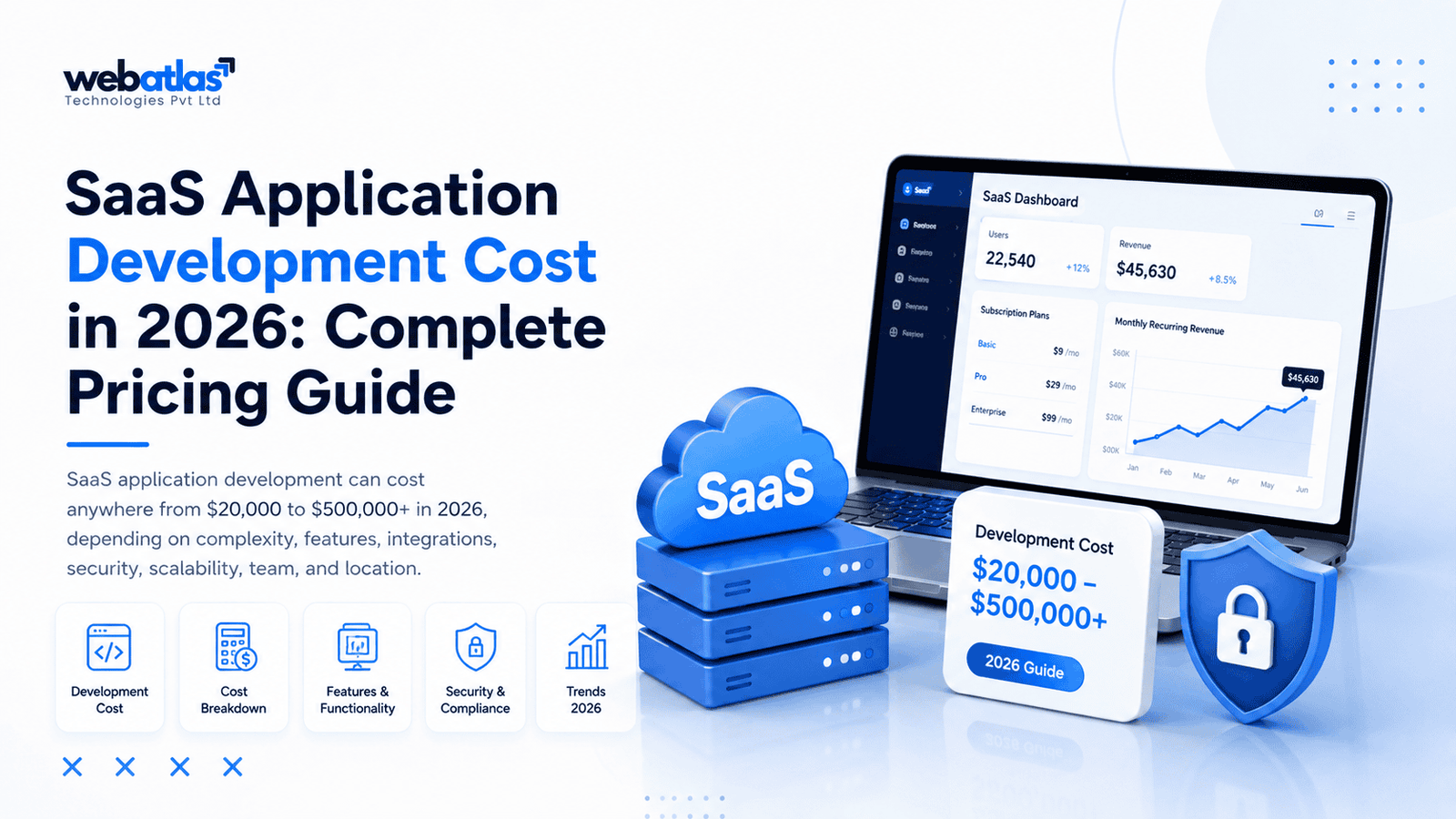
SaaS application development can cost anywhere from $20,000 to $500,000+ in 2026, depending on the product’s complexity, features, architecture, integrations, security requirements, scalability, development team, and location. A focused SaaS MVP may cost around $20,000–$60,000, while a production-ready platform can range from $60,000–$150,000+. Enterprise SaaS products with advanced security, multi-tenancy, AI, integrations, and scalability requirements can exceed $300,000.
However, there is no universal SaaS development price. Two products that both call themselves “SaaS applications” can have completely different budgets.
The more useful question is:
What will your specific SaaS product cost to build, operate, maintain, and scale?
This guide breaks down SaaS application development costs in 2026, including feature-level expenses, architecture, AI, multi-tenancy, development teams, ongoing costs, user scale, and practical budgeting methods.
Key Takeaways
- SaaS development cost in 2026: approximately $20,000–$500,000+
- SaaS MVP: approximately $20,000–$60,000
- Production-ready SaaS: approximately $60,000–$150,000+
- Enterprise SaaS: approximately $300,000–$500,000+
- Multi-tenancy, subscription billing, integrations, AI, security, and scalability can significantly increase costs.
- Development cost is only part of the total first-year SaaS investment.
- AI introduces both development costs and recurring operating costs.
- The most reliable SaaS budget comes from product scope and technical requirements rather than an industry-wide average.
How Much Does SaaS Application Development Cost in 2026?
The estimated development cost depends primarily on the stage and complexity of the product.
| SaaS Product Stage | Estimated Cost | Typical Timeline |
| Prototype / PoC | $5,000–$15,000 | 2–6 weeks |
| Focused SaaS MVP | $20,000–$60,000 | 2–4 months |
| Production-Ready SaaS | $60,000–$150,000 | 4–8 months |
| Growth-Stage SaaS | $150,000–$300,000+ | 7–12 months |
| Enterprise SaaS | $300,000–$500,000+ | 10–18+ months |
These are planning estimates rather than fixed quotations. Current SaaS cost guides show similarly broad ranges because their assumptions vary according to scope, team location, architecture, features, and development methodology.
What moves a project from one range to another?
A SaaS application becomes more expensive when it requires:
- Multiple user roles
- Multi-tenant architecture
- Complex subscription management
- Usage-based billing
- Enterprise authentication
- Advanced analytics
- AI-powered functionality
- Real-time communication
- Multiple third-party integrations
- Mobile applications
- Industry-specific compliance
- High availability and scalability
For example, a simple appointment-management SaaS with authentication, dashboards, and basic subscriptions is significantly less complex than an enterprise healthcare SaaS requiring multi-tenancy, audit logs, advanced permissions, integrations, and compliance controls.
Development cost is not the same as business cost
A $75,000 development quotation does not necessarily mean the business will spend only $75,000 during the first year.
A more realistic model is:
Development + Infrastructure + Third-Party Services + Security + Maintenance + Support + Product Improvements = First-Year SaaS Investment
This distinction should be considered before setting a launch budget.
What Is Included in SaaS Development Cost?
SaaS development involves multiple stages and technical disciplines.
Product discovery
The team defines:
- Target users
- Business objectives
- Core workflows
- Revenue model
- MVP scope
- Technical requirements
- Product roadmap
Good planning can prevent unnecessary features from increasing the development budget.
UI/UX design
SaaS products usually require dashboards, onboarding flows, account settings, billing screens, reports, admin interfaces, and role-specific experiences.
Investing in UI/UX Design early helps identify usability issues before they become expensive development changes.
Frontend development
The frontend includes:
- Responsive interfaces
- Dashboards
- Forms
- Data visualization
- User workflows
- Accessibility
- Browser compatibility
Backend development
The backend handles:
- Business logic
- APIs
- Authentication
- Database operations
- Permissions
- Billing
- Notifications
- Background jobs
- Integrations
Database and architecture
SaaS architecture determines how customer data is stored, accessed, isolated, backed up, and scaled.
Architecture decisions made during MVP development can affect the application’s long-term performance and maintenance costs.
Quality assurance
Testing can include:
- Functional testing
- API testing
- Security testing
- Performance testing
- Compatibility testing
- Payment testing
- User acceptance testing
DevOps and deployment
Deployment work may include:
- Cloud configuration
- CI/CD
- Monitoring
- Logging
- Backups
- Production deployment
- Performance monitoring
Therefore, SaaS development cost represents an entire product delivery lifecycle—not simply programming hours.
SaaS Development Cost by Feature
Feature complexity is one of the most direct cost drivers.
| Feature / Component | Typical Cost Impact |
| User registration & authentication | Low–Medium |
| User dashboard | Medium |
| Admin panel | Medium |
| Role-based access control | Medium–High |
| Subscription billing | Medium–High |
| Multi-tenancy | High |
| Advanced analytics | Medium–High |
| Third-party integrations | Medium–High |
| Real-time functionality | High |
| AI functionality | High |
| Enterprise SSO | High |
| Audit logs | Medium–High |
| Advanced reporting | Medium–High |
| Mobile application | High |
| Multi-region infrastructure | Very High |
However, feature visibility does not always equal development complexity.
A visually sophisticated dashboard may be relatively straightforward compared with a subscription system that needs to handle:
- Trials
- Upgrades
- Downgrades
- Failed payments
- Refunds
- Coupons
- Taxes
- Invoices
- Usage-based billing
Similarly, multi-tenancy may not dramatically change the interface, but it can significantly increase backend and database complexity.
The most expensive features are often the least visible
This is an important budgeting consideration.
Data isolation, billing logic, security, integrations, background processing, scalability, and monitoring may require considerably more engineering than features that users see directly.
How Multi-Tenancy Affects SaaS Development Cost
Multi-tenancy is one of the defining technical characteristics of many SaaS platforms.
Instead of creating a separate application for every customer, a SaaS platform allows multiple organizations or accounts to use the same product while keeping their information appropriately separated.
This can require:
- Tenant creation
- Tenant configuration
- User invitations
- Role management
- Data isolation
- Tenant-level settings
- Tenant billing
- Usage limits
- Account suspension
- Tenant administration
Current competitor research also identifies multi-tenancy, billing, and permissions as significant SaaS cost drivers. Some 2026 estimates suggest these areas can represent a substantial portion of the overall development budget depending on product requirements.
Common multi-tenancy approaches
Shared database
Multiple tenants use the same database with logical data separation.
Schema-per-tenant
Each customer receives a separate database schema.
Database-per-tenant
Each customer receives a dedicated database.
The appropriate model depends on:
- Customer requirements
- Security
- Data volume
- Compliance
- Infrastructure budget
- Scalability
Choosing a more isolated architecture may increase initial costs but can make sense for enterprise customers with strict security or compliance requirements.
The important lesson is:
Don’t select a tenancy model simply because it is cheaper. Select it based on your expected customers, data requirements, and growth strategy.
SaaS Development Cost by Application Type
SaaS products vary considerably by industry and functionality.
CRM SaaS
A basic CRM may include:
- Contact management
- Lead management
- Sales pipelines
- User roles
- Notifications
- Reporting
- Subscription management
Advanced CRM products can add AI forecasting, workflow automation, communication integrations, and advanced analytics.
HR SaaS
Typical functionality includes:
- Employee management
- Attendance
- Leave management
- Payroll integrations
- Reports
- Permissions
- Compliance
Healthcare SaaS
Healthcare platforms often require additional attention to:
- Data privacy
- Security
- Access control
- Auditability
- Healthcare integrations
- Regulatory requirements
FinTech SaaS
Financial applications may require:
- Secure authentication
- Transaction processing
- Financial integrations
- Fraud detection
- Analytics
- Compliance controls
AI SaaS
AI-powered SaaS applications may require:
- LLM integration
- Prompt management
- AI workflows
- Usage limits
- Model selection
- Vector databases
- AI monitoring
- Usage tracking
Project Management SaaS
Common features include:
- Workspaces
- Projects
- Tasks
- Team collaboration
- Notifications
- File management
- Reports
- Integrations
The SaaS category matters because industry requirements can introduce additional workflows, security requirements, integrations, and compliance costs.
SaaS Development Cost by Team Type and Location
Your choice of development team can have a major impact on the overall budget.
Freelancer
Freelancers may work well for:
- Prototypes
- Small MVPs
- Limited-scope products
However, complex SaaS products may require multiple specialties, including architecture, development, QA, DevOps, UI/UX, and security.
In-house team
An internal team provides direct control but requires:
- Recruitment
- Salaries
- Benefits
- Equipment
- Management
- Training
- Employee retention
These costs can make an in-house team significantly more expensive than the initial salary calculation suggests.
Development agency
An agency can provide access to:
- Developers
- UI/UX designers
- QA engineers
- DevOps specialists
- Project managers
- Technical architects
This can be useful for startups and businesses that want one team responsible for product delivery.
Dedicated development team
A dedicated team is useful when a SaaS product requires continuous development after launch.
Does location affect SaaS development cost?
Yes.
Development rates are generally higher in the USA and Western Europe than in India and several other offshore markets.
However, hourly rate alone should not determine your choice.
For example:
$25/hour × 2,000 hours = $50,000
while:
$50/hour × 1,200 hours = $60,000
The second team costs more per hour but less development effort may be required.
Therefore, compare total project cost, expertise, communication, quality, delivery speed, and long-term maintainability rather than focusing only on hourly rates.
How AI Changes SaaS Development Cost in 2026
AI is changing both how SaaS applications are developed and what they cost to operate.
But there is an important distinction:
AI development cost is not the same as AI operating cost.
One-time AI development costs
These may include:
- AI API integration
- Model selection
- Prompt architecture
- RAG implementation
- AI workflow development
- Testing
- Evaluation
- Security controls
Recurring AI costs
After launch, the SaaS business may pay for:
- API usage
- Token consumption
- Embeddings
- Vector databases
- Model inference
- Storage
- Monitoring
This means AI can create a variable operating cost that grows with product usage.
Example
Suppose an AI SaaS application has:
1,000 AI requests/month
Its model usage may remain relatively small.
But if usage grows to:
100,000 or 1,000,000 requests/month
the company may need to reconsider:
- Model selection
- Prompt efficiency
- Caching
- Request limits
- Infrastructure
- Cost monitoring
AI can therefore reduce development effort in certain areas while simultaneously increasing product complexity and ongoing operating costs.
If your product requires AI-powered automation, conversational features, recommendation engines, or generative AI, working with an experienced AI Development team can help select the appropriate architecture and model strategy.
SaaS Development Cost by User Scale
Another commonly overlooked cost factor is expected user volume.
A platform designed for 500 users does not have the same infrastructure requirements as one expected to support 500,000 users.
Up to 1,000 users
A SaaS product may use:
- Managed cloud services
- Basic database infrastructure
- Standard monitoring
- Automated backups
1,000–10,000 users
Additional requirements may include:
- Database optimization
- Caching
- Background processing
- Better monitoring
- Performance improvements
10,000–100,000 users
The platform may require:
- Load balancing
- Queue systems
- Advanced caching
- Database optimization
- Automated scaling
- Improved observability
100,000+ users
Large-scale SaaS applications may require:
- Multi-region infrastructure
- High availability
- Redundancy
- Advanced disaster recovery
- Specialized database architecture
Don’t pay for millions of users before you have thousands
One of the most practical strategies is progressive scalability.
Build an architecture capable of expansion, but avoid paying for enterprise-level infrastructure before the business needs it.
This can reduce early operating costs without preventing future growth.
Hidden and Ongoing SaaS Costs
The development quotation is only the beginning.
Your SaaS budget may also include:
Cloud hosting
Infrastructure costs increase with traffic, processing, storage, and database usage.
Third-party APIs
Payment gateways, email, SMS, analytics, maps, communication services, and AI APIs can introduce recurring expenses.
Security
Security monitoring, vulnerability management, access controls, backups, and audits may become increasingly important as the platform grows.
Maintenance
Post-launch maintenance can include:
- Bug fixes
- Framework updates
- Dependency upgrades
- Database maintenance
- Infrastructure updates
Customer support
As your user base grows, support becomes an operational expense.
Product improvements
A SaaS application typically continues evolving after launch based on:
- Customer feedback
- Product analytics
- Market changes
- Competitor activity
- New integrations
- Business requirements
Therefore, businesses should think beyond:
“How much does it cost to build?”
and consider:
“How much will it cost to build, launch, operate, maintain, and improve?”
Development Cost vs. First-Year SaaS Ownership Cost
This distinction can significantly change the way founders plan their budgets.
Imagine a business receives a $75,000 SaaS development estimate.
A simplified first-year budget might look like this:
| Cost Category | Illustrative Budget |
| Initial development | $75,000 |
| Cloud infrastructure | $6,000 |
| Third-party services | $5,000 |
| Security & monitoring | $4,000 |
| Maintenance | $10,000 |
| Product improvements | $15,000 |
| Support & operations | $5,000 |
| Illustrative Year-1 Total | $120,000 |
These numbers are an example budgeting model, not a universal market price.
The actual amount can vary substantially depending on traffic, infrastructure, team size, feature roadmap, AI usage, customer support requirements, and third-party services.
Your monetization model also affects development cost
A SaaS application may use:
Per-user pricing
Requires user and subscription management.
Tiered pricing
Requires feature restrictions and plan management.
Usage-based pricing
Requires accurate usage tracking and metering.
Freemium
Requires free-tier limits and conversion tracking.
Hybrid pricing
May combine subscriptions with usage charges.
Your monetization strategy should therefore be defined before architecture is finalized because billing requirements can affect backend logic, database structures, reporting, and integrations.
How to Reduce SaaS Development Cost Without Sacrificing Quality
Reducing development cost should not mean selecting the cheapest development team.
The better approach is to remove unnecessary complexity and avoid expensive rework.
Start with one core problem
Your MVP should solve one important customer problem instead of attempting to become a complete enterprise platform.
Prioritize features
Use four categories:
Must-have: Required for the first release.
Should-have: Valuable but not essential for launch.
Could-have: Future enhancements.
Enterprise: Features needed after gaining larger customers.
Use third-party services strategically
You don’t necessarily need to build every component yourself.
Depending on requirements, third-party services can support:
- Authentication
- Payments
- Storage
- Analytics
- Search
- AI
Avoid premature scaling
Build with future growth in mind, but don’t purchase infrastructure designed for millions of users before validating demand.
Plan architecture early
A poorly planned architecture can make later changes expensive.
For businesses that need highly specialized workflows or integrations beyond a typical SaaS model, Custom Software Development may be more appropriate than forcing every requirement into a standard SaaS structure.
Don’t overlook design
Poor UX often leads to redesigns after development has already started. Planning UI/UX Design before implementation can reduce rework and improve product adoption.
Consider mobile requirements early
If customers are expected to use the platform frequently on smartphones, decide early whether mobile functionality belongs in the MVP or a later product phase. Dedicated Mobile App Development can be introduced once usage data validates the requirement.
How to Calculate Your SaaS Development Budget
Rather than relying on a generic industry average, create your estimate from the actual product requirements.
Step 1: Define the product stage
Choose:
- Prototype
- MVP
- Production
- Growth
- Enterprise
Step 2: Define the core workflows
Map the primary user journey.
For example:
Signup → Onboarding → Dashboard → Core Action → Subscription → Account Management
Step 3: Define user roles
Identify whether you need:
- Customer
- Team member
- Manager
- Admin
- Super admin
- Support staff
More roles generally mean more permissions and testing requirements.
Step 4: Select the tenancy model
Determine whether the application requires:
- Single tenancy
- Shared multi-tenancy
- Schema-per-tenant
- Database-per-tenant
Step 5: Define monetization
Determine whether the product needs:
- Free plans
- Trials
- Monthly subscriptions
- Annual subscriptions
- Usage-based billing
- Coupons
- Invoices
- Tax calculations
Step 6: List integrations
Identify requirements such as:
- Payment gateways
- CRM
- SMS
- Accounting
- Analytics
- AI APIs
- Communication tools
Step 7: Identify advanced requirements
Check whether you need:
- AI
- Real-time functionality
- Advanced analytics
- SSO
- Audit logs
- Mobile apps
- Enterprise security
- Compliance
- Multi-region deployment
Step 8: Estimate post-launch requirements
Include:
- Hosting
- Maintenance
- Security
- Monitoring
- Support
- Product iterations
A practical SaaS cost formula
SaaS Development Cost = Core Product + Architecture Complexity + Integrations + Advanced Features + QA/Security + Deployment
Then:
First-Year SaaS Investment = Development Cost + Infrastructure + Third-Party Services + Maintenance + Support + Product Improvements
This approach produces a more realistic budget than simply searching for an “average SaaS development cost.”
SaaS Cost Complexity Framework: A Better Way to Estimate Your Budget
A useful way to understand SaaS pricing is to score the product across its major complexity drivers.
| Cost Driver | Low Complexity | Medium Complexity | High Complexity |
| User roles | 1–2 | 3–5 | 6+ |
| Tenancy | Single | Shared multi-tenant | Advanced isolation |
| Billing | Fixed subscription | Tiered subscription | Usage-based/hybrid |
| Integrations | 0–2 | 3–5 | 6+ |
| AI | None | API-based AI | Advanced AI workflows |
| User scale | <1,000 | 1,000–10,000 | 100,000+ |
| Compliance | Basic | Industry-specific | Enterprise |
| Analytics | Basic reports | Advanced dashboards | Real-time analytics |
| Authentication | Email/password | Social login + RBAC | SSO + enterprise identity |
How to use this framework
A product with mostly low-complexity requirements is more likely to fit an MVP budget.
A product with several medium- and high-complexity requirements should be planned as a production or growth-stage SaaS project.
For example:
Simple CRM
Low tenancy + basic billing + limited roles + basic analytics
→ Lower development complexity
AI SaaS
Multi-user + subscription + AI workflows + usage tracking + analytics
→ Medium/high complexity
Enterprise SaaS
Multi-tenancy + SSO + advanced RBAC + audit logs + AI + integrations + compliance
→ High complexity
This framework helps businesses understand why two SaaS products with similar-looking interfaces can have dramatically different development budgets.
Common SaaS Budgeting Mistakes to Avoid
Before starting development, watch for these mistakes:
1. Building too many features before validation
A larger MVP doesn’t necessarily create a better product.
2. Treating AI as a one-time expense
AI API usage can become a recurring operating cost.
3. Ignoring multi-tenancy until later
Retrofitting tenant isolation can be significantly more complicated than planning for it early.
4. Underestimating billing complexity
Subscription, usage-based, tax, refund, invoice, and payment-failure workflows can require considerable backend logic.
5. Choosing infrastructure for hypothetical scale
You don’t necessarily need enterprise infrastructure on day one.
6. Forgetting post-launch development
Customers will expect improvements after launch.
7. Comparing agencies only by hourly rate
The lowest hourly rate does not necessarily produce the lowest total project cost.
8. Treating design as an afterthought
Poor UX can result in redesigns, development rework, and lower product adoption.
Why Choose Webatlas Tech for SaaS Application Development?
Choosing the right development partner can significantly impact your SaaS product’s cost, scalability, and long-term performance. Webatlas Tech combines product strategy, modern technology, and development expertise to build SaaS solutions aligned with specific business requirements.
Our team focuses on understanding your product goals, target users, workflows, and growth plans before development begins. From UI/UX Design and SaaS architecture to development, testing, deployment, and post-launch support, we follow a structured approach to reduce development risks and unnecessary costs.
Webatlas Tech can also help businesses integrate AI, third-party APIs, subscription models, secure authentication, analytics, and scalable cloud infrastructure into their SaaS products. Whether you are validating an MVP or building an enterprise-ready platform, we prioritize maintainable architecture and future scalability.
With a focus on quality, transparency, and business outcomes, Webatlas Tech helps turn SaaS ideas into reliable digital products designed for sustainable growth.
Conclusion
SaaS application development cost in 2026 can range from approximately $20,000 for a focused MVP to $500,000+ for sophisticated enterprise platforms. The actual budget depends on far more than the number of screens or lines of code.
The biggest cost drivers include:
- Product complexity
- Feature scope
- Multi-tenancy
- Billing
- Integrations
- AI
- Security
- Compliance
- User scale
- Development team
- Architecture
- Post-launch requirements
The most effective way to control your budget is not to eliminate important functionality. Instead, prioritize the right features, select an appropriate architecture, use third-party services strategically, and plan your product in stages.
Most importantly, separate initial development cost from total first-year SaaS investment. Hosting, APIs, maintenance, security, support, AI usage, and product improvements can continue generating costs after launch.
If your SaaS idea requires a scalable architecture, advanced integrations, AI capabilities, or a carefully planned MVP, Webatlas Tech can help turn the concept into a structured development roadmap and scalable product.
The goal isn’t to build the cheapest SaaS application. It’s to build the right SaaS product at the right stage, with a technical foundation that supports sustainable growth.
Frequently Asked Questions
- How much does SaaS application development cost in 2026?
SaaS development can cost approximately $20,000–$500,000+, depending on features, architecture, integrations, AI, security, scalability, team structure, and development location.
- What is the cost of developing a SaaS MVP?
A focused SaaS MVP can typically cost around $20,000–$60,000. The actual budget depends on workflows, user roles, integrations, billing, design, and technical complexity.
- Is SaaS development more expensive than normal web development?
Usually, yes. SaaS products often require multi-tenancy, subscription management, permissions, onboarding, analytics, scalable infrastructure, and customer-specific data isolation.
- How much does AI add to SaaS development cost?
AI costs vary according to model complexity and usage. Development may require AI integration, workflows, testing, and monitoring, while API usage and infrastructure create recurring expenses.
- How much does SaaS maintenance cost?
Maintenance depends on product complexity, infrastructure, user volume, and development requirements. Businesses should budget for bug fixes, security updates, infrastructure, monitoring, support, and ongoing improvements.
- Is India a cost-effective location for SaaS development?
India generally has lower development rates than the USA and Western Europe, but businesses should compare expertise, delivery quality, communication, experience, and total project cost rather than hourly rates alone.
- Should I build a mobile app with my SaaS MVP?
Not necessarily. If users primarily interact with your product through browsers, launching the web SaaS first can help control costs. Mobile development can be introduced when customer behavior justifies it.
- What is the biggest factor affecting SaaS development cost?
Feature and architecture complexity are among the biggest factors. Multi-tenancy, billing, AI, integrations, security, compliance, and scalability can significantly increase development effort.
- How can I get an accurate SaaS development estimate?
Prepare your core workflows, feature list, user roles, monetization model, integrations, tenancy requirements, AI needs, scalability expectations, and post-launch requirements. A development team can then convert the scope into a project-specific estimate.
- Can I reduce SaaS development costs by building an MVP first?
Yes. Building an MVP first can reduce initial SaaS development costs by focusing on essential features and validating the product with real users. Additional features can then be introduced based on customer feedback, usage data, and business growth.