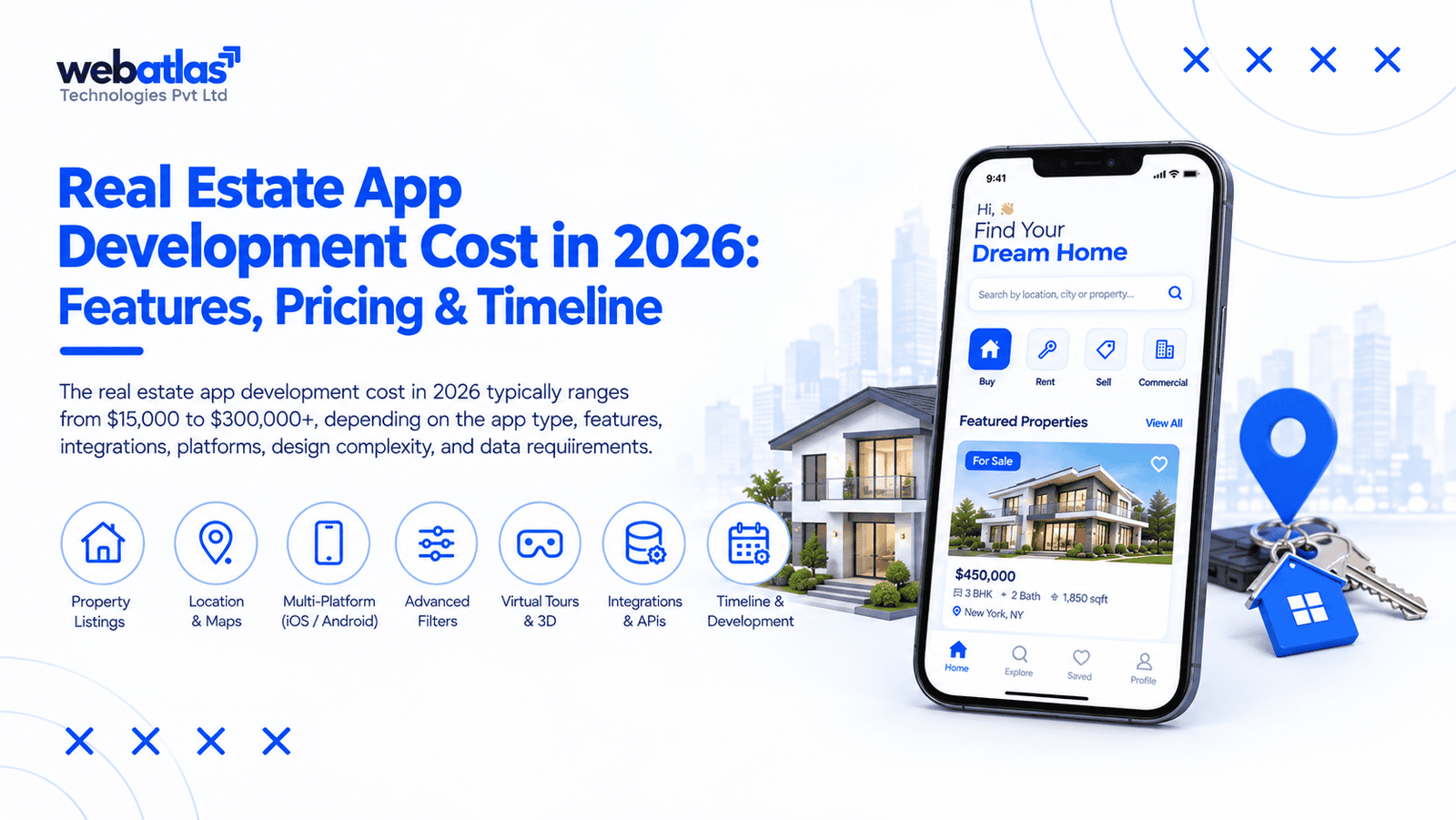
The real estate app development cost in 2026 typically ranges from $15,000 to $300,000+, depending on the app type, features, integrations, platforms, design complexity, and data requirements.
A basic property-listing MVP may cost around $15,000–$40,000, while a mid-level real estate marketplace can range from $40,000–$110,000. Advanced platforms with MLS/IDX integrations, AI-powered recommendations, virtual tours, CRM functionality, analytics, and multiple user roles can reach $110,000–$300,000+.
| Real Estate App Type | Estimated Cost | Typical Timeline |
| Basic Property Listing MVP | $15,000–$40,000 | 2–4 months |
| Rental Property App | $25,000–$60,000 | 3–5 months |
| Agent/Broker App | $30,000–$75,000 | 3–5 months |
| Property Management App | $40,000–$90,000 | 4–6 months |
| Real Estate Marketplace | $50,000–$120,000 | 4–7 months |
| Advanced Real Estate Platform | $110,000–$300,000+ | 6–10+ months |
| Enterprise Real Estate Ecosystem | $300,000+ | 9–12+ months |
These figures are planning estimates rather than fixed quotations. The final price depends heavily on the scope and technical requirements of your product.
The important question is not simply “How much does a real estate app cost?” It is what functionality can you realistically build within your budget?
This guide breaks down the cost by budget, app type, complexity, features, integrations, platforms, development approach, recurring expenses, and timeline.
What Can You Get at Different Real Estate App Budgets?
Your budget directly affects the scope of the product. Instead of selecting features randomly, it is better to define what your budget should deliver.
| Budget | What You Can Build | Typical Features |
| $15K–$30K | Basic MVP | Listings, search, filters, property details, user registration |
| $30K–$60K | Functional marketplace | Maps, favorites, profiles, notifications, inquiry forms |
| $60K–$120K | Mid-level platform | Chat, agent dashboards, CRM, payments, advanced search |
| $120K–$250K | Advanced platform | MLS/IDX, virtual tours, AI recommendations, analytics |
| $250K+ | Enterprise ecosystem | Multiple apps, complex integrations, automation, advanced analytics |
For example, a $25,000 MVP should not attempt to replicate every feature offered by a mature platform such as Zillow. It should focus on one clearly defined user journey, such as search → property details → inquiry → agent contact.
A larger budget can support additional workflows, automation, integrations, and personalized experiences.
This budget-to-scope approach helps prevent one of the most common development problems: building too many features before validating the core product.
What Determines Real Estate App Development Cost?
Several factors influence the final development price.
App Type
A property listing application has different requirements from a property management platform or real estate investment application.
Number of User Roles
A simple application may have buyers and administrators. A larger platform may require separate interfaces for:
- Buyers
- Sellers
- Agents
- Brokers
- Property managers
- Developers
- Administrators
Each additional role can require separate dashboards, permissions, workflows, and testing.
Feature Complexity
Basic search and listing functionality is relatively straightforward. Features such as AI recommendations, mortgage calculators, virtual tours, live chat, property valuation, and automated lead management require additional development.
Third-Party Integrations
External services can significantly affect both development and ongoing expenses.
Examples include:
- MLS/IDX data
- Maps
- Payment gateways
- SMS
- Push notifications
- CRM systems
- Analytics
- Authentication services
- Property valuation APIs
Platform Strategy
Developing for iOS, Android, web, or all three affects both initial development and maintenance costs.
Businesses should decide their platform strategy before development begins rather than adding platforms later without considering architecture and testing requirements.
For businesses planning a mobile-first product, Mobile App Development should be considered as part of the broader product strategy rather than as an isolated development task.
UI/UX Complexity
Real estate applications are heavily visual. Users need to browse photographs, maps, floor plans, videos, property information, pricing, and agent details without feeling overwhelmed.
A strong UI/UX Design process can therefore influence development effort as well as user adoption.
Real Estate App Development Cost by App Type
Different real estate products require different functionality.
Property Listing App
Estimated cost: $15,000–$40,000
A basic listing application can include:
- Property listings
- Search
- Filters
- Property details
- Images
- User registration
- Favorites
- Inquiry forms
- Admin panel
This is generally suitable for an MVP or a focused local property marketplace.
Rental Property App
Estimated cost: $25,000–$60,000
Rental applications may include:
- Property search
- Rental listings
- Availability
- Tenant profiles
- Landlord profiles
- Applications
- Messaging
- Notifications
- Online payments
Agent or Broker App
Estimated cost: $30,000–$75,000
A broker-focused product may require:
- Agent profiles
- Lead management
- Property management
- Client communication
- Appointment scheduling
- Follow-up reminders
- CRM functionality
- Analytics
Property Management App
Estimated cost: $40,000–$90,000
These applications typically involve more operational workflows, such as:
- Tenant management
- Property management
- Rent collection
- Maintenance requests
- Notifications
- Documents
- Reports
- Owner dashboards
Real Estate Marketplace
Estimated cost: $50,000–$120,000
A marketplace can require separate experiences for buyers, sellers, agents, and administrators.
Common features include:
- Advanced search
- Property listings
- Agent profiles
- Saved properties
- Messaging
- Map-based search
- Lead management
- Notifications
- Reviews
- Analytics
Real Estate Investment App
Estimated cost: $70,000–$150,000+
Investment-focused applications may require:
- Property investment opportunities
- Financial calculations
- Investment dashboards
- Portfolio tracking
- Payment functionality
- Reports
- Document management
- Identity verification
The regulatory and financial requirements can also increase project complexity.
Real Estate App Cost by Development Complexity
Another way to estimate cost is by product complexity.
Basic MVP: $15,000–$40,000
A basic MVP normally focuses on one primary user journey.
Typical functionality:
- User registration
- Property listings
- Search and filters
- Property details
- Images
- Favorites
- Contact/inquiry
- Admin dashboard
Mid-Level App: $40,000–$110,000
A mid-level application may add:
- Advanced search
- Maps
- Agent profiles
- Chat
- Push notifications
- CRM
- Appointment scheduling
- Payments
- Analytics
Advanced App: $110,000–$300,000+
Advanced platforms can include:
- MLS/IDX integrations
- AI-powered recommendations
- Virtual property tours
- Property valuation
- Advanced CRM
- Automated lead management
- Multiple user roles
- Real-time communication
- Advanced analytics
- Personalized recommendations
Enterprise Platform: $300,000+
Enterprise products may involve:
- Multiple applications
- Web and mobile platforms
- Complex data integrations
- Enterprise CRM
- Advanced security
- High-volume infrastructure
- Multiple geographic markets
- Custom analytics
- Automation
- Third-party enterprise systems
The biggest cost difference between these categories usually comes from scope and integration complexity, not simply the number of screens.
Feature-Wise Real Estate App Development Cost
Individual features also contribute to the overall budget.
| Feature | Relative Development Complexity |
| User Registration & Login | Low |
| Property Listings | Low–Medium |
| Search & Filters | Medium |
| Favorites | Low |
| Maps & Location Search | Medium |
| Agent Profiles | Medium |
| Push Notifications | Low–Medium |
| Chat/Messaging | Medium–High |
| Appointment Scheduling | Medium |
| Payment Integration | Medium–High |
| CRM Integration | High |
| MLS/IDX Integration | High |
| Virtual Tours | High |
| AI Recommendations | High |
| Property Valuation | High |
| Advanced Analytics | High |
These features should not be treated as isolated prices because their implementation often depends on the application’s architecture.
For example, adding a map is relatively straightforward. However, building map-based property discovery with geolocation, clustering, filters, real-time listing updates, and location-based recommendations requires considerably more work.
The same principle applies to AI. Adding an AI feature is not simply an API integration; the development effort depends on the data, workflow, model, user experience, and business logic surrounding it.
For advanced AI capabilities, businesses can explore AI Development as a separate technical workstream.
MLS/IDX Integration: A Major Cost Factor
Property data is one of the most important cost considerations in real estate app development.
MLS and IDX integrations can introduce additional technical and operational requirements, including:
- API integration
- Authentication
- Data synchronization
- Listing updates
- Data normalization
- Image handling
- Search indexing
- Duplicate detection
- Error handling
- Access restrictions
- Compliance requirements
The actual cost depends on the MLS or data provider, access model, API capabilities, number of markets, synchronization frequency, and application requirements.
Why MLS/IDX Should Be Planned Early
A common mistake is designing the entire application first and deciding where property data will come from later.
Instead, answer these questions before development:
- Where will property listings come from?
- Who owns the data?
- Is MLS access available?
- Will an IDX provider be used?
- How frequently should listings update?
- What fields are available?
- How will duplicate listings be handled?
- What happens when a property becomes unavailable?
Data availability can influence the application’s architecture, search functionality, database design, and even the user experience.
Real Estate App Development Cost by Platform
Your platform strategy also affects development cost.
iOS App
Building a dedicated iOS application may be suitable when your target audience primarily uses Apple devices.
Cost depends on:
- Number of features
- Design complexity
- Backend requirements
- Third-party integrations
- Testing requirements
Android App
Android development can require additional device and operating-system testing because of the broader hardware ecosystem.
Cross-Platform Development
Cross-platform development can allow businesses to share portions of the codebase across platforms.
It may be useful when:
- Both iOS and Android are required
- The application has a similar experience across platforms
- Faster initial deployment is important
- Development resources need to be optimized
However, cross-platform does not automatically mean every project will cost half as much. Backend development, integrations, testing, UI/UX, and platform-specific requirements still contribute to the overall cost.
Web + Mobile
A real estate marketplace may eventually require:
- Customer-facing website
- iOS application
- Android application
- Agent dashboard
- Admin dashboard
This creates a broader ecosystem and therefore a larger development and maintenance budget.
Build vs. Buy: White-Label or Custom Real Estate App?
Businesses generally have three approaches to launching a real estate application:
White-Label Solution
A white-label platform provides an existing product that can be customized with branding and selected functionality.
Advantages:
- Faster launch
- Lower initial cost
- Existing core functionality
Limitations:
- Limited customization
- Vendor dependency
- Potential scalability restrictions
- Less control over architecture
- Difficulties adding highly specific workflows
Semi-Custom Solution
A business can start with existing components or frameworks and customize important workflows.
This can provide a middle ground between cost and flexibility.
Fully Custom Development
Custom development is appropriate when the business needs:
- Unique workflows
- Custom marketplace logic
- Proprietary features
- Advanced integrations
- Complete control over the product
- Long-term scalability
The right choice depends on the business model, expected scale, timeline, and product requirements.
For businesses validating a new idea, MVP Software Development can help reduce initial scope while allowing the core product to be tested before significant investment is made.
Hidden and Recurring Costs After Launch
Development is only one part of the total cost of ownership.
A real estate application may also require ongoing spending for:
Cloud Infrastructure
Costs depend on:
- Traffic
- Database size
- Media storage
- API requests
- Server architecture
Property Data
MLS, IDX, property data, or other third-party providers may have separate fees.
Maps and Location Services
Map providers may charge according to usage.
Communication Services
SMS, email, push notification, and communication providers can introduce recurring costs.
Media Storage
Real estate applications often store large numbers of:
- Property images
- Videos
- Floor plans
- Virtual tour assets
This can increase storage and bandwidth requirements.
Maintenance
Post-launch maintenance can include:
- Bug fixes
- Security updates
- OS compatibility
- API changes
- Performance optimization
- Server monitoring
New Features
Once the application gains users, businesses often need additional functionality based on user behavior and market requirements.
Therefore, a realistic budget should consider:
Total Cost of Ownership = Development + Data/API Costs + Infrastructure + Maintenance + Future Enhancements
How Long Does It Take to Build a Real Estate App?
The development timeline depends on scope and complexity.
| Development Stage | Typical Duration |
| Discovery & Planning | 1–3 weeks |
| UI/UX Design | 2–5 weeks |
| Backend Development | 4–10 weeks |
| Mobile/Web Development | 6–16 weeks |
| API & Third-Party Integrations | 2–8 weeks |
| Testing & QA | 2–5 weeks |
| Deployment | 1–2 weeks |
These stages can overlap, so the total project timeline is not simply the sum of every phase.
Typical Overall Timeline
Basic MVP: 2–4 months
Mid-Level App: 4–6 months
Advanced Platform: 6–10+ months
Enterprise Platform: 9–12+ months
MLS/IDX integration, multiple user roles, complex dashboards, AI, payment workflows, and advanced analytics can extend the timeline.
How Much Does It Cost to Build an App Like Zillow?
A Zillow-like platform is significantly more complex than a basic property-listing application.
A comparable platform can require:
- Large property databases
- Advanced property search
- Map-based discovery
- Property detail pages
- Agent and broker profiles
- Saved searches
- Notifications
- Lead management
- Mortgage tools
- Reviews
- Personalized recommendations
- Data integrations
- Analytics
- Administrative tools
- Potential AI functionality
A realistic planning range for an advanced Zillow-like product can be $150,000–$300,000+, depending on the markets, data sources, platforms, integrations, and depth of functionality.
However, attempting to reproduce an established platform feature-for-feature is rarely the most practical starting point.
A better approach is to identify the specific Zillow-like functionality your target audience actually needs and build that first.
Data Readiness: The Cost Factor Many Businesses Miss
Before development starts, the business should determine whether the required property data is actually available.
This is especially important because real estate applications are fundamentally data-driven products.
Before requesting a development quotation, clarify:
Data Source
Will listings come from:
- MLS
- IDX provider
- Internal database
- Property owners
- Agents
- Developers
- Third-party APIs
Data Structure
Are property fields standardized?
For example:
- Property type
- Price
- Location
- Bedrooms
- Bathrooms
- Area
- Amenities
- Images
- Availability
Update Frequency
How quickly should changes appear in the application?
A listing marketplace may require frequent synchronization, while a private property management system may use an internal database.
Data Quality
Consider:
- Duplicate listings
- Missing information
- Incorrect images
- Expired properties
- Inconsistent addresses
- Incorrect pricing
API Limitations
Check:
- Request limits
- Authentication requirements
- Pricing
- Data availability
- Geographic restrictions
- Usage restrictions
This data-readiness assessment can prevent expensive architectural changes later.
How to Reduce Real Estate App Development Costs
Reducing development cost does not necessarily mean choosing the cheapest development option.
It means controlling scope and prioritizing the features that create the most value.
Start With One Core User Journey
For example:
Search Property → View Details → Contact Agent
Build this workflow first before adding dozens of secondary features.
Launch an MVP
Avoid building advanced features before validating demand.
Start with:
- Listings
- Search
- Filters
- Property details
- User accounts
- Inquiry/contact
- Admin management
Then expand based on user feedback.
Limit the Initial Market
Instead of launching in multiple cities or countries, begin with one target market where data and operational requirements are manageable.
Prioritize Integrations
Identify integrations that are essential to the business model.
Do not integrate every possible CRM, payment provider, communication tool, and data provider at launch.
Delay Advanced AI
AI-powered recommendations, automated valuation, predictive analytics, and conversational search can be valuable, but they should be introduced when the product has sufficient data and a clear use case.
Reuse Proven Services
Instead of building every supporting service from scratch, businesses can use established services for:
- Maps
- Authentication
- Payments
- Notifications
- Analytics
- Cloud infrastructure
Choose the Right Platform Strategy
If the initial audience is concentrated on one platform, launching there first may reduce the initial investment.
The architecture should still account for future expansion.
Why Choose Webatlas Tech for Real Estate App Development?
Webatlas Tech approaches real estate app development around the product’s actual business requirements rather than simply creating a list of features.
The development process can cover product discovery, UI/UX design, application development, API integrations, testing, deployment, and post-launch improvements.
For real estate businesses, the focus can include property listings, advanced search, maps, user roles, agent workflows, third-party integrations, dashboards, notifications, and scalable backend architecture.
The goal is to create a product that fits the intended market, budget, and growth roadmap while avoiding unnecessary functionality in the initial release.
Frequently Asked Questions
- How much does it cost to develop a real estate app in 2026?
Real estate app development can cost approximately $15,000–$40,000 for a basic MVP, $40,000–$110,000 for a mid-level application, and $110,000–$300,000+ for advanced platforms. Enterprise solutions can exceed $300,000.
- How long does it take to build a real estate app?
A basic real estate MVP may take around 2–4 months. Mid-level applications can require 4–6 months, while advanced platforms with complex integrations may take 6–10 months or longer.
- What is the most expensive part of real estate app development?
The most expensive areas are typically complex backend architecture, MLS/IDX integrations, multiple user roles, advanced dashboards, AI functionality, real-time communication, sophisticated search, and large-scale data management.
- How much does MLS or IDX integration cost?
There is no universal MLS/IDX integration price. Costs depend on the provider, API access, geographic coverage, data volume, synchronization requirements, licensing, and technical implementation.
- Can I build a real estate app with a small budget?
Yes. A focused MVP can be developed with a smaller budget by limiting the initial features, targeting one market, choosing one primary platform, and prioritizing the core property-search and inquiry workflow.
- Is it cheaper to develop iOS and Android together?
Cross-platform development can reduce duplicated development work in some projects, but total cost still depends on backend development, integrations, testing, UI/UX, and platform-specific requirements.
- Does adding AI increase real estate app development costs?
Usually, yes. AI functionality can introduce additional costs related to APIs or models, data preparation, backend logic, testing, monitoring, and ongoing usage. The actual increase depends on the AI use case.
- What are the ongoing costs of running a real estate app?
Ongoing expenses can include cloud hosting, databases, property data, MLS/IDX services, maps, communication APIs, media storage, security, maintenance, monitoring, and future feature development.
- How much does it cost to build an app like Zillow?
A Zillow-like application can require $150,000–$300,000+ when it includes advanced property search, large-scale data integration, maps, agent functionality, analytics, recommendations, and multiple platforms. A smaller Zillow-inspired MVP can cost considerably less.
- What is the best way to reduce real estate app development costs?
The most practical approach is to define a focused MVP, prioritize essential workflows, limit the initial market, select necessary integrations, and postpone advanced features until the product has been validated.
- What technology is used to build a real estate app?
The technology stack depends on the product requirements. A typical architecture may include a mobile or web frontend, backend APIs, database, cloud infrastructure, map services, property-data APIs, authentication, notification services, analytics, and third-party integrations.