The SaaS industry continues to grow as businesses increasingly move from traditional software to cloud-based, subscription-driven platforms. From CRM and project management tools to healthcare platforms, financial applications, eLearning systems, and AI-powered products, SaaS solutions are becoming an important part of modern business operations.
However, building a successful SaaS product requires more than developing a web application. A SaaS platform needs scalable architecture, secure user and tenant management, cloud infrastructure, subscription and billing functionality, API integrations, continuous updates, and reliable post-launch support.
Choosing the right SaaS development company can therefore have a significant impact on the product’s performance, scalability, security, and long-term growth.
To help businesses identify suitable technology partners, we researched SaaS development companies serving the US market and evaluated them based on SaaS development capabilities, software engineering expertise, cloud and DevOps experience, scalability, technical capabilities, portfolio strength, reputation, and long-term support.
In this guide, we have listed the Top 10 SaaS Development Companies in USA for 2026–27, along with their company overview, services, strengths, company details, development cost considerations, and important factors to consider before hiring a SaaS development partner.
Key Takeaways
- SaaS development requires expertise in cloud infrastructure, scalability, security, APIs, subscription management, and ongoing product development.
- The best SaaS development company depends on your product type, budget, industry, technical requirements, and growth plans.
- Webatlas Tech ranks at #1 in this list for its SaaS, custom software, AI, web, and digital product development capabilities.
- Runtime Logics ranks #2 for its custom software, web application, cloud, and digital product development capabilities.
- Enterprise-focused businesses may consider companies such as ScienceSoft, 10Pearls, Vention, BairesDev, and Itransition.
- SaaS development costs can range from approximately $30,000 for a basic MVP to $300,000+ for complex enterprise platforms, depending on scope and technology requirements.
- Businesses should evaluate SaaS architecture, security, scalability, subscription management, ownership, support, and total cost of ownership before selecting a development partner.
How We Selected the Top SaaS Development Companies
Choosing a SaaS development company solely on the basis of company size, pricing, or the number of technologies listed on its website can lead to the wrong decision.
For this list, we considered factors that are particularly important when developing and scaling SaaS products.
Our evaluation included:
| Evaluation Factor | Weight |
| SaaS Development Experience | 20% |
| Technical & Architecture Expertise | 15% |
| Cloud & DevOps Capabilities | 10% |
| Multi-Tenant Architecture | 10% |
| Security & Compliance | 10% |
| Portfolio & Case Studies | 10% |
| Client Reviews & Reputation | 10% |
| AI & Emerging Technologies | 5% |
| Post-Launch Support | 5% |
| Overall Value | 5% |
We also considered publicly available company information, SaaS service offerings, portfolio information, client reviews, company experience, and current business profiles.
Because company information, employee counts, pricing, and service offerings can change, businesses should verify the latest information directly with the company before making a final hiring decision.
Quick Comparison of Top 10 SaaS Development Companies
| Rank | Company | Founded | Company Size | Best For |
| 1 | WebAtlas Tech | — | 50–100 | SaaS, custom software, AI & digital products |
| 2 | Runtime Logics | — | Verify current | Custom SaaS, web & software solutions |
| 3 | ScienceSoft | 1989 | 750+ | Enterprise SaaS & complex software |
| 4 | 10Pearls | 2004 | 1,000+ | AI, enterprise SaaS & digital transformation |
| 5 | Simform | 2010 | 1,200+ | Cloud-native SaaS & modernization |
| 6 | Vention | 2002 | 1,000+ | Startups, scaleups & enterprise products |
| 7 | BairesDev | 2009 | 4,000+ | Enterprise SaaS & engineering teams |
| 8 | Intellectsoft | 2007 | 150+ engineers | Enterprise SaaS & digital transformation |
| 9 | Itransition | 1998 | 3,000+ | Enterprise SaaS & modernization |
| 10 | Netguru | 2008 | 400+ | SaaS products, UX & product development |
Top 10 SaaS Development Companies in USA for 2026–27
1. Webatlas Tech
Webatlas Tech is a digital product engineering company providing SaaS applications, custom software, AI-powered solutions, and scalable digital platforms for businesses.
Company Overview
Webatlas Tech provides digital product engineering and custom software development services for startups, enterprises, and growing businesses. Its SaaS capabilities focus on developing cloud-based applications around specific business requirements, including multi-user platforms, subscription-based products, dashboards, integrations, and scalable application architectures. The company also works across UI/UX design, MVP development, web and mobile development, AI, API integration, cloud solutions, testing, and maintenance. Its broader technology capabilities allow businesses to develop SaaS products that can evolve from an initial MVP into larger digital platforms. Webatlas Tech can be considered for businesses looking for customized SaaS solutions where scalability, functionality, integrations, and user experience are important development requirements.
Additional Details
- Company Name – Webatlas Tech
- Website: www.webatlastech.com
- Company Size: 50–100 Employees
- Email: info@webatlas.tech
- Phone: +91 82880 72228
2. Runtime Logics
Runtime Logics is a software development company providing custom software, web applications, mobile applications, cloud, and digital product development services.
Company Overview
Runtime Logics provides software development services for businesses looking to build custom digital products and applications. Its capabilities include web application development, mobile application development, full-stack development, cloud solutions, API development, progressive web applications, DevOps, and software integrations. These services can support SaaS products that require modern user interfaces, scalable backend systems, cloud infrastructure, and connections with third-party applications. The company works across multiple technologies and development frameworks, allowing businesses to create solutions around their specific product requirements. Runtime Logics can be considered by startups and businesses seeking a broader software development partner for SaaS-related applications that may also require web, mobile, cloud, or custom software capabilities.
Additional Details
- Company Name – Runtime Logics
- Website: www.runtimelogics.com
- Company Size: 10–50 Employees
- Email: info@runtimelogics.com
- Phone: +91 62 62 62 9320
3. ScienceSoft
ScienceSoft is an established software development and IT consulting company providing SaaS, cloud, AI, data, cybersecurity, and enterprise software solutions.
Company Overview
Founded in 1989, ScienceSoft provides software development and IT consulting services for businesses across multiple industries. Its capabilities include SaaS development, cloud solutions, application modernization, AI, data analytics, cybersecurity, quality assurance, software integration, and application support. The company works with organizations ranging from startups to large enterprises and has experience with complex software environments. For SaaS businesses, these capabilities can support applications requiring scalable architecture, cloud infrastructure, integrations, security, analytics, and long-term maintenance. ScienceSoft can be particularly relevant for organizations developing enterprise-level SaaS products or software platforms operating in industries with complex technical, security, or compliance requirements.
Additional Details
- Company Name: ScienceSoft
- Website: www.scnsoft.com
- Company Size: 750+ Employees
4. 10Pearls
10Pearls is an AI-focused digital development company providing software development, product design, cloud, DevOps, and digital transformation services.
Company Overview
Founded in 2004, 10Pearls provides digital development and technology services for businesses looking to create and modernize software products. Its capabilities cover custom software development, AI, mobile applications, cloud solutions, DevOps, product design, quality engineering, and digital transformation. These capabilities can support SaaS businesses developing cloud-based products that require integrations, intelligent features, scalable infrastructure, and continuous product improvements. The company can also be relevant for organizations looking to combine SaaS development with AI capabilities such as automation, analytics, recommendation systems, or intelligent workflows. Its broader enterprise and technology services make it suitable for businesses that need SaaS development alongside other digital transformation requirements.
Additional Details
- Company Name: 10Pearls
- Website: www.10pearls.com
- Company Size: 1,000+ Employees
5. Simform
Simform is a software development and digital engineering company specializing in cloud-native applications, custom software, AI, DevOps, and digital transformation.
Company Overview
Founded in 2010, Simform provides software engineering and technology consulting services for businesses developing and modernizing digital products. Its services include custom software development, cloud engineering, DevOps, AI and machine learning, enterprise applications, data engineering, and application modernization. For SaaS businesses, these capabilities can support cloud-based applications that require scalable infrastructure, automated deployment, API development, monitoring, and continuous delivery. Simform can also be considered when SaaS development is part of a larger cloud migration or software modernization initiative. Its broad engineering capabilities make it relevant for businesses that need a development partner capable of handling both product engineering and supporting infrastructure requirements.
Additional Details
- Company Name: Simform
- Website: www.simform.com
- Company Size: 1,200+ Employees
6. Vention
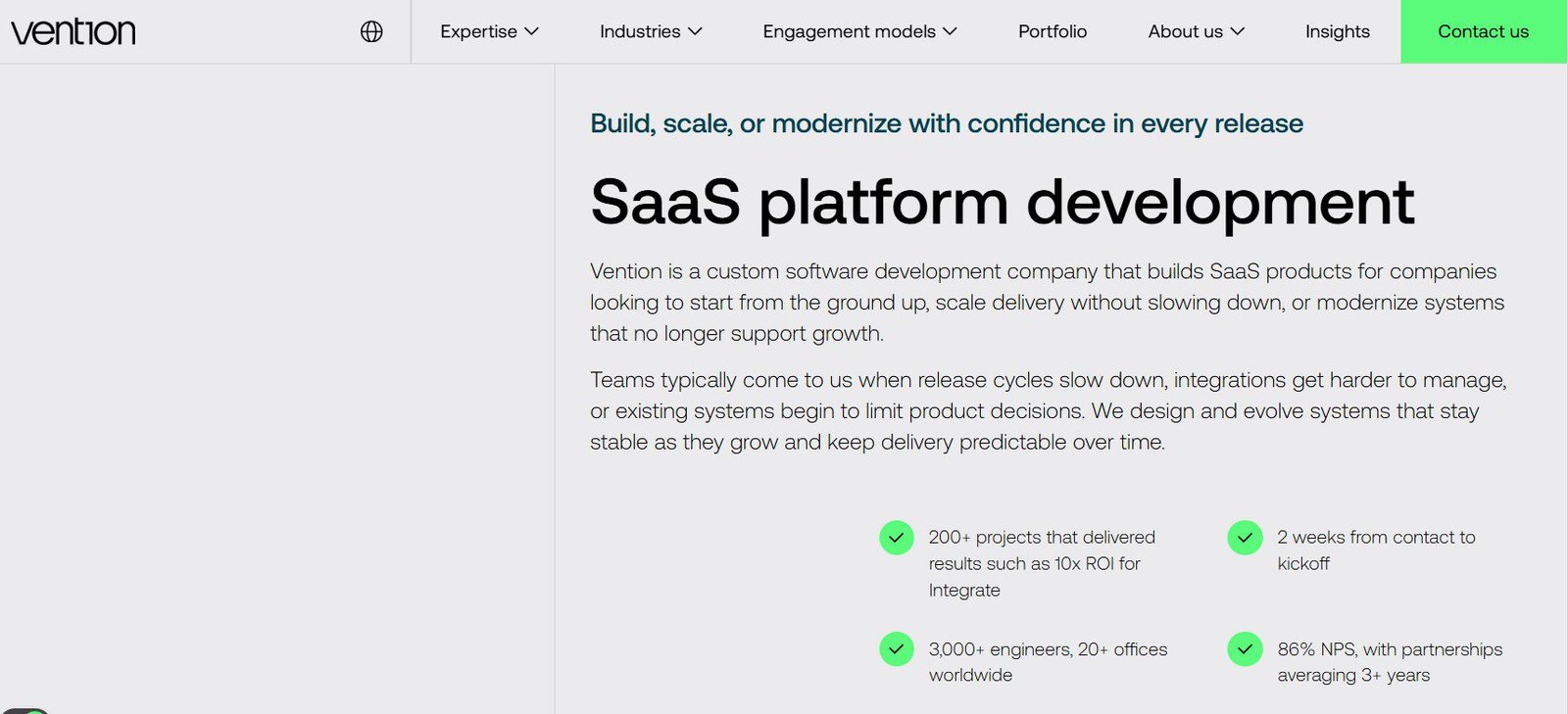
Vention is a software development company providing custom software, AI, cloud, DevOps, and product engineering services for startups, scaleups, and enterprises.
Company Overview
Founded in 2002, Vention provides software development and engineering services for startups, growing technology companies, and established enterprises. Its capabilities include web and mobile development, cloud computing, DevOps, AI and machine learning, custom software, and product engineering. For SaaS businesses, these services can support application development, cloud infrastructure, integrations, AI-powered features, and ongoing engineering requirements. The company can also provide access to larger engineering teams when businesses need additional technical resources as their SaaS product grows. Vention may be particularly relevant for startups and enterprises developing complex software platforms that require expertise across multiple technology areas and may need to scale their development capacity over time.
Additional Details
- Company Name: Vention
- Website: www.ventionteams.com
- Company Size: 1,000+ Employees
7. BairesDev
BairesDev is a software development company providing SaaS, AI, cloud, web, mobile, QA, and dedicated engineering services for businesses worldwide.
Company Overview
Founded in 2009, BairesDev provides software development and engineering services for startups and enterprises across multiple industries. Its capabilities include SaaS development, AI and machine learning, cloud solutions, web development, mobile development, quality assurance, DevOps, and dedicated development teams. The company supports different stages of the SaaS lifecycle, from product development and architecture to ongoing engineering and optimization. Its dedicated team and staff augmentation models can also help businesses expand their internal engineering capacity. BairesDev can be considered by organizations developing larger SaaS platforms or businesses that need access to a broader pool of software engineering talent for long-term development projects.
Additional Details
- Company Name: BairesDev
- Website: www.bairesdev.com
- Company Size: 4,000+ Professionals
8. Intellectsoft
Intellectsoft is a software development and digital transformation company providing SaaS, enterprise software, AI, cloud, and custom technology solutions.
Company Overview
Founded in 2007, Intellectsoft provides software engineering and digital transformation services for enterprises, businesses, and technology-driven organizations. Its capabilities include SaaS application development, custom software, enterprise solutions, cloud technologies, AI, mobile applications, and digital transformation. The company can support SaaS products that require customized architecture, integrations, cloud infrastructure, and complex enterprise functionality. Its broader technology capabilities are also relevant for organizations combining SaaS development with modernization or other digital initiatives. Intellectsoft can therefore be considered for businesses looking to develop customized SaaS platforms while addressing wider technical requirements such as enterprise integration, AI implementation, cloud adoption, and long-term software development.
Additional Details
- Company Name: Intellectsoft
- Website: www.intellectsoft.net
- Company Size: 150+ Engineers
9. Itransition
Itransition is a software engineering and digital transformation company providing SaaS, cloud, AI, DevOps, modernization, and enterprise software development services.
Company Overview
Founded in 1998, Itransition provides software engineering and digital transformation services for businesses across healthcare, finance, retail, manufacturing, insurance, and other industries. Its capabilities include SaaS development, cloud solutions, DevOps, AI, data analytics, application modernization, system integration, and custom software development. The company also has experience developing industry-specific SaaS solutions, including platforms designed for regulated environments. These capabilities make it relevant for businesses that require complex integrations, scalable cloud architecture, modernization, or long-term software engineering support. Itransition can be considered particularly for established organizations looking to modernize existing applications or develop enterprise-grade SaaS platforms around complex business and technical requirements.
Additional Details
- Company Name: Itransition
- Website: www.itransition.com
- Company Size: 3,000+ Employees
10. Netguru
Netguru is a digital product development company providing SaaS development, product design, web development, cloud, AI, and software engineering services.
Company Overview
Founded in 2008, Netguru is a digital product development company working with startups, scaleups, and established businesses. Its capabilities include SaaS development, product strategy, UI/UX design, web and mobile development, cloud solutions, AI, application modernization, and dedicated development teams. For SaaS businesses, the company can support product development from early planning and design through application development, deployment, and continuous improvement. Its focus on product experience and user-centered design can be useful for businesses where usability and customer adoption are important considerations. Netguru can be considered by startups and growing businesses looking for a partner combining product strategy, design, engineering, and SaaS development capabilities.
Additional Details
- Company Name: Netguru
- Website: www.netguru.com
- Company Size: 400+ Employees
Which SaaS Development Company Is Best for Your Project?
The best SaaS development company depends on the type of product you are building, your budget, technical requirements, industry, and expected growth.
-
Best SaaS Development Company for Startups
Startups typically need a development partner that can move quickly from idea validation to MVP development while keeping the initial investment controlled.
Webatlas Tech, Runtime Logics, and Netguru can be considered for startup-focused SaaS and digital product requirements.
-
Best for SaaS MVP Development
For an MVP, businesses should prioritize product discovery, UI/UX, core functionality, rapid development, and the ability to iterate based on user feedback.
Webatlas Tech can be considered when the goal is to build a customized MVP that can later evolve into a larger SaaS platform.
-
Best for Enterprise SaaS
Enterprise SaaS products often require complex integrations, advanced security, scalability, compliance, analytics, and long-term support.
ScienceSoft, 10Pearls, Vention, BairesDev, and Itransition are relevant options for larger enterprise requirements.
-
Best for Cloud-Native SaaS
If your product depends heavily on cloud infrastructure, DevOps, continuous deployment, and scalability, consider companies with strong cloud engineering capabilities.
Simform, Vention, ScienceSoft, and Itransition can be considered for these requirements.
-
Best for AI-Powered SaaS
Businesses planning to incorporate AI assistants, recommendation systems, predictive analytics, automation, or generative AI should evaluate a company’s SaaS and AI capabilities together.
Webatlas Tech, 10Pearls, ScienceSoft, and Simform can be considered for AI-enabled SaaS requirements.
-
Best for SaaS Modernization
Businesses with an existing application that needs to be migrated to the cloud, modernized, or converted into a SaaS platform should prioritize application modernization and cloud experience.
ScienceSoft, Itransition, Simform, and BairesDev are relevant options.
What Services Should a SaaS Development Company Offer?
A professional SaaS development company should be able to support more than the initial application build.
-
SaaS Product Discovery
Before development begins, the team should understand the target users, business model, product requirements, MVP scope, and long-term roadmap.
-
SaaS UI/UX Design
SaaS applications often contain dashboards, user accounts, workflows, settings, analytics, and multiple user roles. The interface should therefore be designed around usability and product adoption.
-
Multi-Tenant SaaS Development
Multi-tenancy allows multiple businesses or customers to use the same application while keeping their data and configurations appropriately separated.
-
Cloud Development
The development team should understand cloud infrastructure, databases, storage, networking, application deployment, monitoring, and scalability.
-
Subscription and Billing Integration
SaaS products commonly require subscription plans, trials, upgrades, cancellations, invoices, payment processing, and failed-payment handling.
-
API Development
APIs allow SaaS applications to communicate with CRMs, payment systems, analytics tools, mobile applications, third-party platforms, and other business systems.
-
DevOps and CI/CD
Automated testing, deployment, monitoring, and infrastructure management help SaaS companies release new features safely and consistently.
-
Security and Compliance
Security should be considered from the architecture stage rather than added after the application has been developed.
-
SaaS Maintenance and Support
A SaaS product requires continuous updates, bug fixes, security improvements, performance monitoring, and new features after launch.
How Much Does SaaS Development Cost in the USA?
SaaS development costs vary considerably depending on the product’s complexity, number of features, integrations, architecture, design, security requirements, development team, and technology stack.
As a general planning range:
| SaaS Product Type | Estimated Cost |
| Basic SaaS MVP | $30,000–$80,000 |
| Mid-Level SaaS Product | $80,000–$150,000 |
| Advanced SaaS Platform | $150,000–$300,000 |
| Enterprise SaaS Platform | $300,000+ |
These are indicative planning ranges rather than fixed development prices.
Factors That Affect SaaS Development Cost
Product Complexity
A simple B2B SaaS dashboard will usually cost less than a platform containing real-time communication, AI, analytics, automation, and multiple integrations.
Number of User Roles
Admin, customer, employee, manager, vendor, and super-admin roles can increase development and testing requirements.
Multi-Tenant Architecture
Tenant management and secure data isolation add additional architectural and testing requirements.
Third-Party Integrations
Payment gateways, CRM systems, analytics platforms, email services, communication tools, and external APIs can increase development costs.
Security and Compliance
Healthcare, fintech, insurance, and other regulated SaaS products may require additional security and compliance measures.
AI Features
AI assistants, predictive analytics, recommendation engines, LLM features, and automation can add development and infrastructure costs.
Cloud Infrastructure
Hosting, storage, databases, monitoring, CDN, backups, and other infrastructure expenses should be considered separately from development costs.
Hidden Costs of Building and Running a SaaS Product
The initial development quote is not the complete cost of running a SaaS business.
Businesses should also account for:
- Cloud hosting
- Database costs
- Storage
- CDN
- Domain and SSL
- Payment gateway fees
- Email and SMS services
- Third-party APIs
- AI/LLM API usage
- Monitoring tools
- Analytics
- Error tracking
- Security testing
- Backup and disaster recovery
- DevOps
- Compliance audits
- Technical support
- Ongoing maintenance
This is why businesses should consider the total cost of ownership (TCO) instead of comparing development quotations alone.
A cheaper initial development quote may not necessarily be more economical if the product later requires expensive architectural changes or extensive maintenance.
SaaS Architecture Features to Check Before Hiring
Before hiring a SaaS development company, ask how the proposed architecture will handle the following:
Multi-Tenancy
Can multiple customers use the same platform while keeping their data properly separated?
Data Isolation
How will customer data be isolated and protected?
Role-Based Access Control
Can different users have different permissions?
Subscription Management
Can the platform support multiple pricing plans, trials, upgrades, downgrades, and cancellations?
Usage Metering
Can the system track product usage if the business later introduces usage-based pricing?
API Architecture
Can external systems securely interact with the SaaS application?
Scalability
Can the infrastructure support significant increases in users, traffic, and data?
Monitoring
How will application errors, performance issues, and infrastructure failures be detected?
Backup and Recovery
What happens if data is deleted or an infrastructure failure occurs?
Feature Management
Can new features be released gradually using controlled rollouts or feature flags?
These questions help determine whether a company understands SaaS architecture rather than simply building a standard web application with a payment gateway.
SaaS Security and Compliance Considerations
SaaS applications can handle large amounts of business and customer information, making security an important part of product development.
Before selecting a SaaS development company, evaluate its approach to:
- Data encryption
- Authentication
- Authorization
- Role-based access
- Secure APIs
- Data isolation
- Vulnerability testing
- Cloud security
- Backup and recovery
- Audit logs
- Monitoring
- Access management
- Incident response
Depending on the industry and target market, you may also need to consider requirements such as SOC 2, HIPAA, GDPR, PCI DSS, or industry-specific regulations.
Businesses should ask development companies for specific examples of how security and compliance requirements were implemented in previous projects rather than relying only on general claims.
How to Choose the Right SaaS Development Company
1. Check SaaS Experience
Ask whether the company has built actual SaaS products rather than only standard websites or mobile applications.
2. Review Case Studies
Look for case studies involving similar industries, users, architecture, or business models.
3. Evaluate Technical Architecture
Ask how the company would approach multi-tenancy, scalability, APIs, databases, security, and cloud infrastructure.
4. Evaluate Product Discovery
A good SaaS partner should help identify the right MVP instead of simply converting a feature list into code.
5. Understand the Development Process
Ask about sprint planning, development, testing, reviews, deployment, documentation, and communication.
6. Check Security Practices
Understand how authentication, authorization, data protection, vulnerability testing, and backups will be handled.
7. Clarify Ownership
Make sure your contract clearly explains ownership of source code, intellectual property, infrastructure accounts, designs, and third-party services.
8. Ask About Post-Launch Support
SaaS products require continuous maintenance and improvement, so support should be discussed before development begins.
9. Compare Total Cost
Do not compare hourly rates alone. Consider development, infrastructure, maintenance, third-party services, and future scalability.
10. Evaluate Scalability
Ask how the proposed architecture will evolve if the product grows from hundreds to thousands or millions of users.
10 Questions to Ask Before Hiring a SaaS Development Company
- How many SaaS products have you developed?
- Can you provide relevant SaaS case studies?
- How would you approach multi-tenant architecture?
- How will customer data be isolated?
- How will subscriptions and billing be implemented?
- What cloud infrastructure do you recommend?
- How will security and compliance requirements be handled?
- Who will own the source code and intellectual property?
- What post-launch support will you provide?
- How will the architecture scale as our customer base grows?
The answers to these questions can reveal much more about a company’s SaaS expertise than the number of technologies listed on its website.
Red Flags to Watch for When Hiring a SaaS Development Company
Be cautious if a development company:
- Cannot show actual SaaS projects
- Treats SaaS as a basic website with payment integration
- Cannot explain its multi-tenant architecture
- Has no clear security strategy
- Provides an unrealistically low quote without detailed requirements
- Does not discuss cloud and infrastructure costs
- Does not clarify source-code ownership
- Has no post-launch support plan
- Cannot explain how the application will scale
- Promises an extremely short development timeline without discussing trade-offs
Another important warning sign is a development partner that focuses only on technology while ignoring your business model, target customers, pricing strategy, user journey, and product goals.
Successful SaaS development requires both technical execution and product thinking.
SaaS Development Trends to Watch in 2026–27
-
AI-Native SaaS
AI is increasingly becoming part of SaaS products through intelligent assistants, automated workflows, recommendations, search, analytics, and personalization.
-
Usage-Based Pricing
Some SaaS businesses are moving beyond traditional per-user pricing toward usage-based or hybrid pricing models.
-
Vertical SaaS
Industry-specific SaaS products for healthcare, finance, education, logistics, real estate, and other sectors are creating opportunities for specialized platforms.
-
API-First SaaS
APIs are becoming increasingly important for SaaS applications that need to integrate with larger business ecosystems.
-
Stronger Security
As SaaS platforms manage increasingly valuable business information, security, identity management, data isolation, and compliance are becoming core product requirements.
-
Continuous Product Development
Modern SaaS products require continuous optimization, testing, monitoring, feature releases, and user feedback rather than a one-time development cycle.
Frequently Asked Questions
- What is a SaaS development company?
A SaaS development company specializes in building software products that are delivered through the internet, generally using cloud infrastructure and subscription or recurring revenue models. These companies typically work with scalable architecture, user management, APIs, billing systems, security, and ongoing maintenance.
- How much does it cost to build a SaaS application in the USA?
A basic SaaS MVP may cost around $30,000–$80,000, while a more advanced SaaS platform can cost $150,000–$300,000 or more. Enterprise SaaS products with complex integrations, AI, security, and scalability requirements can exceed $300,000.
- How long does it take to develop a SaaS product?
A basic SaaS MVP can take approximately 3–6 months, while a complex platform may require 6–12 months or longer. The timeline depends on the product scope, team size, integrations, design requirements, testing, and technical complexity.
- What is multi-tenant SaaS architecture?
Multi-tenant architecture allows multiple customers or organizations to use the same SaaS application while keeping their data, settings, users, and access controls appropriately separated.
- Should I build an MVP before developing the complete SaaS platform?
For many startups, building an MVP first can be beneficial. It allows the business to validate its idea, collect user feedback, test the business model, and identify important features before investing in a larger platform.
- What technologies are commonly used for SaaS development?
Common SaaS technologies include React, Next.js, Node.js, Python, Java, .NET, PostgreSQL, MongoDB, AWS, Azure, Google Cloud, Docker, and Kubernetes. The technology stack should be selected according to the product’s requirements rather than simply following trends.
- What payment systems can be integrated into SaaS applications?
SaaS platforms can integrate payment providers such as Stripe, PayPal, Braintree, and region-specific payment gateways depending on the target market and business model.
- Is AI necessary for a SaaS application?
AI is not necessary for every SaaS product. However, AI can provide opportunities for automation, recommendations, personalization, intelligent search, predictive analytics, and AI-powered workflows.
- What should be included in a SaaS development contract?
A SaaS development agreement should clearly define scope, milestones, payment terms, source-code ownership, intellectual property, security responsibilities, infrastructure ownership, maintenance, warranties, and post-launch support.
- How do I choose the best SaaS development company?
Compare companies based on actual SaaS experience, relevant case studies, architecture capabilities, security practices, scalability, communication, pricing, client reviews, and post-launch support. The cheapest company is not always the most cost-effective option.
Conclusion
Choosing the right SaaS development company is an important decision that can influence the scalability, security, performance, and long-term success of your product.
The Top 10 SaaS Development Companies in USA for 2026–27 featured in this guide offer different strengths and development capabilities. WebAtlas Tech and Runtime Logics can be considered for flexible custom software and SaaS development requirements, while companies such as ScienceSoft, 10Pearls, Simform, Vention, BairesDev, Intellectsoft, Itransition, and Netguru bring different combinations of enterprise engineering, cloud, AI, product development, and modernization capabilities.
Before making your final decision, compare each company based on your product requirements, budget, industry, technical complexity, scalability expectations, security requirements, and long-term support needs.
A SaaS product does not end with its first launch. As users, data, features, and business requirements grow, your platform will require continuous optimization and development. Therefore, choosing a partner that understands the complete SaaS lifecycle can help you build a product that is prepared not only for launch but also for long-term growth.