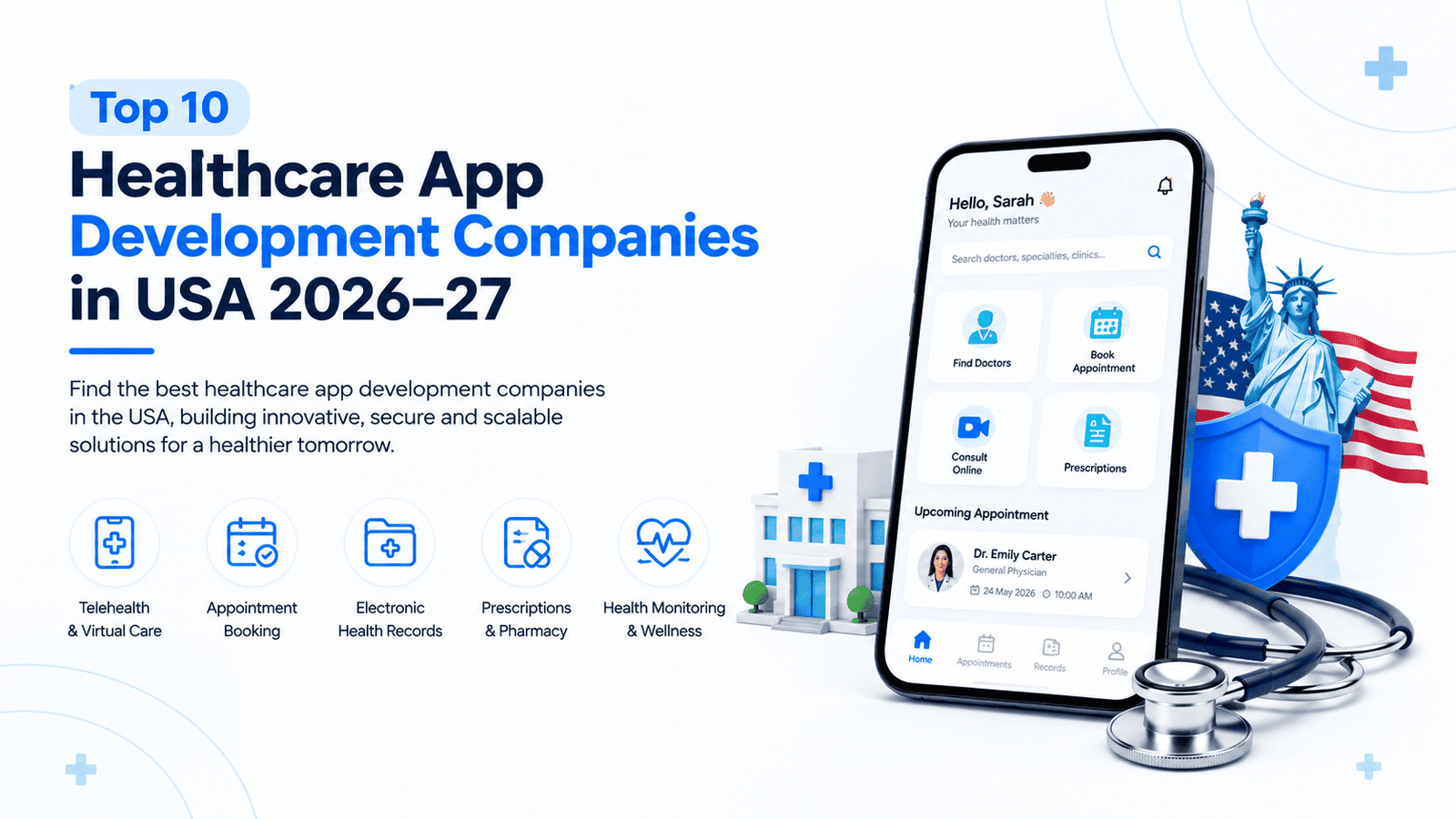
Healthcare is rapidly becoming a digital-first industry. Patients increasingly expect convenient access to doctors, appointments, medical records, prescriptions, health monitoring, and virtual care through mobile and web applications. At the same time, healthcare providers and businesses are adopting technology to improve workflows, automate repetitive tasks, connect systems, and deliver more personalized care.
However, developing a healthcare application is significantly more complex than developing a conventional consumer app. Healthcare products may handle protected health information (PHI), integrate with EHR/EMR systems, connect wearable devices, support telemedicine, and require strong security and privacy controls. Depending on the product’s functionality and intended use, additional regulatory considerations may also apply.
That makes the choice of development partner particularly important.
The best healthcare app development company should understand more than mobile or web development. It should be able to work with healthcare workflows, security requirements, integrations, interoperability standards, scalable architecture, and the specific needs of patients, providers, administrators, or healthcare businesses.
To help businesses make a more informed decision, we have compiled the top 10 healthcare app development companies in USA for 2026–27. The companies are compared based on healthcare expertise, technology capabilities, security and compliance experience, interoperability, product development capabilities, scalability, and overall project suitability.
Quick Comparison of the Top 10 Healthcare App Development Companies
| Rank | Company | Best For | Key Healthcare Capabilities |
| 1 | Webatlas Tech | Custom healthcare apps and digital health solutions | Telemedicine, patient portals, EHR/EMR, RPM, healthcare analytics |
| 2 | Runtime Logics | Healthcare startups and custom applications | Mobile apps, web apps, healthcare portals, custom software |
| 3 | Arkenea | HealthTech and complex healthcare software | EHR, FHIR, HL7, telemedicine, AI healthcare |
| 4 | Topflight Apps | Healthcare startups and AI-powered products | AI, healthcare apps, EHR, UX/UI, digital health |
| 5 | Glorium Technologies | mHealth and full-cycle healthcare software | Healthcare apps, mHealth, custom software |
| 6 | MindSea | Patient-centered digital health products | Mobile apps, wearables, research apps, digital health |
| 7 | ScienceSoft | Enterprise healthcare software | Healthcare IT, analytics, medical software, enterprise systems |
| 8 | Sidebench | Digital health products and product strategy | Healthcare platforms, UX, EHR/FHIR, data modernization |
| 9 | Cleveroad | Healthcare software and digital transformation | EHR/EMR, telemedicine, RPM, AI, healthcare software |
| 10 | Chop Dawg | Healthcare startups and custom apps | HIPAA-focused apps, EMR integration, mobile/web apps |
How We Selected These Healthcare App Development Companies
A top-10 list is more useful when readers understand how the companies were evaluated.
Rather than ranking companies only by search visibility or generic software development experience, this list focuses on factors that can directly influence the success of a healthcare application.
Our evaluation framework considers:
| Evaluation Criteria | Weight |
| Healthcare expertise and portfolio | 20% |
| HIPAA and healthcare security capabilities | 15% |
| EHR/EMR integration | 15% |
| HL7/FHIR interoperability | 10% |
| Mobile and web development | 10% |
| AI and emerging technologies | 10% |
| Scalability | 5% |
| Client reputation | 5% |
| Pricing/value | 5% |
| Post-launch support | 5% |
Healthcare expertise receives the highest weighting because developing a healthcare product requires a different understanding of workflows, data, privacy, integrations, and security compared with general-purpose software.
For example, a company may have extensive experience building eCommerce applications but still lack experience with PHI, EHR integrations, clinical workflows, healthcare interoperability, or remote patient monitoring.
The companies below should therefore be evaluated based on project fit, rather than assuming that the company ranked first is automatically the right choice for every healthcare project.
Top 10 Healthcare App Development Companies in USA 2026–27
1. Webatlas Tech
Webatlas Tech is a digital product engineering company providing custom healthcare apps, mobile applications, AI-powered solutions, and scalable digital platforms for healthcare businesses.
Company Overview
Webatlas Tech is a digital product engineering company offering custom healthcare app development services for startups, healthcare providers, and businesses looking to build secure, scalable, and user-friendly digital health solutions. Its healthcare development services include custom healthcare applications, telemedicine apps, patient portals, EHR/EMR integration, remote patient monitoring, healthcare analytics, and other digital health solutions.
The company develops solutions for different healthcare users, including patients, doctors, healthcare providers, administrators, and healthcare businesses. Its published healthcare app development capabilities include appointment management, video consultations, patient portals, EHR/EMR integration, remote care, wearable integration, analytics, cloud computing, and cybersecurity.
Webatlas Tech also brings expertise in AI, IoT, cloud technologies, mobile development, and custom software development. This allows healthcare businesses to build applications that can evolve beyond an initial MVP into larger digital platforms.
For businesses planning a healthcare product, Webatlas Tech can be considered for custom applications where functionality, scalability, integration, and user experience need to be designed around specific business requirements.
Additional Details
- Company Name – Webatlas Tech
- Website: www.webatlastech.com
- Company Size: 50–100 Employees
- Email: info@webatlas.tech
- Phone: +91 82880 72228
2. Runtime Logics
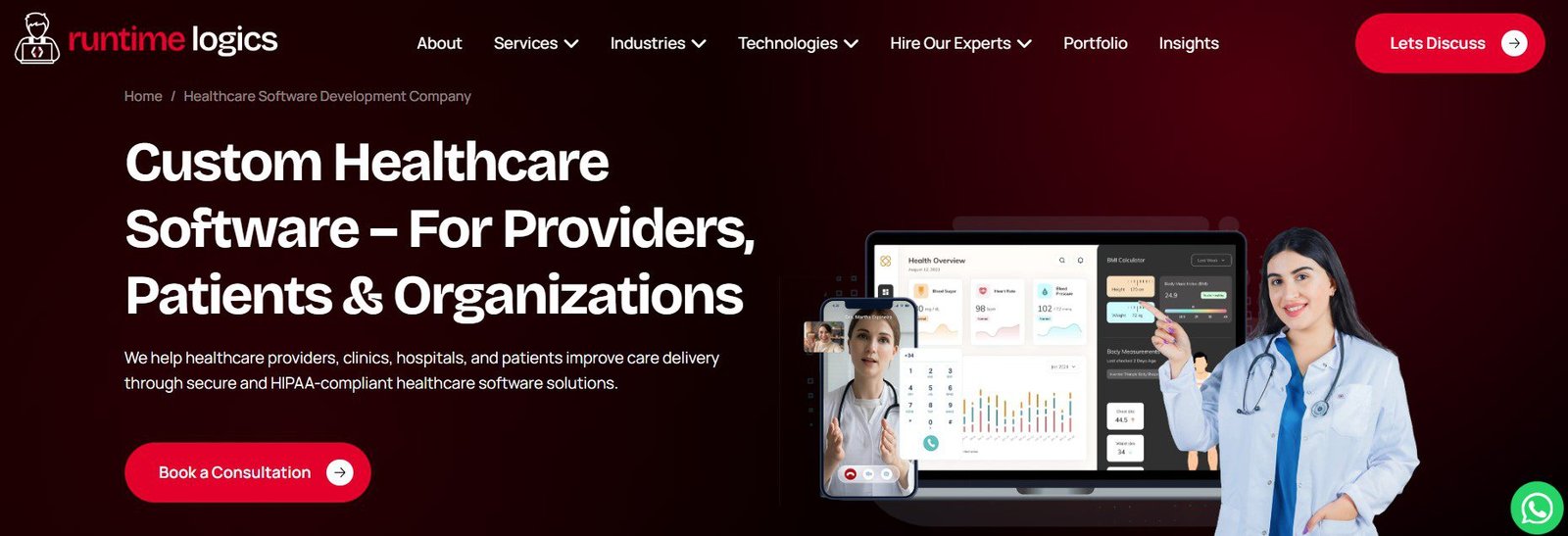
Runtime Logics is a software development company specializing in custom applications, web platforms, mobile apps, and digital solutions, with healthcare included among its target industries.
Company Overview
Runtime Logics provides custom software, mobile application, web application, and full-stack development services for businesses and startups. Its official website identifies healthcare as one of the industries it serves, with a focus on patient-centric portals and healthcare workflows.
The company’s healthcare-related mobile development capabilities include applications supporting areas such as remote patient monitoring, appointment booking, telemedicine, electronic medical records, and healthcare data management. Its broader technical capabilities include mobile development, web applications, APIs, backend systems, and cross-platform technologies.
Runtime Logics can be a suitable option for healthcare startups and businesses that require a custom digital product rather than an off-the-shelf application. Its development approach can support healthcare portals, mobile applications, custom software, and integrated digital solutions.
For highly specialized healthcare projects involving complex EHR interoperability, medical-device software, or specific regulatory requirements, businesses should verify the vendor’s relevant project experience and technical scope during the discovery phase.
Additional Details
- Company Name – Runtime Logics
- Website: www.runtimelogics.com
- Company Size: 10–50 Employees
- Email: info@runtimelogics.com
- Phone: +91 62 62 62 9320
3. Arkenea
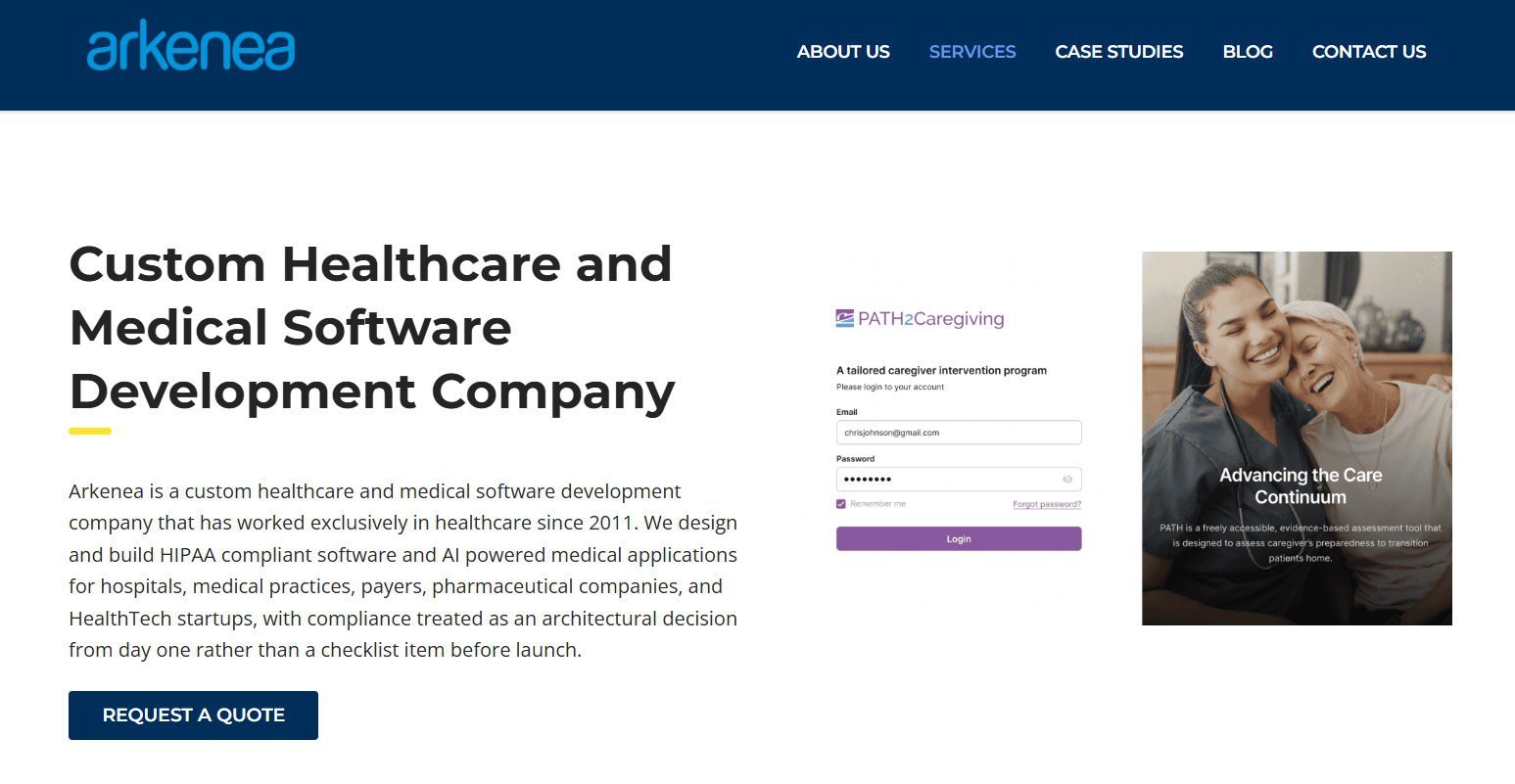
Arkenea is a healthcare-focused software development company specializing in custom healthcare applications, EHR systems, interoperability, telemedicine, and AI-powered healthcare software.
Company Overview
Arkenea has focused exclusively on healthcare software development since 2011 and works with HealthTech startups, medical practices, hospitals, pharmaceutical organizations, and other healthcare businesses. Its services cover custom healthcare software, mobile applications, EHR/EMR solutions, telemedicine, healthcare analytics, patient portals, and AI-powered healthcare products.
One of Arkenea’s notable strengths is its focus on healthcare interoperability. The company states that it works with healthcare standards such as HL7 and FHIR and integrates healthcare software with EHR systems and third-party healthcare APIs, including systems such as Epic, Oracle Cerner, and athenahealth.
Its healthcare portfolio also includes remote patient monitoring, healthcare CRM, pharmacy software, hospital operations software, and custom EHR development.
This specialization makes Arkenea particularly relevant for businesses building complex healthcare products where clinical workflows, healthcare data, interoperability, and compliance need to be considered from the beginning.
Additional Details
- Company Name: Arkenea
- Website: www.arkenea.com
- Company Size: 10–50 Employees
4. Topflight Apps
Topflight Apps is a healthcare and AI development company specializing in secure digital health applications, healthcare AI, EHR integrations, and patient-provider platforms.

Company Overview
Topflight Apps focuses heavily on healthcare technology and AI-powered digital products. Its healthcare development services cover strategy, UX/UI design, engineering, quality assurance, security, and ongoing optimization. The company positions its development approach around secure and scalable healthcare applications designed for patients, providers, and healthcare organizations.
Its published healthcare capabilities include AI-powered healthcare products, patient applications, provider applications, clinical workflows, remote monitoring, and EHR-connected solutions. The company also highlights HIPAA-aligned security practices, privacy-focused architecture, auditability, and least-privilege access.
Topflight Apps can be especially relevant for healthcare startups looking to integrate artificial intelligence into a digital health product. Its services also support organizations that have an early prototype and need to transform it into a more secure, scalable, and production-ready application.
Additional Details
- Company Name: Topflight Apps
- Website: www.topflightapps.com
- Company Size: 10–50 Employees
5. Glorium Technologies
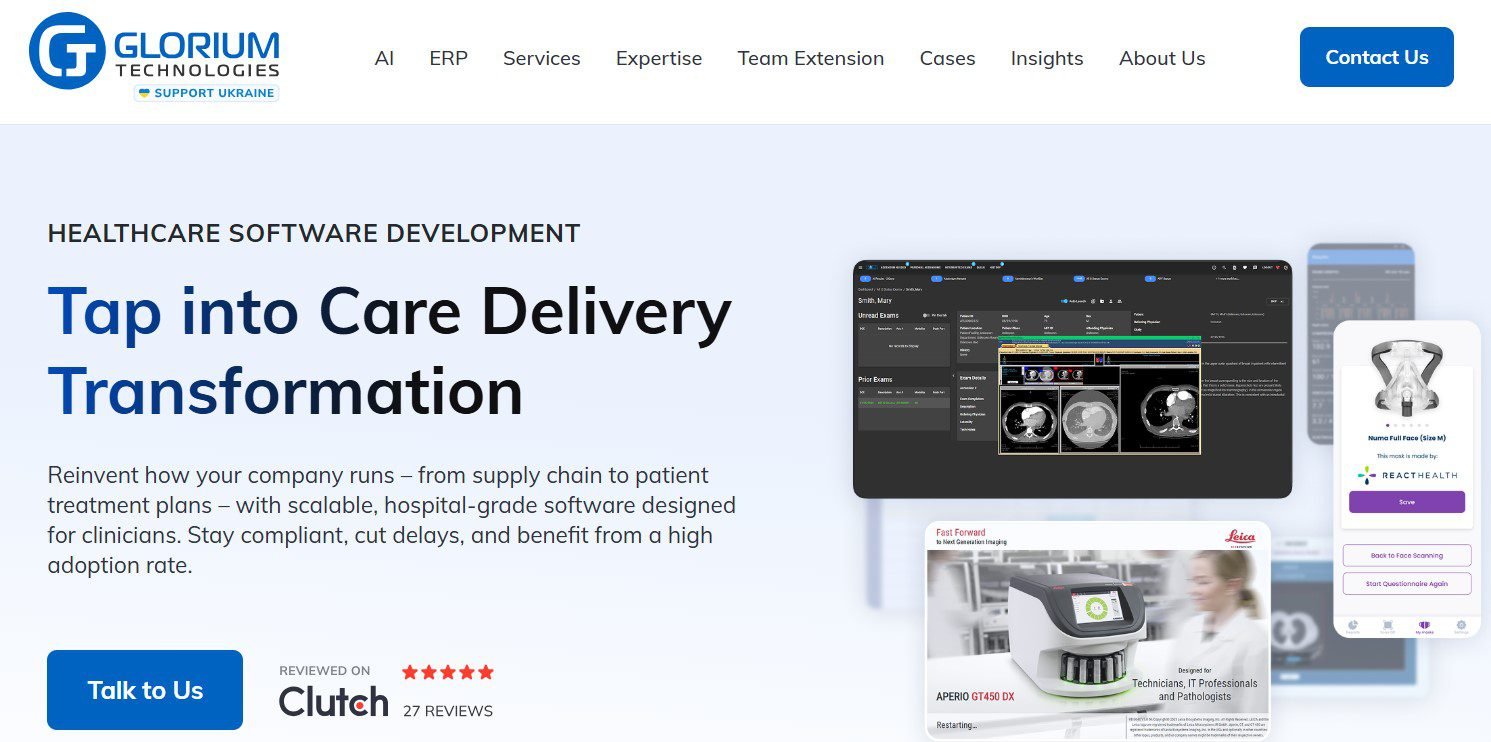
Glorium Technologies is a full-cycle software development company offering healthcare, mHealth, mobile, and custom software solutions for startups and established organizations.
Company Overview
Glorium Technologies provides full-cycle software development services covering product planning, design, development, and ongoing technology support. Its healthcare offering focuses on mobile health applications and digital healthcare solutions designed to improve patient access, streamline workflows, and support healthcare organizations.
The company has been operating since 2010 and states that it works with startups and businesses to develop technology solutions around specific business requirements. Its healthcare application capabilities can support mobile experiences, healthcare platforms, patient-focused solutions, and other custom digital products.
Glorium Technologies can be considered by healthcare organizations that need an end-to-end technology partner rather than a company focused solely on one development stage.
Additional Details
- Company Name: Glorium Technologies
- Website: www/gloriumtech.com
- Company Size: 200+ Employees
6. MindSea
MindSea is a digital health app development company specializing in patient-centered applications, healthcare research tools, wearable integrations, and clinician-facing digital products.
Company Overview
MindSea focuses on healthcare and digital health applications designed around real-world patient and clinical workflows. Its services include patient-facing applications, clinician tools, research applications, wearable-connected apps, and other digital health products.
The company’s approach places significant emphasis on understanding how patients and clinicians interact with technology before designing the product. Its digital health services include UX design, prototyping, application development, backend systems, integrations, and ongoing support.
MindSea also highlights experience with wearable and sensor-connected applications, including Bluetooth/BLE integrations and health data platforms. This makes it particularly relevant for products involving remote monitoring, research, wellness, or patient engagement.
Additional Details
- Company Name: MindSea
- Website: www.mindsea.com
- Company Size: 11–50 Employees
7. ScienceSoft
ScienceSoft is an established software development and IT consulting company offering healthcare software, analytics, medical applications, and enterprise healthcare technology solutions.
Company Overview
ScienceSoft provides healthcare software development services for organizations that need secure applications, data platforms, analytics solutions, and technology systems for healthcare operations. Its healthcare portfolio includes care management systems, patient applications, medical software, laboratory solutions, and software as a medical device (SaMD).
The company’s broader enterprise IT capabilities can be valuable for healthcare organizations working with complex technology environments. Large healthcare projects often require more than a mobile application and may involve data platforms, analytics, integrations, enterprise infrastructure, and security requirements.
ScienceSoft states that it has delivered more than 150 healthcare software projects and has 750+ IT specialists. It also highlights certifications including ISO 13485, ISO 27001, and ISO 9001.
This makes ScienceSoft particularly relevant for larger healthcare organizations and businesses working on complex healthcare software initiatives.
Additional Details
- Company Name: ScienceSoft
- Website: www.scnsoft.com
- Company Size: 900+ Employees
8. Sidebench
Sidebench is a California-based innovation and product development company providing custom healthcare solutions, digital health platforms, systems integration, and patient-focused digital experiences.
Company Overview
Sidebench works with healthcare payers, providers, startups, and enterprises to create custom technology solutions. Its healthcare services cover product strategy, innovation, systems integration, data modernization, and digital experience design.
The company highlights expertise in EHR integrations, FHIR APIs, Salesforce Health Cloud, data engineering, and HIPAA-compliant architecture. Its product design capabilities also focus on creating accessible and intuitive experiences for patients and healthcare providers.
Sidebench can be a good fit for healthcare businesses that need assistance across product strategy, design, engineering, and technology modernization. This can be especially useful for startups that need to validate an idea or established organizations that need to modernize existing healthcare systems.
Additional Details
- Company Name: Sidebench
- Website: www.sidebench.com
- Company Size: 11–50 Employees
9. Cleveroad
Cleveroad is a custom software development company offering healthcare software, EHR/EMR solutions, telemedicine platforms, remote patient monitoring, and AI-powered healthcare applications.
Company Overview
Cleveroad has more than 15 years of software development experience and provides custom healthcare software development services for healthcare institutions and businesses. Its healthcare portfolio includes EHR/EMR systems, patient portals, telemedicine solutions, remote patient monitoring, healthcare AI, and other digital health applications.
The company also highlights healthcare interoperability and regulatory expertise, including HIPAA, HL7, FHIR, DICOM, and other healthcare standards. Its published technology stack includes healthcare system integrations, telehealth and secure messaging platforms, payment and insurance systems, cloud technologies, mobile development, and backend technologies.
Cleveroad can be considered by businesses that need a full-cycle software development partner for healthcare applications, especially projects involving multiple integrations, AI, telemedicine, or patient monitoring.
Additional Details
- Company Name: Cleveroad
- Website: www.cleveroad.com
- Company Size: 201–500 Employees
10. Chop Dawg
Chop Dawg is a US-based app development company offering custom mobile and web applications, including healthcare applications designed around healthcare data security and EMR integration.
Company Overview
Chop Dawg provides custom mobile and web application development services and has a dedicated healthcare offering. The company states that it develops healthcare applications designed to meet HIPAA requirements and securely manage patient data while integrating with electronic medical record systems.
Its healthcare development approach is relevant for both patient-facing applications and internal healthcare systems. This can include applications designed to improve care delivery, streamline operations, manage patient information, and connect with existing healthcare systems.
Chop Dawg can be considered by startups and organizations looking for an end-to-end product development partner. Businesses working on highly specialized medical-device software or complex enterprise interoperability should still verify the vendor’s experience with their exact regulatory and technical requirements.
Additional Details
- Company Name: Chop Dawg
- Website: www.chopdawg.com
- Company Size: 50–100 Employees
Which Healthcare App Development Company Is Best for Your Project?
The highest-ranked company isn’t necessarily the best option for every healthcare application. A telemedicine startup, hospital, pharmaceutical company, and remote patient monitoring provider can have completely different technical requirements.
Use the following framework when comparing vendors:
| Healthcare Project | What to Prioritize |
| Healthcare MVP | Product discovery, MVP development, scalability |
| Telemedicine app | Video, scheduling, secure messaging, provider workflows |
| Patient app | UX, accessibility, engagement, security |
| Hospital application | Enterprise architecture and integrations |
| AI healthcare app | AI/ML, data architecture, security, validation |
| RPM application | Wearables, IoT, real-time data and alerts |
| EHR-connected app | EHR APIs, HL7/FHIR, interoperability |
| Pharmacy app | Prescription, inventory, payments, delivery |
| Healthcare SaaS | Multi-tenant architecture and scalability |
| Enterprise healthcare platform | Security, integrations, data management, support |
The key is to match the development company’s specific capabilities with the application’s requirements.
What Types of Healthcare Apps Can These Companies Build?
Healthcare app development covers a wide range of products. The required technology stack, security architecture, integrations, and development effort can vary considerably depending on the application type.
Telemedicine Apps
Telemedicine applications connect patients with healthcare professionals through video, audio, secure messaging, appointment scheduling, and virtual consultations.
Patient Engagement Apps
Patient applications can provide appointment management, health records, reminders, secure communication, care plans, health education, and other engagement features.
Doctor and Provider Apps
Provider-facing applications can support scheduling, patient information, secure communication, documentation, clinical workflows, and care coordination.
Remote Patient Monitoring Apps
RPM applications collect information from connected devices or wearables and can provide dashboards, alerts, trends, and monitoring workflows for patients and healthcare professionals.
Pharmacy and Medicine Delivery Apps
These applications can support prescription management, medicine ordering, inventory, payments, delivery tracking, pharmacist communication, and medication reminders.
Chronic Disease Management Apps
These platforms can help patients monitor conditions, follow care plans, record health information, receive reminders, and communicate with healthcare teams.
Healthcare Marketplace Apps
Healthcare marketplaces can connect patients with physicians, specialists, clinics, pharmacies, laboratories, and other healthcare service providers.
AI Healthcare Apps
AI can be used for healthcare analytics, documentation, patient engagement, clinical decision support, personalization, predictive models, and workflow automation. However, AI functionality needs to be evaluated carefully for privacy, data quality, validation, security, and applicable regulatory requirements.
Healthcare App Development Cost in the USA in 2026–27
The cost of developing a healthcare application depends heavily on its complexity. A basic healthcare MVP may cost tens of thousands of dollars, while an enterprise platform with EHR integrations, AI, remote monitoring, and advanced security can require several hundred thousand dollars.
Estimated Healthcare App Development Cost
| App Type | Estimated Cost |
| Basic Healthcare App | $40,000–$100,000+ |
| Patient/Doctor App | $50,000–$120,000+ |
| Telemedicine App | $80,000–$250,000+ |
| Remote Patient Monitoring App | $80,000–$250,000+ |
| EHR-Integrated App | $100,000–$300,000+ |
| AI Healthcare App | $120,000–$400,000+ |
| Enterprise Healthcare Platform | $200,000–$500,000+ |
These are planning ranges, not fixed quotations. The actual cost depends on the features, number of platforms, development team, integrations, security requirements, testing, infrastructure, and post-launch support.
Major Factors That Affect Cost
- Number of user roles
- UI/UX complexity
- iOS and Android development
- Backend architecture
- EHR/EMR integration
- HL7/FHIR interoperability
- Telemedicine and video
- AI/ML functionality
- Wearable integration
- Payment integration
- Third-party APIs
- Cloud infrastructure
- Security testing
- Data migration
- Maintenance and support
Internal resource: For a deeper discussion of healthcare application costs, link this section to your dedicated healthcare app development cost article once that page is published.
Healthcare App Compliance: What Goes Beyond HIPAA?
HIPAA is one of the most frequently discussed topics in healthcare application development, but healthcare security should not be reduced to simply adding a “HIPAA compliant” label to a product.
The HIPAA Security Rule establishes administrative, physical, and technical safeguards for electronic protected health information for covered entities and business associates.
For a healthcare application, businesses should consider areas such as:
Protected Health Information
The architecture needs to account for how PHI is collected, stored, transmitted, accessed, and managed.
Encryption
Sensitive healthcare information should be appropriately protected during transmission and storage.
Authentication
Healthcare applications may require secure authentication mechanisms to prevent unauthorized access.
Role-Based Access
Patients, doctors, nurses, administrators, and other users may require different levels of access.
Audit Logging
Important data access and system activity should be logged to support monitoring and security investigations.
Secure APIs
Third-party APIs and healthcare integrations can introduce additional security risks and should be assessed carefully.
Business Associates
When applicable, organizations should understand how vendors and service providers handle PHI and whether appropriate contractual arrangements are required.
Regulatory Scope
Healthcare applications can have different regulatory obligations depending on what the application actually does.
For example, the FDA’s current digital-health guidance makes clear that regulatory oversight is function-specific. Certain software functions may fall under medical-device regulation while other health and wellness functions may not.
Therefore, businesses should determine the regulatory scope of their particular product instead of assuming that every healthcare app has the same requirements.
EHR, EMR, HL7 & FHIR Integration: What Should You Look For?
Healthcare applications frequently need to communicate with existing healthcare systems. This is where interoperability becomes important.
EHR vs. EMR
An Electronic Medical Record (EMR) generally represents a patient’s digital medical information within a healthcare practice or organization.
An Electronic Health Record (EHR) is designed to support a broader view of patient information and exchange across healthcare settings.
What Is HL7?
HL7 refers to a family of healthcare information-exchange standards used to support communication between healthcare systems.
What Is FHIR?
FHIR, or Fast Healthcare Interoperability Resources, is an API-focused standard created by HL7 for representing and exchanging healthcare information. The Office of the National Coordinator for Health IT describes FHIR as a widely used standard for exchanging clinical and administrative health information through modern APIs.
Why FHIR Matters for Healthcare Apps
Suppose you are developing a patient application that needs to retrieve information from an EHR. The development team may need to determine:
- Which EHR system is being used
- Which APIs are available
- What data needs to be exchanged
- Whether the integration is one-way or bidirectional
- How authentication works
- How patient identity is matched
- Which FHIR resources are required
- How errors and unavailable data are handled
- How access is logged
- How synchronization works
FHIR can provide a standardized framework, but integration is not automatically simple just because an EHR supports FHIR. Implementation guides, profiles, authentication, data mappings, permissions, and specific vendor capabilities still need to be considered.
When evaluating a healthcare app development company, ask for specific examples of EHR/EMR integrations and interoperability projects rather than accepting a generic claim of healthcare experience.
The Hidden Costs of Building a Healthcare App
The initial development quotation is not the same as the total cost of owning a healthcare application.
Businesses should also consider the following ongoing or project-related costs.
Cloud Infrastructure
Hosting, databases, storage, backups, monitoring, logging, and scaling can create recurring expenses.
Third-Party APIs
Communication, video, payment, healthcare, analytics, identity, and other APIs may involve usage-based or subscription fees.
Security Testing
Penetration testing, vulnerability assessments, security reviews, and remediation can increase project costs.
EHR Integration
EHR integration may require additional development, testing, vendor coordination, authentication, and data mapping.
Communication
SMS, email, push notifications, video consultations, and secure messaging can introduce recurring operational expenses.
Data Migration
If a healthcare organization is replacing an existing system, migrating and validating historical data can become a significant project.
Maintenance
Healthcare applications require ongoing maintenance, including:
- Bug fixes
- Security updates
- OS updates
- Dependency updates
- Performance optimization
- Infrastructure management
- New feature development
Compliance and Security Updates
Security and compliance should be treated as ongoing responsibilities rather than a one-time development activity.
This is why businesses should compare total cost of ownership, not simply choose the development company offering the lowest initial quotation.
10 Red Flags When Hiring a Healthcare App Development Company
Choosing the wrong healthcare development company can create technical, financial, and operational problems.
Watch for these warning signs:
1. No Relevant Healthcare Portfolio
If a company only shows generic apps but claims extensive healthcare experience, ask for specific healthcare examples.
2. Vague HIPAA Claims
Ask exactly how the company approaches security, access controls, encryption, logging, infrastructure, and PHI.
3. No EHR/FHIR Experience
If your application requires healthcare interoperability, verify actual EHR and FHIR experience.
4. Unrealistically Low Pricing
A low quotation may exclude testing, security, integrations, infrastructure, or post-launch maintenance.
5. No Security Testing Strategy
Healthcare applications should include security considerations throughout the development lifecycle.
6. Unclear Source-Code Ownership
The agreement should clearly define intellectual property, source code, repositories, documentation, and third-party licenses.
7. No Post-Launch Support
Ask who will handle security updates, bug fixes, monitoring, maintenance, and future development.
8. No Change-Management Process
Healthcare projects can grow quickly when requirements change. A formal process helps control scope and budget.
9. Promises of Guaranteed Regulatory Approval
Be cautious if a vendor guarantees FDA approval without first evaluating your application’s intended use and regulatory classification.
10. Treating Healthcare Like a Normal Consumer App
Healthcare products require additional attention to privacy, accessibility, security, interoperability, and healthcare workflows.
How to Choose the Right Healthcare App Development Company
Choosing a healthcare app development partner should be a structured process rather than a simple comparison of hourly rates.
Step 1: Define Your Healthcare Product
Clearly identify the problem your application will solve and what makes the product different.
Step 2: Identify Your Users
Determine whether the application will be used by:
- Patients
- Doctors
- Nurses
- Hospitals
- Clinics
- Administrators
- Pharmacists
- Insurance companies
- Caregivers
Step 3: Identify Your Data Requirements
Determine what healthcare information your application will collect, store, display, or transmit.
Step 4: Map Required Integrations
List the systems that the application needs to connect with, including:
- EHR/EMR
- Payment gateways
- Wearables
- Medical devices
- Pharmacy systems
- Insurance systems
- Communication platforms
- Analytics tools
Step 5: Evaluate Healthcare Experience
Don’t rely only on a general software portfolio. Look for experience with projects similar to yours.
Step 6: Review Security Practices
Ask how the company approaches:
- Authentication
- Authorization
- Encryption
- Audit logs
- Secure APIs
- Infrastructure
- Security testing
- Data protection
Step 7: Compare Development Estimates
Don’t compare only the final price.
Check what is included in each proposal and identify exclusions.
Step 8: Clarify Ownership
Before signing a contract, confirm:
- Source-code ownership
- Intellectual property
- Repository access
- Documentation
- Third-party licenses
- Deployment ownership
Step 9: Evaluate Post-Launch Support
Healthcare software needs continuous updates and maintenance. Ask about support plans, response times, security updates, and future development.
Step 10: Start With Discovery
A structured discovery phase can identify technical risks, integrations, compliance considerations, user workflows, and MVP priorities before significant development investment begins.
The right healthcare app development company should not simply say “we can build your app.”
It should be able to explain how the application should be built, what risks exist, what integrations are required, how security will be handled, and how the product can scale after launch.
Frequently Asked Questions
- What is the best healthcare app development company in the USA?
There is no single best company for every healthcare project. The right development partner depends on the type of application, healthcare workflows, integrations, security requirements, budget, scalability, and target users.
- How much does it cost to develop a healthcare app in the USA?
A healthcare app can cost approximately $40,000 to $500,000+, depending on its complexity. EHR integrations, AI, telemedicine, remote monitoring, security requirements, and multiple platforms can significantly increase the overall development cost.
- How long does it take to develop a healthcare app?
A relatively simple healthcare MVP may take around 3–5 months, while complex telemedicine, EHR-integrated, AI, or enterprise applications may take 6–12 months or longer.
- Does every healthcare app need to be HIPAA compliant?
Not every health-related application has identical regulatory obligations. HIPAA applicability depends on factors such as the organizations involved and how protected health information is handled. Businesses should evaluate the requirements of their specific product.
- How much does EHR integration cost?
EHR integration costs vary depending on the EHR platform, APIs, data requirements, number of workflows, authentication, testing, and whether the integration is one-way or bidirectional.
- What is the difference between HL7 and FHIR?
HL7 refers to a broader family of healthcare information standards, while FHIR is a modern interoperability standard designed around standardized resources and API-based data exchange. FHIR is widely used for modern healthcare interoperability.
- Can startups build a HIPAA-compliant healthcare MVP?
Yes. Startups can build healthcare MVPs with appropriate privacy and security considerations. However, security and compliance should be considered during architecture and product planning rather than added after development.
- What should I ask a healthcare app development company before hiring them?
Ask about healthcare case studies, EHR/FHIR experience, security architecture, PHI handling, testing, source-code ownership, development methodology, pricing assumptions, maintenance, and post-launch support.
- Do healthcare apps require FDA approval?
Not necessarily. FDA requirements depend on the application’s functionality, intended use, claims, and whether the software meets the applicable definition of a medical device. The FDA uses a risk-based, function-specific approach to software oversight.
- How do I choose the right healthcare app development company?
Start by defining your product, users, data, integrations, and compliance requirements. Then compare companies based on healthcare experience, technical capabilities, security practices, relevant case studies, pricing transparency, communication, and post-launch support.
Final Verdict
The healthcare app development market in the USA offers many potential technology partners, but choosing the right company requires more than looking at a list of rankings.
The right development partner depends on your specific application. A healthcare startup building a patient engagement MVP may prioritize rapid product development and UX, while a hospital may need enterprise architecture, EHR integration, interoperability, security, and long-term support.
Companies such as Webatlas Tech and Runtime Logics can be considered for custom healthcare applications and digital products, while healthcare-focused specialists such as Arkenea and Topflight Apps may be particularly relevant for projects requiring deeper HealthTech expertise. Larger and more complex initiatives may benefit from providers such as ScienceSoft, Cleveroad, or Sidebench.
Before making a final decision, evaluate each company against your healthcare requirements, technical integrations, security expectations, development budget, scalability needs, and post-launch support.
Most importantly, don’t choose a healthcare app development company solely because it offers the lowest quote. Choose the partner that can demonstrate a clear understanding of your healthcare workflow and can build a secure, scalable product that continues to work as your business grows.