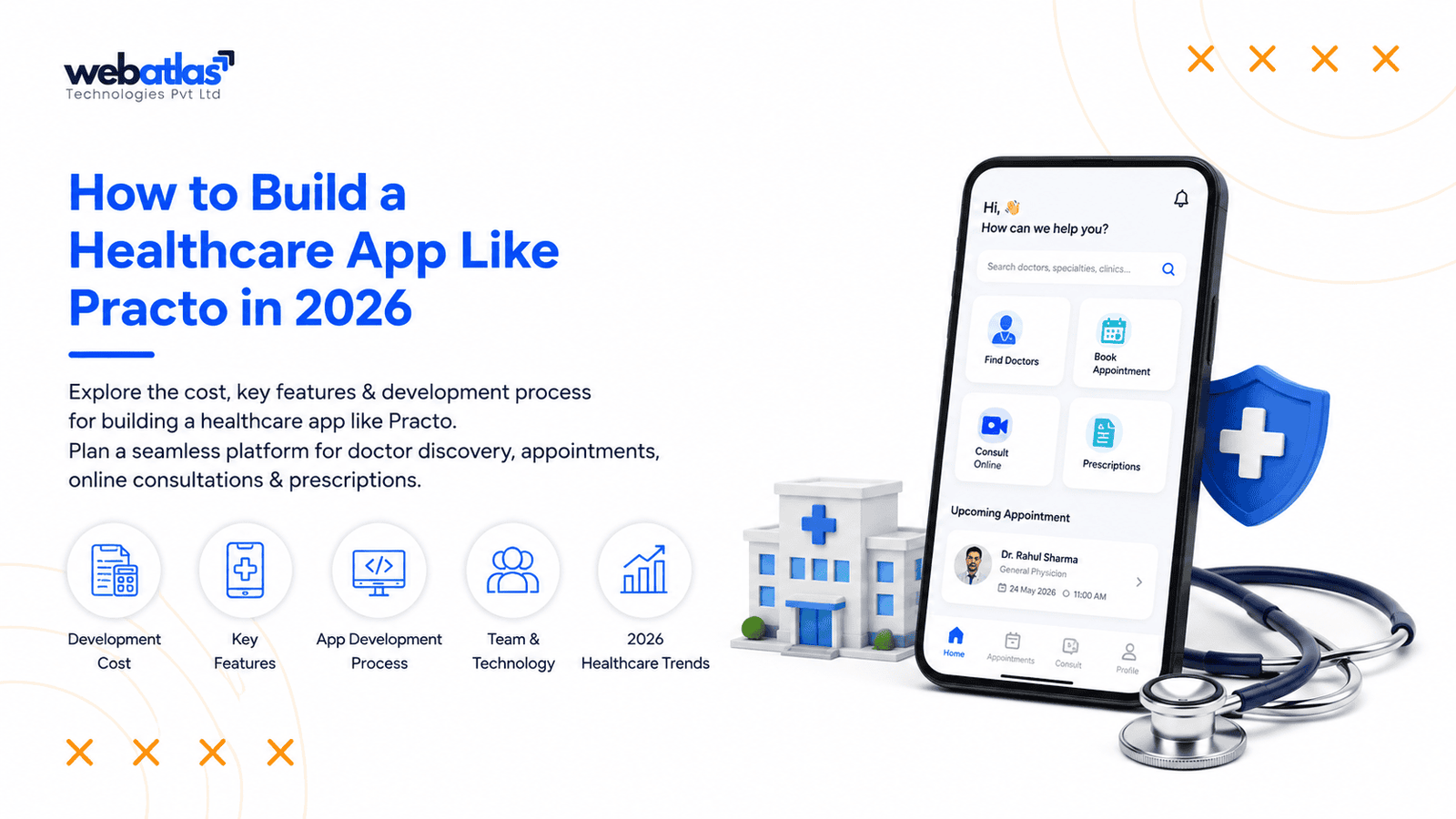
Healthcare is rapidly moving toward connected digital experiences. Patients now expect to find doctors, compare providers, check availability, book appointments, consult remotely, receive prescriptions, and manage follow-ups through a single digital platform.
Practo is a well-known example of this healthcare marketplace approach. However, building an app like Practo in 2026 does not mean copying every feature of the existing platform. A successful healthcare application needs to solve a specific patient or provider problem while supporting secure data management, appointment scheduling, healthcare integrations, compliance, and long-term scalability.
Building a healthcare app like Practo typically involves market research, healthcare UX design, patient and doctor features, appointment management, secure payments, healthcare integrations, compliance, testing, deployment, and ongoing maintenance. Depending on the scope, development can range from a focused MVP to a complete healthcare ecosystem with telemedicine, AI, EHR integrations, pharmacy, and diagnostic services.
This guide explains how to build a Practo-inspired healthcare app, what features it should include, how much development can cost in 2026, what technology and integrations are required, and how to launch and scale the platform.
Key Takeaways
- A Practo-like app is more than a doctor-booking application; it can connect patients, doctors, clinics, laboratories, pharmacies, and healthcare services.
- A focused MVP is usually more practical than attempting to reproduce the entire Practo ecosystem.
- Real-time doctor availability and appointment synchronization can be major technical challenges.
- EHR/EMR, FHIR, payment, video consultation, laboratory, and pharmacy integrations can significantly affect development complexity.
- AI can improve provider matching, scheduling, patient engagement, documentation, and administrative workflows.
- A basic healthcare app MVP can cost considerably less than a full-scale healthcare ecosystem.
- Security, privacy, and compliance requirements should be considered during architecture and product planning rather than added immediately before launch.
What Is a Practo-Like Healthcare App and How Does It Work?
A Practo-like application is best understood as a multi-sided healthcare marketplace, rather than simply a doctor appointment app.
The platform can connect:
Patients → Doctors → Clinics/Hospitals → Laboratories → Pharmacies → Platform Administration
A patient may use the application to search for a specialist, compare profiles, check availability, book an appointment, pay online, attend a virtual consultation, receive a prescription, and manage follow-ups.
Doctors require a different workflow. They may need to create and verify their professional profile, manage availability, accept appointments, conduct consultations, access relevant patient information, issue digital prescriptions, and track their earnings.
The administration layer manages provider verification, users, appointments, payments, subscriptions, reviews, disputes, content, analytics, notifications, and platform security.
This means a Practo-like product is essentially a combination of:
- Healthcare marketplace
- Appointment management system
- Telemedicine platform
- Provider management platform
- Patient engagement system
- Healthcare data and integration layer
For businesses planning this type of product, Healthcare App Development can involve everything from telemedicine and patient portals to EHR/EMR integration and healthcare analytics.
A typical patient journey
Search → Compare → Check availability → Select slot → Book → Pay → Consult → Receive prescription → Follow up
The provider journey is different:
Register → Verify → Create profile → Set availability → Accept booking → Consult → Update records → Manage follow-up
Understanding these workflows before development begins is critical because every additional participant introduces new permissions, data flows, notifications, integrations, and business rules.
Quick Answer: How Much Does It Cost to Build an App Like Practo?
In 2026, a healthcare app like Practo can cost approximately $40,000 to $300,000+ depending on its scope. A focused MVP may fall around $40,000–$70,000, while a sophisticated healthcare ecosystem with telemedicine, AI, EHR integrations, pharmacy, diagnostics, and enterprise-level infrastructure can exceed $200,000.
| Development Level | Estimated Cost | Typical Timeline |
| Basic MVP | $40,000–$70,000 | 3–5 months |
| Standard Platform | $80,000–$130,000 | 5–8 months |
| Advanced Platform | $130,000–$200,000 | 8–12 months |
| Enterprise Ecosystem | $200,000–$300,000+ | 12+ months |
These figures are planning ranges rather than fixed quotations. The final cost depends on the number of platforms, features, integrations, security requirements, AI capabilities, development location, testing requirements, and post-launch support.
What increases the cost?
The biggest cost drivers include:
- Number of user roles
- iOS and Android development
- UI/UX complexity
- Appointment scheduling architecture
- Video consultation
- Payment integration
- EHR/EMR integration
- Healthcare interoperability
- AI functionality
- Security and compliance
- Testing
- Cloud infrastructure
- Third-party API costs
- Maintenance and support
Therefore, instead of asking only “How much does a Practo clone cost?”, businesses should first define the exact version of the healthcare platform they want to build.
Practo Clone vs. Practo-Inspired Healthcare Platform: What Should You Build?
One of the biggest mistakes a healthcare startup can make is trying to reproduce an established platform feature by feature.
The better approach is to build a Practo-inspired platform around a specific healthcare problem, audience, geography, or specialty.
For example, a startup could focus on:
- Dermatology appointments
- Mental healthcare
- Women’s healthcare
- Pediatric consultations
- Chronic disease management
- Telemedicine
- Local clinic discovery
- Diagnostic booking
- Pharmacy and prescription management
- Corporate healthcare services
Which approach is right?
| Approach | Best For | Complexity |
| Basic appointment marketplace | Validating a new idea | Low–Medium |
| Niche healthcare platform | Specialized healthcare businesses | Medium |
| Practo-inspired marketplace | Growing healthcare startups | Medium–High |
| Full healthcare ecosystem | Large healthcare organizations | High |
A focused platform can reach the market faster because development resources are concentrated on the most important workflow.
For example, an MVP could initially support:
Patient registration → Doctor discovery → Availability → Appointment booking → Payment → Notifications
Telemedicine, EHR integrations, AI, pharmacy, laboratory booking, and advanced analytics can then be introduced in later phases.
This approach reduces initial development risk while giving the business real user feedback before making larger investments.
How Does a Practo-Like App Make Money?
A healthcare marketplace should define its monetization strategy before development begins.
Possible revenue models include:
Appointment Commission
The platform earns a percentage or fixed fee from completed appointments.
Doctor or Clinic Subscription
Healthcare providers pay monthly or annual fees for premium features such as enhanced profiles, analytics, appointment management, communication tools, or marketing capabilities.
Featured Listings
Doctors and clinics can pay for increased visibility in relevant searches.
Teleconsultation Fees
The platform can retain a service fee from online consultations.
Laboratory Partnerships
The platform can earn commissions from diagnostic bookings.
Pharmacy Revenue
Medicine orders can create additional transaction or partnership revenue where legally and operationally appropriate.
SaaS Revenue
Clinic-management capabilities can be offered as a recurring software service.
This creates an interesting opportunity: the consumer side can generate appointment demand while the provider side can generate recurring SaaS revenue.
Businesses that want to turn healthcare management functionality into a subscription platform can explore SaaS Application Development.
A phased monetization model
Rather than activating every revenue stream immediately:
Phase 1: Appointment commissions
Phase 2: Premium provider subscriptions
Phase 3: Teleconsultation
Phase 4: Laboratory and pharmacy partnerships
Phase 5: Provider SaaS and advanced services
The right model depends on the target market, healthcare regulations, provider economics, and user behavior.
Essential Features of a Practo-Like Healthcare App
A scalable healthcare marketplace generally needs multiple interfaces instead of a single application.
Patient App
Essential patient features can include:
- Registration and login
- Doctor search
- Specialty filters
- Location filters
- Doctor profiles
- Availability calendar
- Appointment booking
- Online payments
- Appointment reminders
- Video consultation
- Secure messaging
- Digital prescriptions
- Medical records
- Reviews and ratings
- Follow-up reminders
- Notifications
- Customer support
The search experience deserves special attention.
Patients should be able to discover providers using combinations such as:
Specialty + Location + Availability + Consultation Type + Experience + Language + Rating
Doctor App or Provider Panel
Doctors may need:
- Registration and verification
- Professional profile
- Availability management
- Appointment calendar
- Patient information
- Consultation management
- Video/audio consultation
- Digital prescriptions
- Secure messaging
- Earnings dashboard
- Cancellation management
- Appointment history
- Notifications
- Analytics
Clinic/Hospital Panel
For multi-provider organizations:
- Multiple doctor management
- Clinic schedule
- Appointment management
- Staff roles
- Patient management
- Billing
- Reports
- Provider availability
Admin Panel
The platform administrator may manage:
- Patients
- Doctors
- Clinics
- Verification
- Appointments
- Payments
- Subscriptions
- Reviews
- Content
- Reports
- Disputes
- Notifications
- Security logs
- Analytics
A major difference between a basic booking application and a healthcare marketplace is the depth of its provider-side workflows.
Feature Prioritization: What Should Be in the MVP?
One of the easiest ways to increase healthcare app development cost is to build every possible feature before validating the business.
A better strategy is to divide functionality into stages.
| Feature | MVP | Phase 2 | Advanced |
| Patient registration | ✓ | ||
| Doctor search | ✓ | ||
| Provider profiles | ✓ | ||
| Availability | ✓ | ||
| Appointment booking | ✓ | ||
| Payments | ✓ | ||
| Notifications | ✓ | ||
| Reviews | ✓ | ||
| Video consultation | ✓ | ||
| Digital prescriptions | ✓ | ||
| Medical records | ✓ | ||
| EHR/EMR integration | ✓ | ||
| Laboratory integration | ✓ | ||
| Pharmacy | ✓ | ||
| AI provider matching | ✓ | ||
| Predictive analytics | ✓ | ||
| Wearable integrations | ✓ | ||
| Advanced personalization | ✓ |
A practical MVP rule
Your MVP should answer one question:
Can patients successfully find and book the right healthcare provider while providers can reliably manage those appointments?
If the answer is yes, you have validated the core marketplace workflow.
You can then invest in advanced functionality based on actual user demand.
Advanced Features That Can Make Your App Better Than a Practo Clone
Matching a competitor’s feature list is not a differentiation strategy.
The better question is:
What healthcare friction can your platform remove more effectively?
Smart Provider Matching
Instead of presenting hundreds of providers, the platform can rank relevant doctors based on:
- Specialty
- Location
- Availability
- Consultation type
- Language
- Patient preferences
- Previous interactions
Intelligent Scheduling
The platform can recommend appropriate slots based on provider schedules and patient preferences.
No-Show Reduction
Automated reminders can help reduce missed appointments.
Digital Follow-Up
After consultations, patients can receive reminders for:
- Follow-up appointments
- Prescription refills
- Tests
- Health checks
Multilingual Experiences
Supporting multiple languages can improve accessibility in geographically diverse markets.
Accessibility-First Design
Healthcare applications should consider users with visual, hearing, motor, and cognitive accessibility needs.
Personalized Healthcare Journeys
Instead of treating every patient interaction as an isolated appointment, the application can connect:
Discovery → Consultation → Prescription → Follow-up → Future appointment
This creates a stronger long-term patient relationship.
For businesses with specialized healthcare workflows that cannot be handled by a generic template, Custom Software Development can provide greater flexibility for custom workflows, integrations, and scalable business logic.
The 5-Layer Architecture of a Practo-Like Healthcare App
A useful way to understand a healthcare marketplace is to divide the product into five connected layers.
Layer 1: Discovery
Doctor search → Filters → Profiles → Reviews → Availability
This is where patients find the right provider.
Layer 2: Booking
Available slot → Temporary lock → Payment → Confirmation → Calendar update
This layer manages the actual transaction.
Layer 3: Consultation
Chat → Video → Prescription → Follow-up
This extends the platform beyond simple appointment booking.
Layer 4: Healthcare Data
EHR → EMR → FHIR → Laboratory → Pharmacy
This layer allows healthcare information to move between appropriate systems.
Layer 5: Intelligence
AI matching → Smart scheduling → Personalization → Analytics
This layer can improve efficiency and user experience as the platform matures.
This five-layer model is useful because it demonstrates why a Practo-like application is more complex than a typical appointment-booking app.
Real-Time Appointment Booking: The Hidden Technical Challenge
Displaying a doctor’s available time is relatively straightforward.
Keeping that availability accurate when multiple patients are booking simultaneously is much more difficult.
Consider a doctor with one available appointment at 5:00 PM.
Two patients select the same slot within seconds.
Without proper booking logic, both users could potentially proceed as if they had secured the appointment.
A robust workflow can be:
Available Slot → Temporary Lock → Payment/Confirmation → Appointment Creation → Calendar Update → Notification
The temporary lock prevents another user from claiming the same slot during the booking process.
The system should also account for:
- Payment failure
- Booking expiration
- User abandonment
- Cancellation
- Rescheduling
- Doctor cancellation
- Time-zone differences
- Recurring availability
- Clinic holidays
- Emergency schedule changes
Why this matters
A healthcare marketplace cannot afford unreliable appointment information.
If a patient books a slot that is actually unavailable, the result can be:
Poor user experience → provider dissatisfaction → cancellations → loss of trust
Calendar synchronization
If doctors already use external scheduling or healthcare systems, the platform may need to synchronize appointments and availability.
This is where EHR/EMR integrations can add significant technical complexity.
Healthcare Integrations, Security & Compliance
A healthcare app rarely operates in isolation.
Depending on its business model and target market, it may integrate with:
- EHR systems
- EMR platforms
- Laboratory systems
- Pharmacy systems
- Payment gateways
- Video consultation APIs
- Insurance systems
- Wearables
- Notification services
- Identity verification services
- Calendar platforms
HL7 and FHIR
Healthcare interoperability standards such as HL7 and FHIR can support structured exchange of health information between compatible systems.
The exact implementation depends on the healthcare systems being connected, available APIs, the market, and the type of information being exchanged.
Security requirements
Healthcare applications should consider:
- Encryption in transit and at rest
- Role-based access control
- Multi-factor authentication
- Secure API authentication
- Audit logs
- Access monitoring
- Backup and disaster recovery
- Data retention
- Consent management
- Vulnerability testing
HIPAA and other regulations
For applications operating in the United States, HIPAA may apply depending on the organization’s role, data flows, and relationships with covered entities or business associates.
Other markets may have different privacy and healthcare requirements.
The important point is that compliance should influence architecture from the beginning.
It should not become a checklist added just before launch.
AI Features for a Modern Practo-Like Healthcare App
AI can create meaningful value in healthcare applications, but adding an AI chatbot simply because it is popular is not enough.
AI opportunities can be divided into three categories.
Patient-Facing AI
Potential use cases include:
- Healthcare navigation
- Appointment assistance
- Provider discovery
- Patient FAQs
- Personalized reminders
- Pre-consultation information collection
Provider-Facing AI
AI can assist with:
- Consultation note summarization
- Medical-document organization
- Patient-history summaries
- Administrative documentation
- Follow-up reminders
Platform-Level AI
AI can support:
- No-show prediction
- Appointment optimization
- Demand forecasting
- Support automation
- Provider matching
- Search personalization
- Unusual activity detection
AI should not replace clinical judgment
A healthcare platform should distinguish between administrative AI and clinical decision-making AI.
Administrative automation can often be implemented with lower clinical risk.
Clinical use cases may require additional validation, governance, safety controls, monitoring, and regulatory assessment.
Businesses looking to integrate intelligent capabilities into their healthcare platform can explore AI Development as part of their broader product architecture.
How to Build a Healthcare App Like Practo: Step-by-Step Process
A structured development process helps control scope, cost, security, and quality.
Step 1: Define the Healthcare Problem
Start with a specific problem rather than the idea of building a Practo clone.
For example:
“Help patients find available dermatologists within a defined location and book appointments quickly.”
This is much more actionable than:
“We want to build another Practo.”
Step 2: Define the Target Market
Identify:
- Country
- Region
- Healthcare specialty
- Patient segment
- Provider segment
- Business model
Step 3: Conduct Competitor and Market Research
Analyze:
- Existing healthcare platforms
- User complaints
- Provider pain points
- Pricing models
- Competitor features
- Market gaps
Step 4: Define the MVP
Separate essential functionality from future features.
Step 5: Map User Journeys
Create separate workflows for:
- Patients
- Doctors
- Clinics
- Administrators
Step 6: Design the User Experience
The design process should move through:
User flows → Wireframes → Prototype → UI design → Usability testing
For a healthcare application, UI/UX Design should prioritize trust, clarity, accessibility, and low-friction navigation.
Step 7: Build the Backend and APIs
Develop:
- Authentication
- User roles
- Database
- Appointment logic
- Payments
- Notifications
- Provider availability
- APIs
- Integrations
- Audit logging
Step 8: Develop the Applications
Build the patient-facing application, provider interface, clinic dashboard, and admin system.
For mobile-first products, the choice between native and cross-platform development should be based on device requirements, budget, performance, integrations, and long-term maintenance.
Step 9: Integrate Healthcare Services
Connect required EHR/EMR, video, payment, laboratory, pharmacy, calendar, or other systems.
Step 10: Security and QA Testing
Test:
- Functional workflows
- API behavior
- Appointment conflicts
- Payment flows
- Security
- Performance
- Accessibility
- Device compatibility
- Integration reliability
Step 11: Pilot Launch
Instead of immediately targeting a large market, launch with a controlled group of providers and patients.
Step 12: Measure and Improve
Use actual user behavior to determine which features should be improved or introduced next.
Development Timeline, Cost Optimization & Launch Strategy
How Long Does It Take to Build a Practo-Like App?
A realistic development timeline depends on scope, team size, platforms, integrations, and compliance requirements.
| Development Stage | Approx. Timeline |
| Research & planning | 2–4 weeks |
| UI/UX design | 3–6 weeks |
| MVP development | 8–14 weeks |
| Integrations | 3–8+ weeks |
| Testing & security | 3–5 weeks |
| Deployment | 1–2 weeks |
These stages can overlap during agile development, so the total project timeline is not simply the sum of every stage.
How to Reduce Development Cost
Reducing cost should not mean cutting essential healthcare security or testing.
Instead:
Start with an MVP
Build the core booking workflow first.
Use cross-platform development where appropriate
This can reduce duplicated development effort when native-specific capabilities are not required.
Use third-party APIs strategically
Consider established services for payments, video, maps, notifications, and authentication instead of developing every service from scratch.
Delay complex integrations
If an EHR or laboratory integration is not required to validate the business model, it may be introduced during a later phase.
Prototype before coding
A well-tested prototype can identify workflow problems before they become expensive development changes.
How to Launch a Practo-Like App
A healthcare marketplace needs both supply and demand.
Start with providers
Potential provider acquisition strategies include:
- Free initial onboarding
- Clinic partnerships
- Premium provider profiles
- Early-adopter programs
- Provider referral programs
- Clinic management tools
Then acquire patients
Potential patient acquisition channels include:
- Local SEO
- Healthcare content
- Search advertising
- Referral programs
- Partnerships
- Social media
- Employer partnerships
Track the right KPIs
Don’t focus only on downloads.
Patient KPIs
- Search-to-booking conversion
- Booking completion
- Cancellation rate
- Repeat bookings
- Patient retention
Provider KPIs
- Active providers
- Provider retention
- Available slots
- Slot utilization
- Bookings per provider
Business KPIs
- Customer acquisition cost
- Lifetime value
- Revenue per booking
- Commission revenue
- Subscription revenue
Don’t forget post-launch costs
Healthcare software requires continuous investment in:
- Security updates
- Cloud infrastructure
- Monitoring
- Bug fixes
- API maintenance
- Compliance
- Performance optimization
- Customer support
- New features
A platform that works for 5,000 users may require architectural improvements when it reaches 500,000 users.
Scalability should therefore be considered during initial architecture planning.
Why Choose Webatlas Tech for Healthcare App Development?
Building a Practo-like healthcare app requires expertise in healthcare workflows, secure architecture, intuitive UX, integrations, and scalable development. Webatlas Tech helps businesses turn healthcare ideas into reliable digital products tailored to their specific requirements.
With expertise across healthcare app development, AI integration, UI/UX design, custom software, and SaaS solutions, WebAtlas Tech can help you build everything from a focused doctor-booking MVP to a complete healthcare ecosystem.
Key capabilities include:
- Custom patient, doctor, and admin applications
- Appointment and telemedicine solutions
- EHR/EMR and third-party integrations
- AI-powered healthcare features
- Secure and scalable architecture
- End-to-end development and post-launch support
Have a healthcare app idea? Partner with Webatlas Tech to build, launch, and scale your Practo-inspired healthcare solution.
Frequently Asked Questions
- How much does it cost to build an app like Practo?
A Practo-like healthcare app can cost approximately $40,000 to $300,000+ depending on features, platforms, integrations, security, compliance, AI capabilities, and development scope.
- How long does it take to develop a healthcare app like Practo?
A focused MVP may take around 3–5 months, while an advanced healthcare platform with integrations, AI, telemedicine, and complex compliance requirements can take 8–12 months or longer.
- What features should a Practo-like app have?
Core features include doctor search, provider profiles, availability, appointment booking, payments, notifications, reviews, provider management, and administration. Advanced platforms may add telemedicine, medical records, EHR integrations, AI, pharmacy, and laboratory services.
- Can I build a Practo-like healthcare app as an MVP?
Yes. An MVP can focus on doctor discovery, provider profiles, availability, appointment booking, payments, notifications, and basic administration. Advanced capabilities can be added after validating the product.
- Do healthcare apps need HIPAA compliance?
Not every healthcare application automatically falls under HIPAA. Applicability depends on the organization’s role, data flows, and relationships with covered entities or business associates. Healthcare businesses should evaluate applicable regulations before development.
- What technology is used to build a healthcare app?
A healthcare application may use technologies such as Flutter or React Native for cross-platform mobile development, React or Angular for web interfaces, Node.js, Python, Java or .NET for backend systems, relational or document databases, cloud infrastructure, APIs, and healthcare interoperability technologies.
- How can AI improve a Practo-like app?
AI can support provider matching, appointment scheduling, no-show prediction, patient support, documentation assistance, search personalization, follow-up reminders, and administrative automation. Clinical AI requires additional validation and governance.
- How can a healthcare app make money?
Common models include appointment commissions, provider subscriptions, featured listings, teleconsultation fees, laboratory partnerships, pharmacy revenue, advertising where appropriate, and healthcare SaaS subscriptions.
- What integrations are needed for a healthcare app?
Depending on the platform, integrations may include EHR/EMR, FHIR-based systems, payment gateways, video consultation, laboratory services, pharmacy systems, insurance, calendars, notifications, and wearable devices.
- How do I make my healthcare app different from Practo?
Instead of copying Practo, focus on a specific healthcare niche, geography, patient group, or provider problem. Differentiation can come from better provider matching, specialized workflows, multilingual experiences, AI-assisted operations, better provider tools, or deeper healthcare integrations.
Final Thoughts
Building a healthcare app like Practo in 2026 is not simply a matter of reproducing doctor profiles and appointment booking.
The real challenge is creating a reliable healthcare ecosystem where patients can discover appropriate providers, providers can manage their schedules efficiently, healthcare data can move securely between connected systems, and the business can grow sustainably.
The most practical strategy is to begin with a focused MVP, validate the core patient-provider workflow, and then expand into telemedicine, healthcare records, AI, laboratory services, pharmacy, provider SaaS, and other capabilities as the market demands.
Before development begins, answer five questions:
Who are you serving?
What healthcare problem are you solving?
What belongs in the MVP?
Which integrations and compliance requirements apply?
How will you acquire both providers and patients?
Once these decisions are clear, the technology becomes a tool for executing the business strategy rather than the strategy itself.
Ready to build a Practo-inspired healthcare platform? Start with a focused MVP, scalable architecture, and a development roadmap designed around your target healthcare market.