
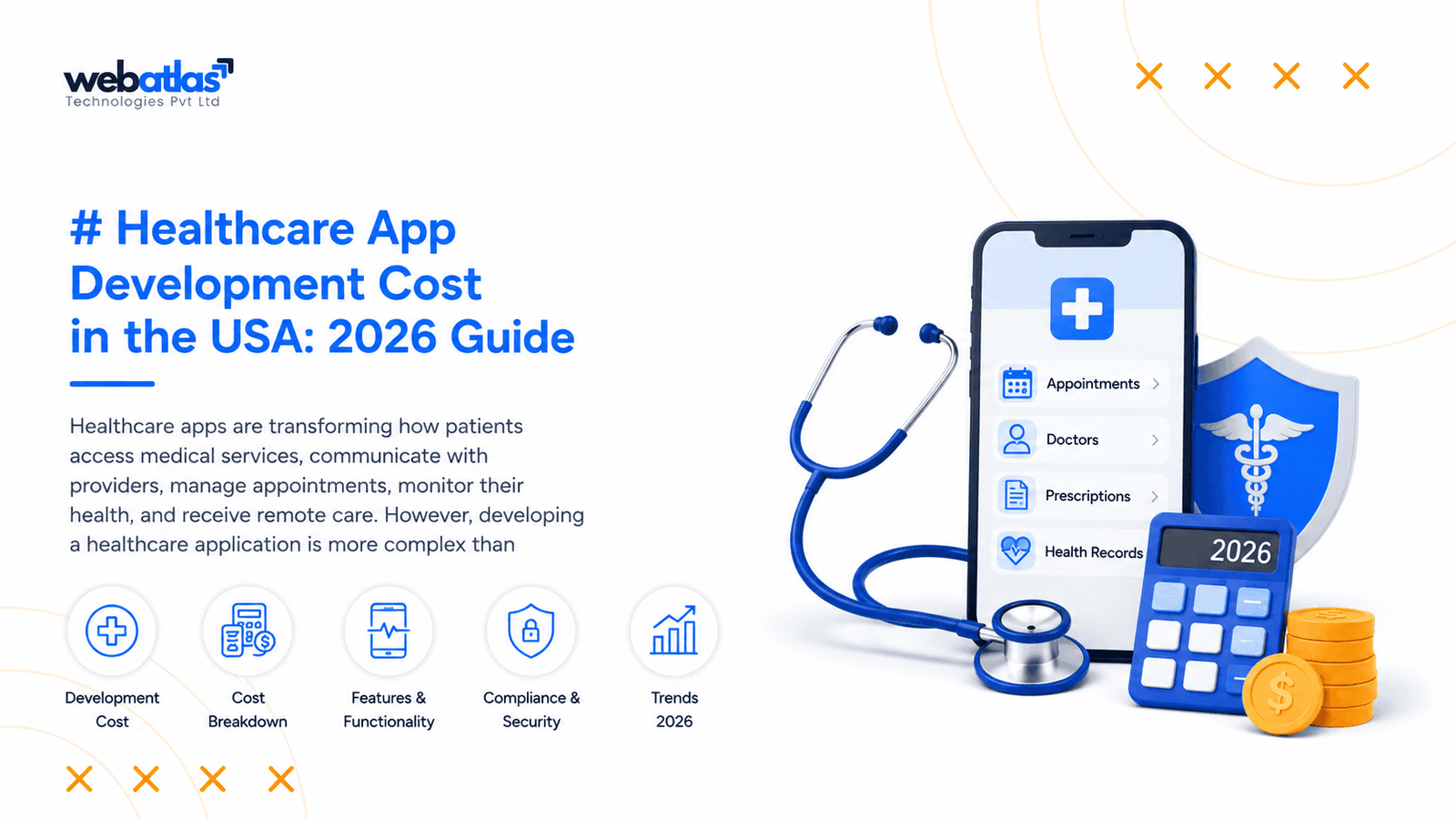
Healthcare apps are transforming how patients access medical services, communicate with providers, manage appointments, monitor their health, and receive remote care. However, developing a healthcare application is more complex than building a standard consumer app. Healthcare solutions often need secure data handling, HIPAA-focused architecture, healthcare integrations, multiple user roles, and reliable performance.
So, how much does healthcare app development cost in the USA in 2026?
A healthcare app can cost approximately $40,000 to $500,000+, depending on its features, complexity, number of platforms, integrations, security requirements, AI capabilities, and scalability needs. Simple healthcare MVPs may fall toward the lower end, while enterprise platforms with EHR/EMR integrations, advanced analytics, AI, and multiple user roles can cost several hundred thousand dollars.
This guide breaks down the healthcare app development cost in the USA, including app types, features, HIPAA and security requirements, EHR integration, AI development, hidden expenses, first-year ownership costs, and practical ways to control your budget.
How Much Does Healthcare App Development Cost in the USA in 2026?
The estimated cost of healthcare app development in the USA generally falls into the following ranges:
These are planning estimates rather than fixed quotes. The actual cost depends on the scope and technical requirements of your application.
For example, a basic patient application with appointment scheduling and secure messaging requires significantly less development work than an enterprise healthcare platform supporting multiple providers, EHR systems, AI, real-time monitoring, and complex administrative workflows.
Why can healthcare app quotes differ by $100,000 or more?
The difference usually comes from:
- Number of platforms
- Number of user roles
- Feature complexity
- HIPAA and security requirements
- EHR/EMR integrations
- FHIR or HL7 requirements
- Video consultation
- Payment integrations
- AI functionality
- Wearable and medical-device integrations
- Data migration
- Testing and security audits
- Scalability requirements
- Post-launch support
Therefore, businesses should evaluate the scope behind a quote, rather than comparing development companies based only on their headline price.
Healthcare App Development Cost by App Type
The type of healthcare application you want to build is one of the biggest factors affecting development cost.
-
Patient Portal
A patient portal may allow users to register, manage appointments, view medical information, communicate with providers, and access prescriptions or reports.
Estimated cost: $40,000–$100,000+
The budget increases when the portal needs EHR integration, insurance functionality, advanced medical records, or multiple healthcare-provider systems.
-
Telemedicine App
A telemedicine application can include patient and doctor interfaces, appointment scheduling, secure video consultations, chat, payments, notifications, and prescription management.
Estimated cost: $80,000–$200,000+
The cost can increase significantly when EHR integration, multiple platforms, advanced provider workflows, or AI features are added.
Businesses interested in building virtual-care solutions can also explore [telemedicine app development] as part of a broader healthcare application strategy.
-
Remote Patient Monitoring App
RPM applications collect health information from patients, wearable devices, or medical equipment and make that information available to healthcare providers.
Estimated cost: $100,000–$250,000+
Real-time monitoring, device connectivity, alerts, analytics, and clinical workflows can make these applications considerably more complex.
-
EHR/EMR Healthcare Application
Healthcare applications that exchange information with electronic health record or electronic medical record systems require additional integration and interoperability work.
Estimated cost: $150,000–$300,000+
Supporting multiple healthcare systems or bidirectional data exchange can push the project beyond this range.
-
AI Healthcare App
AI-powered healthcare applications can include virtual assistants, symptom checkers, clinical documentation tools, predictive analytics, personalized recommendations, and medical image analysis.
Estimated cost: $100,000–$500,000+
The final budget depends on whether the application uses an existing AI API, a customized model, or a proprietary AI system.
Webatlas Tech’s healthcare app development services cover solutions such as telemedicine, patient portals, EHR/EMR integration, remote patient monitoring, analytics, and AI-powered healthcare applications.
What Actually Drives Healthcare App Development Costs?
The number of features is only one part of the development budget. The complexity behind those features can have a much greater impact.
Number of Platforms
Developing for iOS, Android, web, and administrative dashboards requires additional development, testing, deployment, and maintenance.
Number of User Roles
A patient-only app is much simpler than a platform supporting:
- Patients
- Doctors
- Nurses
- Administrators
- Caregivers
- Pharmacists
- Insurance providers
Each role may require different dashboards, permissions, workflows, and security controls.
Data Sensitivity
Healthcare applications may handle protected health information. Security therefore needs to be considered during architecture and development rather than added at the end.
Third-Party Integrations
Healthcare apps often connect with:
- EHR/EMR systems
- Payment gateways
- Video APIs
- SMS services
- Wearables
- Medical APIs
- Insurance systems
- Identity verification services
Real-Time Functionality
Video calls, real-time messaging, remote monitoring, live alerts, and dashboards require additional backend infrastructure and testing.
Scalability
An application designed for a small clinic has very different infrastructure requirements from a national healthcare platform supporting hundreds of thousands or millions of users.
The Complexity Multiplier
Consider EHR integration.
It isn’t simply:
“Connect API → Done.”
The work can involve:
API development → authentication → data mapping → security → testing → error handling → synchronization → monitoring
That is why healthcare integrations can increase costs far more than ordinary third-party integrations.
Healthcare App Development Cost by Features
Features directly influence development effort, but their cost impact varies significantly.
| Feature | Relative Cost Impact |
| User registration and login | Low |
| Patient profile | Low |
| Appointment scheduling | Low–Medium |
| Push notifications | Low–Medium |
| Secure messaging | Medium |
| Patient records | Medium–High |
| Video consultation | High |
| Payment integration | Medium–High |
| E-prescription | High |
| Wearable integration | High |
| EHR/EMR integration | Very High |
| AI assistant | High |
| AI diagnostics | Very High |
| Advanced analytics | Medium–High |
Instead of trying to build every possible feature in the first release, businesses should prioritize functionality according to their business model.
What should go into a healthcare MVP?
Phase 1 — Must-have features
These should support the core healthcare workflow and provide enough value to validate the product.
Phase 2 — Growth features
Add advanced communication, analytics, additional integrations, and workflow automation after the core product is validated.
Phase 3 — Advanced features
AI, predictive analytics, multiple EHR integrations, wearable ecosystems, and advanced automation can be introduced as the product grows.
This approach helps businesses control their initial investment while keeping the architecture ready for future expansion.
How Much Do HIPAA, Security & Compliance Add to the Cost?
Security and compliance can have a major impact on healthcare app development costs in the USA.
HIPAA isn’t simply a certification checkbox. Its requirements can influence application architecture, infrastructure, data handling, access control, logging, vendor selection, testing, and operational processes.
Depending on the project, security and HIPAA-related requirements can add a significant percentage to the overall development budget.
Where does the compliance budget go?
It can include:
- Data encryption
- Secure authentication
- Multi-factor authentication
- Role-based access control
- Audit logs
- PHI protection
- Secure cloud infrastructure
- Business Associate Agreements where applicable
- Security testing
- Penetration testing
- Compliance documentation
- Monitoring and incident response
The important point is that security should be planned before development begins.
Trying to retrofit security into an already-developed application can lead to architectural changes, additional development work, and higher costs.
For a US healthcare business, the development estimate should therefore distinguish between the core product cost and the additional work required to meet its security, privacy, and compliance requirements.
EHR, EMR, FHIR & HL7 Integration: The Cost You Should Expect
EHR and EMR integration can become one of the largest healthcare app development expenses.
The integration approach, data requirements, healthcare system, and direction of data exchange all affect the final cost.
What affects EHR integration cost?
Before requesting an EHR integration quote, businesses should answer five questions.
- Which EHR needs to be integrated?
Different EHR platforms can have different APIs, documentation, authorization methods, and integration requirements.
- Is the integration read-only or bidirectional?
A system that only retrieves patient information is generally less complex than one that reads and writes data back into the EHR.
- What data needs to be exchanged?
Examples include:
- Patient demographics
- Appointments
- Medications
- Lab results
- Diagnoses
- Clinical notes
- Documents
- How many healthcare systems need to connect?
One EHR integration is very different from supporting multiple EHR platforms.
- Does information need to move in real time?
Real-time synchronization introduces additional backend, monitoring, error-handling, and reliability requirements.
FHIR vs HL7
FHIR is a modern interoperability standard built around web technologies and structured resources, while HL7 v2 remains widely used in many healthcare environments.
The integration technology required by the healthcare organization can therefore have a significant effect on development cost.
For businesses looking for EHR/EMR integration solutions, planning the data flow before development begins can help avoid expensive changes later.
How Much Does AI Add to Healthcare App Development Cost?
AI is becoming an important component of modern healthcare applications, but not every AI implementation has the same development cost.
Potential healthcare AI features include:
- AI healthcare chatbots
- Virtual medical assistants
- Symptom checkers
- Clinical documentation assistants
- AI-powered search
- Predictive analytics
- Personalized recommendations
- Medical image analysis
- Voice-based healthcare assistants
Three common AI approaches
Existing AI API
The application connects to an established AI model through an API. This can be the fastest approach for many general-purpose AI features.
Customized AI solution
An existing model may be adapted or fine-tuned for a particular use case, requiring additional data preparation and testing.
Proprietary AI system
A specialized AI system can require substantial investment in data, model development, infrastructure, evaluation, monitoring, and maintenance.
Therefore, AI cost should not simply be estimated as:
“AI feature = $XX,XXX.”
Instead, consider:
Model + data + integration + infrastructure + evaluation + security + monitoring
Healthcare AI also requires careful consideration of privacy, accuracy, reliability, clinical risk, and appropriate human oversight.
Businesses planning AI-enabled healthcare products can explore [AI-powered healthcare solutions] alongside their broader app development requirements.
Real-World Healthcare App Budget Examples
Broad cost ranges are useful, but practical project examples make budgeting easier.
Example 1: Basic Patient App — $50,000–$80,000
A focused patient application could include:
- Secure registration
- Patient profile
- Appointment booking
- Basic records access
- Secure messaging
- Notifications
- Admin dashboard
- Basic reporting
This type of application could be suitable for a healthcare startup or provider validating a focused digital workflow.
Example 2: Telemedicine Platform — $125,000–$175,000
A more advanced telemedicine platform could include:
- Patient application
- Doctor dashboard
- Appointment scheduling
- Secure video consultations
- Chat
- Payments
- Notifications
- Prescription functionality
- Security controls
- Administrative management
Adding EHR integration, multiple platforms, AI, or complex clinical workflows could increase the budget.
Example 3: Enterprise Healthcare Platform — $250,000–$500,000+
A larger healthcare ecosystem could include:
- Patient and provider applications
- Multiple administrative roles
- Web and mobile platforms
- EHR integrations
- FHIR/HL7 interoperability
- Advanced analytics
- AI functionality
- Wearable integration
- Complex permissions
- Advanced security
- Scalable cloud infrastructure
- Ongoing monitoring
These examples are planning scenarios rather than fixed quotes. The final cost should always be calculated from the application’s actual scope.
Hidden Healthcare App Costs Most Businesses Miss
The initial development quote isn’t necessarily the complete project budget.
Businesses should account for several additional expenses.
Cloud Infrastructure
Secure hosting, databases, backups, monitoring, and scaling can create recurring expenses.
Third-Party APIs
Video, SMS, email, payment, AI, identity verification, and medical data services may charge based on usage.
EHR Vendor Costs
Some healthcare integrations can involve vendor-specific requirements, onboarding, or additional fees.
Security Testing
Penetration testing and specialized security assessments may be separate from normal application QA.
Data Migration
If an existing healthcare organization already has patient, provider, or operational data, migrating that information can become a significant project.
Compliance Maintenance
Security and compliance aren’t one-time activities. Requirements, infrastructure, and application components may need ongoing review and updates.
Support and Monitoring
After launch, healthcare applications require bug fixes, security updates, performance monitoring, infrastructure management, and feature enhancements.
This is why businesses should separate their initial development budget from their total cost of ownership.
How Much Does a Healthcare App Cost in Year 1?
One of the biggest budgeting mistakes is focusing only on development.
A more realistic calculation is:
Year-1 Cost = Development + Infrastructure + Third-Party Services + Security/Compliance + Maintenance + Support
For example, consider a healthcare application with an initial development budget of $120,000.
| Expense | Example Budget |
| Initial development | $120,000 |
| Cloud & infrastructure | $6,000–$15,000 |
| Third-party APIs | $3,000–$10,000 |
| Security testing | $5,000–$15,000 |
| Maintenance & updates | $18,000–$30,000 |
| Monitoring/support | $6,000–$15,000 |
| Potential Year-1 Total | $158,000–$205,000 |
These numbers are illustrative. Actual costs vary according to application size, user volume, API usage, infrastructure, compliance requirements, and support needs.
A common planning benchmark for software maintenance is around 15%–25% of the original development cost annually, but healthcare applications may have additional security, compliance, infrastructure, and monitoring expenses.
Why Year-1 TCO matters
Imagine receiving a $120,000 development quote and assuming that is your complete first-year investment.
After launch, you may still need to budget for:
- Cloud services
- Security testing
- Third-party APIs
- Maintenance
- Monitoring
- Support
- Compliance activities
Planning these expenses upfront gives healthcare businesses a much more realistic financial picture.
How to Reduce Healthcare App Development Costs Without Cutting Critical Features
Reducing healthcare app development costs doesn’t mean removing security or essential functionality.
Instead, businesses should reduce unnecessary scope.
1. Start with one core workflow
Focus the first version on the primary problem your application needs to solve.
2. Prioritize features
Separate essential features from functionality that can be introduced later.
3. Plan integrations early
Understanding EHR, payment, video, wearable, or other integration requirements before development can prevent expensive rework.
4. Use established services where appropriate
You don’t necessarily need to build every infrastructure component from scratch when established services can meet the project’s technical and security requirements.
5. Phase AI development
Start with one valuable AI use case rather than launching multiple AI features simultaneously.
6. Avoid unnecessary platforms
If your first target audience primarily uses one platform, launching there first can reduce the initial investment.
7. Define compliance requirements early
Security and compliance requirements should influence architecture from the beginning.
8. Compare development proposals by scope
A $70,000 proposal and a $150,000 proposal may not deliver the same product.
Compare:
- Features
- Platforms
- Integrations
- Security
- Testing
- Deployment
- Documentation
- Maintenance
- Support
For startups and businesses validating a healthcare product, an MVP development approach can help prioritize essential functionality, validate the concept, and delay non-critical features until there is real user feedback.
The safest way to reduce healthcare app development cost is to reduce unnecessary scope—not critical security.
Healthcare App Development Timeline
Development time depends on the application’s scope, integrations, number of platforms, compliance requirements, and testing needs.
| Project Type | Approx. Timeline |
| Basic healthcare MVP | 3–5 months |
| Medium-complexity app | 5–8 months |
| Telemedicine platform | 5–9 months |
| EHR-integrated platform | 8–14+ months |
| Enterprise healthcare ecosystem | 10–18+ months |
What happens during development?
A typical healthcare app development process includes:
Discovery & Planning → UI/UX Design → Prototype → Frontend & Backend Development → API/Integration Development → Security & QA Testing → Deployment → Post-Launch Maintenance
The timeline can increase when the application requires multiple EHR integrations, complex clinical workflows, advanced AI, device connectivity, or extensive security testing.
WebAtlas Tech’s healthcare development process includes requirement analysis, UI/UX design, prototyping, frontend and backend development, QA, deployment, post-launch support, and analytics.
Frequently Asked Questions
- How much does it cost to develop a healthcare app in the USA in 2026?
Healthcare app development can cost approximately $40,000–$500,000+, depending on app complexity, features, platforms, integrations, security requirements, AI, and scalability.
- How much does a HIPAA-compliant healthcare app cost?
A focused HIPAA-ready healthcare MVP may start around $40,000–$80,000, while complex applications with multiple integrations and advanced functionality can exceed $200,000.
- How much does a telemedicine app cost?
A basic telemedicine MVP may cost around $50,000–$90,000, while a full-featured platform with EHR integration, advanced workflows, and AI can cost $150,000–$300,000+.
- How much does EHR integration cost?
The cost depends on the EHR, integration method, data requirements, and whether the integration is read-only or bidirectional. Complex healthcare integrations can add tens of thousands of dollars or more to a project.
- How much does AI add to healthcare app development?
AI costs vary according to the use case and implementation approach. Connecting an existing AI API is generally less complex than developing a customized or proprietary AI system.
- How long does it take to build a healthcare app?
A basic healthcare MVP may take around 3–5 months, while complex EHR-integrated or enterprise healthcare applications can take 8–18+ months.
- How much does healthcare app maintenance cost?
A common planning benchmark is around 15%–25% of the initial development cost annually, although healthcare applications may require additional spending on infrastructure, security, monitoring, compliance, and support.
- Is healthcare app development cheaper in India than in the USA?
Development rates can be lower in India, but businesses should compare the complete project scope, healthcare experience, security practices, communication, time-zone requirements, compliance knowledge, and post-launch support rather than comparing hourly rates alone.
- What is the biggest healthcare app development cost?
For complex applications, EHR/EMR integrations, security and compliance, multiple platforms, advanced clinical workflows, AI, and device integrations can become major cost drivers.
- How can I get an accurate healthcare app development estimate?
Start by defining your target users, core workflows, features, platforms, compliance requirements, integrations, and expected user volume. A development partner can then convert those requirements into estimated development hours, timeline, and budget.
Final Thoughts
The healthcare app development cost in the USA in 2026 can range from tens of thousands of dollars for a focused MVP to more than $500,000 for a complex enterprise healthcare ecosystem.
The final price isn’t determined simply by the number of screens or features. Security, compliance, EHR/EMR integration, interoperability, AI, user roles, scalability, device connectivity, and long-term operating requirements can have a much greater impact on the budget.
Before development begins, define the core problem your application will solve, identify your target users, determine which healthcare systems need to be connected, and separate essential MVP functionality from future enhancements.
A well-planned MVP can help validate the concept, control the initial investment, and create a scalable foundation for future functionality.
If you’re planning a healthcare application for the US market, WebAtlas Tech provides custom healthcare app development covering telemedicine, patient portals, EHR/EMR integrations, remote patient monitoring, healthcare analytics, AI-powered solutions, and other custom healthcare applications.
The right development strategy isn’t simply about finding the lowest quote. It’s about building the right product scope, meeting healthcare security requirements, planning integrations correctly, and creating an application that can scale as your business grows.

Let’s Turn Your Idea Into Reality for Your Next Project?
Book a FREE consultation with our experts and get the right roadmap for your project.
Tell Us About Your Project
Fill in your details and our experts will get back to you within one business day.