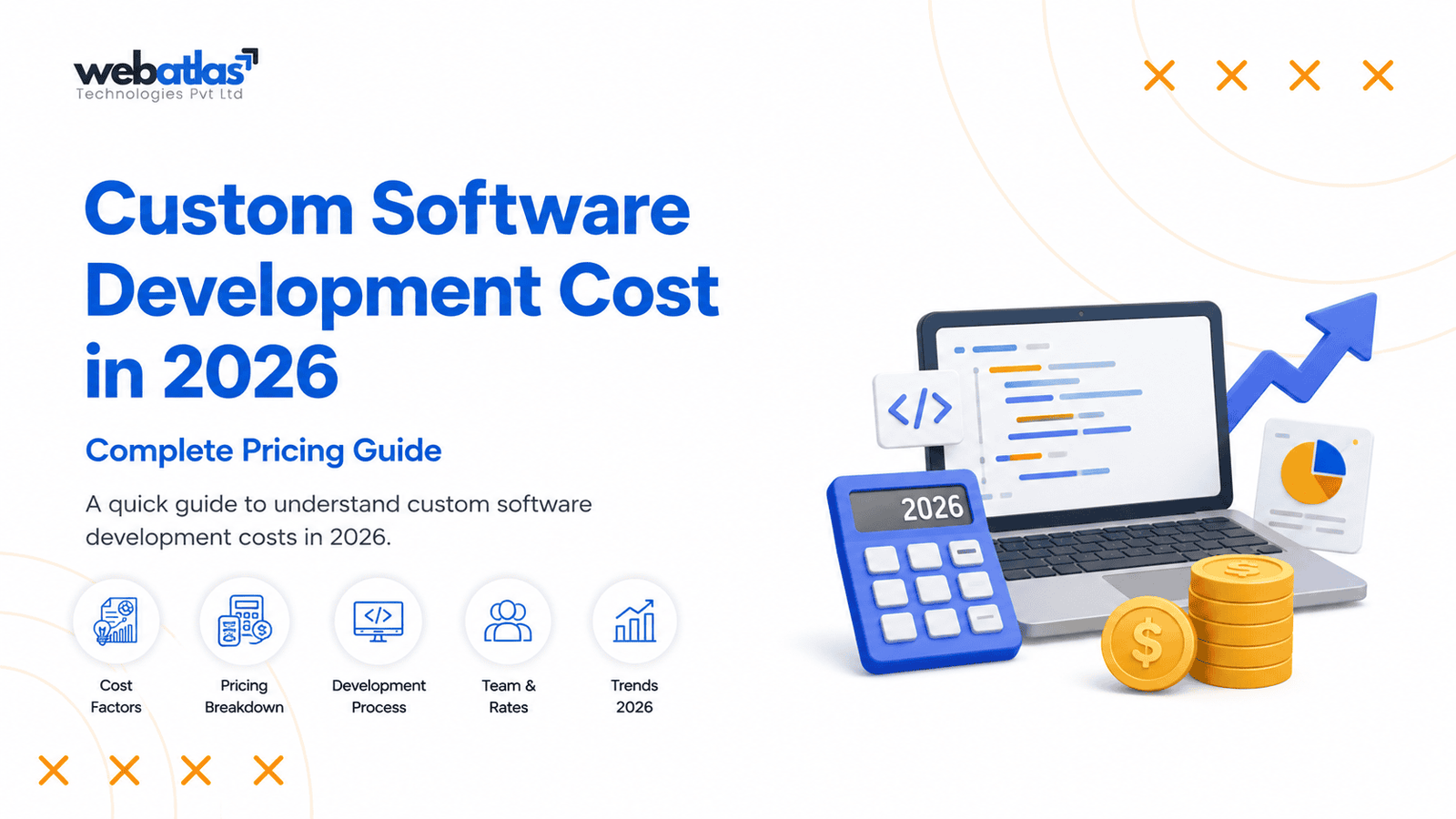
If you’re planning to build custom software in 2026, one of the first questions you’ll probably ask is: How much does custom software development cost?
The answer depends on what you’re building, how complex the software is, which platforms you need, the number of integrations, the development team’s location and experience, and how much post-launch support your product requires.
In 2026, a basic custom software MVP can start around $10,000–$30,000, while mid-complexity business applications commonly fall around $30,000–$100,000+. Complex SaaS platforms, enterprise systems, AI-powered applications and highly integrated software can reach $150,000–$500,000 or more.
Current 2026 pricing guides show similarly broad ranges. For example, Datasoft places focused MVPs around $9,000–$30,000 and enterprise-grade systems at $90,000–$300,000+, while other current guides put complex enterprise projects at $500,000 or more.
However, the initial development quote is only part of the picture.
A realistic custom software development cost should also consider UI/UX design, project management, quality assurance, cloud infrastructure, security, third-party APIs, deployment, maintenance and future improvements.
This guide explains the custom software development cost in 2026, what affects pricing, what you can build at different budgets, how development companies calculate quotes, and how businesses can control costs without sacrificing quality.
Key Takeaways
- Custom software development cost in 2026 can range from approximately $10,000 for a basic MVP to $500,000+ for complex enterprise systems.
- Project complexity, features, integrations, platforms, security and scalability have a major impact on the final cost.
- Development location can significantly affect hourly rates and total project investment.
- A low hourly rate does not automatically mean a lower total development cost.
- AI, real-time functionality, complex integrations and compliance requirements can substantially increase development costs.
- Businesses should consider Total Cost of Ownership (TCO) instead of focusing only on the initial development quote.
- A clearly defined MVP can help validate the idea and control initial software development costs.
- Comparing development proposals based only on price can result in unexpected expenses later.
How Much Does Custom Software Development Cost in 2026?
There is no universal price for custom software because every project has a different scope and technical requirement.
As a general 2026 benchmark:
| Software Type | Estimated Development Cost | Typical Timeline |
| Basic MVP | $10,000–$30,000 | 1.5–3 months |
| Simple Business Application | $20,000–$50,000 | 2–4 months |
| Mid-Complexity Application | $40,000–$100,000 | 3–6 months |
| SaaS Application | $60,000–$200,000+ | 4–9 months |
| Complex Marketplace | $80,000–$250,000+ | 5–10 months |
| Enterprise Software | $150,000–$500,000+ | 8–18+ months |
| AI-Powered Software | $50,000–$300,000+ | 4–12+ months |
These are planning ranges rather than fixed quotations. Current 2026 competitors show similarly wide ranges, with some estimating $25,000–$400,000 for typical version-one products and others placing enterprise platforms above $500,000.
The biggest mistake businesses make is treating these figures as a final quote.
For example, a $30,000 application with five basic screens and one integration is very different from a $30,000 application requiring multiple user roles, real-time communication, payment processing, advanced analytics and complex third-party integrations.
Therefore, the most accurate way to determine how much custom software development costs is to calculate the actual scope and development effort.
Custom Software Development Cost by Project Complexity
Project complexity is one of the biggest factors affecting the cost of custom software development.
1. Basic Software — $10,000–$30,000
A basic application usually includes:
- Limited number of screens
- One or two user roles
- Basic authentication
- Simple database
- Basic admin panel
- Limited integrations
- Standard UI components
Examples include internal tools, basic dashboards, proof-of-concept applications and simple business automation software.
2. Medium-Complexity Software — $30,000–$100,000
These projects may include:
- Multiple user roles
- Advanced dashboards
- Payment integration
- API integrations
- Notifications
- Custom workflows
- Reporting
- Cloud deployment
- More sophisticated UI/UX
CRM systems, customer portals, booking platforms and medium-sized SaaS applications often fall into this category.
3. Complex Software — $100,000–$250,000+
Complex software usually requires:
- Multiple platforms
- Advanced integrations
- Complex business logic
- High scalability
- Advanced security
- Real-time functionality
- Large databases
- Third-party services
- Advanced analytics
- Extensive QA
4. Enterprise Software — $250,000–$500,000+
Enterprise projects can exceed $500,000 when they involve:
- Large-scale infrastructure
- Thousands or millions of users
- Complex integrations
- Advanced permissions
- Regulatory compliance
- AI/ML
- Real-time processing
- High availability
- Legacy system integration
Current enterprise-focused pricing guides similarly place mission-critical systems in the $250,000–$500,000+ range.
What Can You Build With $25K, $50K, $100K and $250K+?
Instead of simply asking “What is the average cost of custom software development?”, businesses should ask:
“What can I realistically build with my available budget?”
What Can You Build With $25,000?
A $25K budget may support an MVP containing:
- User registration
- Login
- Basic dashboard
- Core business functionality
- Basic admin panel
- Simple database
- One or two integrations
- Responsive web interface
The goal should be validation rather than building every planned feature.
What Can You Build With $50,000?
At approximately $50K, you may be able to develop a more production-ready application with:
- Multiple user roles
- Custom UI/UX
- Advanced workflows
- Payment integration
- Notifications
- Reporting
- Third-party APIs
- Admin management
- QA and deployment
What Can You Build With $100,000?
A $100K budget can support a significantly more sophisticated product, such as:
- SaaS application
- Multi-role business platform
- Customer-facing web application
- Advanced marketplace
- Mobile + web ecosystem
- Multiple integrations
- Analytics
- Advanced security
What Can You Build With $250,000+?
A $250K+ budget may support:
- Enterprise software
- Advanced SaaS platforms
- Multi-tenant systems
- Complex marketplaces
- AI-powered applications
- Large-scale integrations
- Advanced analytics
- High-performance infrastructure
This budget-based approach gives decision-makers a clearer understanding of custom software development pricing than a generic “simple vs complex” classification.
Also Read – Top 5 CRM Software Development Company in USA 2026-2027
Custom Software Development Cost by Software Type
The type of software you build also influences the custom software development cost.
SaaS Application
A SaaS platform may cost approximately $60,000–$200,000+, depending on features.
Costs increase with:
- Multi-tenancy
- Subscription billing
- User management
- Analytics
- APIs
- Admin controls
- Data isolation
- Scalability
CRM Software
A custom CRM may cost around $40,000–$150,000+.
Features can include:
- Lead management
- Customer profiles
- Sales pipelines
- Reporting
- Communication
- Role-based access
- Automation
ERP Software
Enterprise ERP systems can cost $100,000–$500,000+ because they often connect multiple business departments.
Marketplace
A multi-vendor marketplace can cost approximately $75,000–$250,000+, depending on:
- Vendor management
- Customer accounts
- Payments
- Commissions
- Search
- Reviews
- Logistics
- Notifications
- Analytics
AI-Powered Software
AI software can range from $50,000 to $300,000+, depending on whether the project requires API-based AI, RAG, custom models, data pipelines or advanced machine learning.
Internal Business Software
Internal tools can be relatively affordable when the scope is focused, often beginning around $15,000–$50,000.
These figures are planning benchmarks. A proper estimate should be based on requirements rather than software category alone.
What Factors Affect Custom Software Development Cost?
Several factors influence the final custom software development cost in 2026.
1. Number of Features
More functionality generally means more development hours.
2. Number of Platforms
Building for web, iOS and Android costs more than building for one platform.
3. User Roles
Admin, customer, vendor, employee and partner roles require different workflows, permissions and testing.
4. Integrations
Payment gateways, CRM systems, ERP systems, shipping APIs, maps, social platforms and third-party APIs can increase development effort.
5. UI/UX Complexity
Highly customized interfaces require more research, wireframing, prototyping and design iterations.
6. Security
Sensitive applications may require encryption, authentication, penetration testing and additional security controls.
7. Scalability
A system designed for 500 users is different from one designed for 500,000 users.
8. Compliance
Healthcare, finance and other regulated industries may require additional compliance, security and documentation.
9. Technology Stack
The technology itself isn’t necessarily the main cost driver. Developer availability, architecture, complexity and required expertise matter more.
10. Timeline
An accelerated project may require a larger team working in parallel, increasing the overall investment.
Current 2026 guides consistently identify scope, integrations, geography, team composition and compliance among the major cost drivers.
How Much Do Individual Software Features Cost?
One area many generic pricing guides don’t explain clearly is the cost impact of individual features.
The following ranges can be used as rough planning benchmarks, not fixed quotations:
| Feature | Approximate Cost Range |
| User Authentication | $1,000–$4,000 |
| Admin Dashboard | $3,000–$10,000 |
| Payment Gateway | $2,000–$6,000 |
| Push Notifications | $1,000–$3,000 |
| Real-Time Chat | $4,000–$12,000 |
| GPS/Location Features | $3,000–$10,000 |
| Advanced Analytics | $4,000–$15,000 |
| Third-Party API Integration | $1,500–$8,000+ |
| AI Chatbot | $5,000–$25,000+ |
| Advanced AI/RAG | $15,000–$60,000+ |
| Multi-Tenant Architecture | $10,000–$30,000+ |
| SSO | $3,000–$10,000 |
These costs overlap with one another and should not simply be added together. The architecture, existing codebase, platform and integration complexity can dramatically change the final estimate.
For example, adding a basic payment gateway to an existing application may be relatively straightforward, while building a complete subscription billing system with invoices, tax handling, refunds, multiple currencies and payment reconciliation requires considerably more work.
Custom Software Development Cost by Location and Hourly Rates
Development location can have a significant impact on software development costs.
Typical 2026 blended hourly-rate ranges may look like:
| Region | Approx. Hourly Rate |
| India | $20–$60+ |
| Southeast Asia | $25–$70+ |
| Eastern Europe | $40–$90+ |
| Latin America | $40–$100+ |
| Western Europe | $70–$150+ |
| USA/Canada | $100–$250+ |
Current 2026 pricing research shows substantial regional differences, with offshore teams commonly operating at lower hourly rates than North American agencies.
However, hourly rate should never be the only factor used to compare vendors.
Consider this example:
Agency A charges $40/hour but needs 2,500 hours.
Agency B charges $80/hour but completes the same project in 1,200 hours.
The calculation becomes:
Agency A = $100,000
Agency B = $96,000
The higher hourly rate actually produced the lower project cost.
Therefore, businesses should compare:
Rate × Estimated Hours + Included Deliverables + Quality + Support
rather than simply choosing the lowest hourly rate.
Hidden Costs You Should Include in Your Software Budget
The initial development quote isn’t necessarily the total amount you will spend.
Some costs that businesses overlook include:
Discovery and Requirements
Business analysis, requirements gathering and technical planning.
UI/UX Design
Wireframes, prototypes, user testing and design iterations.
Quality Assurance
Manual testing, automation, regression testing, performance testing and security testing.
DevOps and Deployment
Cloud infrastructure, CI/CD pipelines, monitoring and production deployment.
Third-Party Services
Payment gateways, maps, email services, SMS, AI APIs, analytics and other external services.
Data Migration
Moving information from spreadsheets, legacy software or existing databases.
Security
Audits, penetration testing, encryption and compliance requirements.
Training
Employees may need onboarding and training before the system goes live.
Maintenance
Ongoing bug fixes, updates, security patches and infrastructure management.
Some 2026 estimates recommend budgeting roughly 15–25% of the original development cost annually for maintenance and ongoing improvements, although the actual percentage varies by system.
Total Cost of Ownership: The Number Businesses Should Really Calculate
The initial development cost is only one part of the investment.
A better approach is to calculate Total Cost of Ownership (TCO).
First-Year Software Cost
Development
- UI/UX
- QA
- Deployment
- Cloud
- Third-party services
- Security
- Training
- Maintenance
Example
Suppose your initial custom software development cost is:
$100,000
You may also have:
- Cloud infrastructure: $6,000/year
- Third-party APIs: $5,000/year
- Maintenance: $15,000–$20,000/year
- Security/testing: $5,000
- Support: $10,000
Your actual first-year investment could therefore be significantly higher than the original $100,000 development quote.
This is why businesses evaluating custom software development pricing should ask vendors:
“What will I actually spend during the first year and over the next three to five years?”
Some current competitors have already started emphasizing lifecycle costs and ROI rather than focusing only on initial development.
Fixed Price vs Time & Material vs Dedicated Development Team
The engagement model also influences your software development budget.
Fixed-Price Development
You agree on a defined scope and price.
Best for:
- Clearly defined requirements
- MVPs
- Small projects
- Projects with stable scope
Advantage:
Greater budget predictability.
Limitation:
Changes outside the agreed scope can increase the cost.
Time and Material
You pay for the actual development time and resources used.
Best for:
- Complex products
- Long-term projects
- Projects where requirements evolve
Advantage:
Greater flexibility.
Limitation:
The final budget can change as requirements evolve.
Dedicated Development Team
You hire a dedicated team for an extended period.
Best for:
- SaaS platforms
- Continuous development
- Enterprise applications
- Products requiring frequent updates
Advantage:
Long-term control and flexibility.
Limitation:
Requires stronger project management and product planning.
For many larger projects, a hybrid approach can work well: fixed-price discovery or clearly defined phases followed by flexible development. Some 2026 pricing guides also recommend hybrid models when requirements contain uncertainty.
How to Reduce Custom Software Development Cost Without Sacrificing Quality
Reducing custom software development costs doesn’t mean hiring the cheapest developer.
Instead, reduce unnecessary development effort.
1. Start With an MVP
Build the most important features first.
2. Prioritize Features
Separate features into:
- Must-have
- Should-have
- Could-have
- Future
3. Validate UX Before Development
Fixing a design problem during prototyping is much cheaper than rebuilding functionality after development.
4. Use Proven Technologies
Avoid unnecessary experimentation unless your project genuinely requires it.
5. Reuse Existing Components
Reusable libraries and proven frameworks can reduce development time.
6. Avoid Unnecessary Integrations
Every integration adds development, testing and maintenance requirements.
7. Plan Your Architecture Properly
Poor architecture can result in expensive rewrites later.
8. Automate Testing
Automation can reduce repetitive QA effort for long-term products.
9. Define Requirements Clearly
Unclear requirements create scope creep.
10. Choose the Right Development Partner
The cheapest initial quote isn’t necessarily the cheapest overall solution.
A strong development partner should help identify unnecessary features, technical risks and future scalability requirements before development begins.
How to Estimate Your Custom Software Development Budget + FAQs
Before requesting a software development quote, follow this simple estimation framework.
Step 1: Define the Business Objective
What problem will the software solve?
Step 2: Identify Users
Who will use it?
For example:
- Admin
- Customer
- Vendor
- Employee
- Manager
Step 3: List Core Features
Separate essential MVP features from future features.
Step 4: Select Platforms
Determine whether you need:
- Web
- iOS
- Android
- Desktop
Step 5: Identify Integrations
List payment gateways, APIs, CRM, ERP, maps, communication tools and other third-party systems.
Step 6: Define Security and Compliance
Identify whether your application requires special security or regulatory requirements.
Step 7: Estimate Development Hours
Your development partner can translate features into estimated hours.
Step 8: Add Non-Development Costs
Include:
- UI/UX
- QA
- DevOps
- Project management
- Security
- Deployment
Step 9: Add Post-Launch Costs
Estimate maintenance, cloud infrastructure, support and future development.
Step 10: Add a Contingency
A reasonable contingency helps protect your budget against unforeseen technical requirements.
Frequently Asked Questions
- How much does custom software development cost in 2026?
Custom software development can cost approximately $10,000–$30,000 for a basic MVP, $30,000–$100,000+ for a medium-complexity application and $150,000–$500,000+ for complex enterprise software.
- What is the average cost of custom software development?
There is no single industry-wide average. A realistic budget depends on complexity, features, platforms, integrations, development location and team composition. Many production-grade projects fall somewhere between $30,000 and $200,000, while enterprise systems can cost considerably more.
- How much does it cost to build an MVP?
A focused MVP software development project can cost approximately $10,000–$30,000, although an MVP requiring advanced integrations, AI, multiple platforms or complex workflows may cost significantly more.
- Is custom software cheaper than SaaS?
Custom software usually has a higher upfront cost, while SaaS products typically have lower initial costs but recurring subscription fees. The better option depends on customization, ownership, scalability and long-term Total Cost of Ownership.
- How much does custom software cost in the USA?
US development agencies commonly charge substantially higher hourly rates than offshore teams. A production-grade custom application can range from tens of thousands to several hundred thousand dollars depending on scope and complexity.
- Is software development cheaper in India?
India generally offers lower development rates than the US and Western Europe. However, businesses should compare the total project scope, team experience, delivery process and quality rather than choosing a vendor solely based on hourly rates.
- How much does SaaS development cost?
A custom SaaS application development can cost approximately $60,000–$200,000+, depending on multi-tenancy, subscriptions, integrations, dashboards, security, scalability and other requirements.
- How much does AI software development cost?
AI-powered software can range from approximately $50,000 to $300,000+ depending on whether the project uses third-party AI APIs or requires custom AI models, RAG, data pipelines, model evaluation and specialized infrastructure.
- What is the biggest factor affecting software development cost?
The biggest factor is usually scope and complexity. The number of features, workflows, user roles, integrations, platforms, security requirements and scalability expectations all influence the development effort.
- How can I get an accurate custom software development estimate?
Start with a detailed requirements document covering business objectives, users, features, platforms, integrations, security and timeline. A professional development company can then perform discovery and provide a project-specific estimate.
Final Thoughts
The question “How much does custom software development cost in 2026?” does not have a single answer.
A basic MVP may cost around $10,000–$30,000, while a sophisticated SaaS platform, enterprise system or AI-powered application can require $100,000, $250,000 or even $500,000+.
The most important thing is not finding the cheapest quote.
It is finding the right balance between cost, functionality, scalability, security, development quality and long-term business value.
Before starting development, define your requirements, prioritize your MVP, understand the total cost of ownership and compare vendors based on the complete scope of work.
If you’re planning a custom software product, Webatlas Tech can help you evaluate your requirements, choose the right technology approach and estimate the development effort before you commit your budget.
Ready to estimate your custom software development cost? Talk to Webatlas Tech for a project-specific consultation and development estimate.