
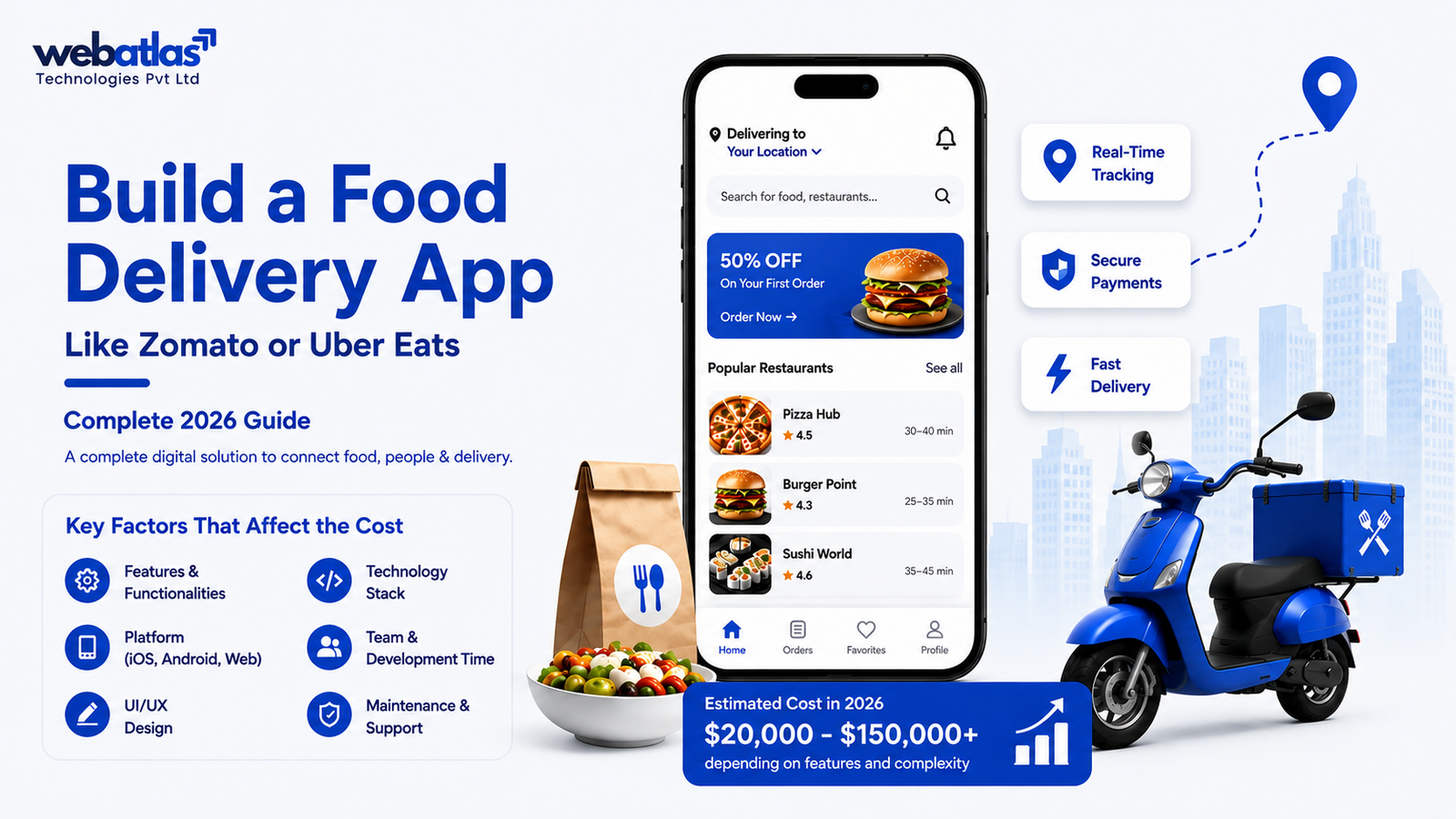
The food delivery industry has evolved from simple online ordering into a complex digital marketplace connecting customers, restaurants, delivery partners, and businesses in real time. If you want to build a food delivery app like Zomato or Uber Eats, you need more than a customer-facing mobile application. You need a complete ecosystem for restaurant management, delivery operations, payments, order tracking, analytics, and administration.
So, how do you build a food delivery app like Zomato or Uber Eats?
The process typically involves defining your business model, researching your target market, planning an MVP, designing the customer and partner experiences, developing the required applications and backend infrastructure, integrating payment and location services, testing the platform, and continuously optimizing it after launch.
A basic food delivery MVP can start with restaurant discovery, menus, ordering, payments, delivery management, and an admin panel. Advanced platforms can later introduce AI-powered recommendations, predictive delivery estimates, intelligent delivery assignment, subscriptions, loyalty programs, and personalized offers.
This guide explains how to build a food delivery app like Zomato or Uber Eats, including the business model, development process, features, architecture, technology stack, AI capabilities, cost, timeline, challenges, cost-saving strategies, and scaling opportunities.
Key Takeaways
Building a Zomato or Uber Eats-like app requires a complete marketplace ecosystem, not just a mobile application.
- Start with a focused MVP instead of developing every advanced feature from day one.
- A complete platform generally includes customer, restaurant, delivery partner, and admin systems.
- Real-time order management, GPS tracking, payments, notifications, and delivery assignment are core technical components.
- Your business model can combine restaurant commissions, delivery fees, service charges, subscriptions, advertising, and sponsored listings.
- AI can improve food recommendations, customer support, demand forecasting, delivery ETAs, and dispatch optimization.
- Launching in one focused market can help validate demand and unit economics before expanding.
- Development costs depend on the number of applications, features, integrations, technology, and development team.
- The best alternative to competing directly with Zomato or Uber Eats is to build a differentiated platform for a specific audience, location, cuisine, or business problem.
Why Build a Food Delivery App Like Zomato or Uber Eats in 2026?
Food delivery platforms have become an important part of the on-demand economy. Customers expect to discover restaurants, compare menus, place orders, make secure payments, receive accurate delivery estimates, and track their food from a single platform.
For entrepreneurs and businesses, this creates opportunities to develop specialized food delivery platforms instead of trying to compete with established marketplaces on their scale alone.
Potential opportunities include:
- Hyperlocal food delivery
- Healthy and diet-specific meals
- Homemade food marketplaces
- Regional cuisines
- Corporate meal delivery
- Cloud kitchen marketplaces
- Premium restaurant delivery
- Faster local delivery
- Niche food communities
However, there is an important distinction between a food ordering app and a food delivery marketplace.
A basic ordering application may allow customers to order food directly from restaurants. A marketplace similar to Zomato or Uber Eats coordinates customers, restaurants, delivery partners, payments, orders, logistics, reviews, and support through a connected technology ecosystem.
This makes product strategy just as important as development.
A successful platform needs to provide value to all three major marketplace participants:
Customers need convenience, variety, competitive pricing, reliable delivery, and a smooth experience.
Restaurants need more orders, visibility, manageable commissions, operational tools, and useful analytics.
Delivery partners need consistent delivery opportunities, efficient routes, transparent earnings, and a simple workflow.
How Does a Food Delivery App Like Zomato or Uber Eats Work?
Although ordering food may take only a few taps, several systems work together behind the scenes.
A typical workflow looks like:
Customer searches → Restaurant selected → Order placed → Payment processed → Restaurant accepts → Delivery partner assigned → Food prepared → Order picked up → Customer tracks delivery → Order delivered
A complete food delivery ecosystem generally consists of four major systems.
Customer App
Customers can:
- Register and log in
- Select their location
- Search for restaurants and dishes
- Browse menus
- Add items to cart
- Apply coupons
- Make payments
- Track orders
- Rate restaurants
- Contact support
Restaurant App or Panel
Restaurants can:
- Manage profiles
- Add and update menus
- Set item availability
- Accept or reject orders
- Update preparation status
- Manage offers
- View earnings and reports
Delivery Partner App
Delivery partners can:
- Complete registration and verification
- Set availability
- Receive delivery requests
- Accept orders
- Navigate to restaurants
- Confirm pickups
- Navigate to customers
- Confirm deliveries
- Track earnings
Admin Dashboard
Administrators can manage:
- Customers
- Restaurants
- Delivery partners
- Orders
- Payments
- Commissions
- Coupons
- Refunds
- Promotions
- Analytics
- Support
This is why a Zomato or Uber Eats-like product is best approached as a multi-application marketplace development project.
Zomato vs Uber Eats: What Should You Learn Before Building?
Before building your platform, studying established food delivery businesses can help you understand how different marketplace models work.
However, the objective shouldn’t be to duplicate either platform.
Instead, identify what they do well, where their models differ, and where your product can create a better experience.
Zomato vs Uber Eats Comparison
| Factor | Zomato-Style Approach | Uber Eats-Style Approach | What Your Startup Can Learn |
| Restaurant discovery | Strong focus on restaurant and food discovery | Strong marketplace discovery | Make discovery relevant to your niche |
| Ordering | Integrated food ordering experience | Integrated ordering experience | Keep checkout fast and simple |
| Delivery | Connected delivery ecosystem | Strong logistics integration | Optimize delivery operations |
| Personalization | Uses customer behavior and preferences | Uses data to personalize discovery | Use customer data responsibly |
| Monetization | Multiple revenue streams | Multiple revenue streams | Avoid depending on one source |
| Restaurant ecosystem | Large restaurant network | Large merchant ecosystem | Build strong restaurant relationships |
| Customer retention | Offers, loyalty and engagement | Promotions and personalized experiences | Build reasons for customers to return |
| Scale | Strong presence across markets | Broad international footprint | Start focused before expanding |
| Differentiation opportunity | Large marketplace | Large marketplace | Solve a specific underserved problem |
What Can You Learn From Zomato?
The Zomato model demonstrates the importance of restaurant discovery, reviews, ratings, food exploration, offers, and marketplace engagement.
For a new business, this can inspire features that help customers discover relevant restaurants rather than simply displaying a large list.
What Can You Learn From Uber Eats?
Uber Eats demonstrates the importance of delivery logistics, real-time tracking, location technology, marketplace coordination, and operational efficiency.
This highlights an important point: food delivery isn’t only about ordering food. The delivery infrastructure behind the order can determine the quality and profitability of the entire experience.
What Should You Do Differently?
Instead of asking:
“How can I copy Zomato?”
Ask:
“What can I offer that Zomato or Uber Eats does not prioritize?”
You could differentiate through:
- Hyperlocal delivery
- Lower restaurant commissions
- Faster delivery
- Better restaurant analytics
- Health-focused food
- Regional cuisines
- Homemade food
- Corporate meal delivery
- Transparent pricing
- AI-powered personalization
- Better restaurant support
The strongest strategy is to build a Zomato- or Uber Eats-inspired platform with a unique value proposition, rather than a direct clone.
Food Delivery App Business Model and Monetization Strategy
Before starting development, decide how your platform will generate revenue.
Restaurant Commission
Restaurants can pay a percentage of the order value for orders generated through the platform.
Delivery Fees
Customers can be charged based on:
- Distance
- Location
- Order value
- Delivery demand
- Time
- Delivery conditions
Service Fees
A service or convenience fee can be added to eligible orders.
Subscription Plans
Customers can receive benefits such as:
- Free or discounted delivery
- Exclusive offers
- Loyalty rewards
- Member-only promotions
Sponsored Listings
Restaurants can pay for additional visibility through sponsored placements.
Advertising
Once the platform has significant traffic, restaurants and brands can use advertising opportunities to reach customers.
Premium Restaurant Services
Restaurants can potentially pay for:
- Advanced analytics
- Marketing tools
- Customer insights
- Promotional campaigns
Don’t Ignore Unit Economics
Revenue isn’t the same as profitability.
A simple order-level calculation is:
Revenue per order − delivery costs − incentives − payment costs − support costs = contribution margin
If the contribution margin is consistently negative, increasing order volume won’t necessarily create a sustainable business.
Therefore, unit economics should influence pricing, delivery strategy, commissions, promotions, and product decisions from the beginning.
Complete Food Delivery App Architecture
A scalable food delivery application requires an architecture capable of coordinating multiple applications and real-time events.
A simplified architecture can be represented as:
Customer App
↓
API Layer
↓
Backend Services
↓
Order Management System
↓
Restaurant + Delivery Systems
↓
Payment + Maps + Notification Services
↓
Admin Dashboard
Core backend services can include:
- Authentication
- User management
- Restaurant management
- Menu management
- Order management
- Payment processing
- Delivery management
- Location tracking
- Notifications
- Promotions
- Reviews
- Customer support
- Analytics
Why Order Management Is Critical
When a customer places an order, the system must:
- Create the order.
- Process the payment.
- Notify the restaurant.
- Receive restaurant confirmation.
- Update the customer.
- Find a suitable delivery partner.
- Notify the delivery partner.
- Track preparation.
- Confirm pickup.
- Track delivery.
- Confirm completion.
Order status can move through stages such as:
Placed → Accepted → Preparing → Ready → Picked Up → Out for Delivery → Delivered
Every participant needs to receive the correct status at the correct time.
This makes reliable order-state management one of the most important technical components of a food delivery platform.
How to Build a Food Delivery App: Step-by-Step Development Process
Step 1: Conduct Market Research
Identify:
- Target customers
- Competitors
- Restaurant categories
- Pricing
- Delivery expectations
- Customer pain points
- Restaurant challenges
- Delivery partner challenges
The objective is to identify a genuine market opportunity.
Step 2: Define Your Target Audience
Decide whether the platform will target:
- Families
- Students
- Working professionals
- Corporate customers
- Health-conscious users
- Premium customers
- Local communities
Step 3: Define the Business Model
Determine how the platform will generate revenue before finalizing the product scope.
Step 4: Establish Your USP
Identify why customers and restaurants should choose your platform instead of existing alternatives.
Step 5: Define the MVP
Separate essential functionality from features that can be introduced later.
Step 6: Design UI/UX
Design the primary user journeys:
- Restaurant discovery
- Menu browsing
- Food customization
- Checkout
- Order tracking
- Restaurant order management
- Delivery acceptance
Businesses that need professional interface design can also consider Mobile App Development alongside UI/UX planning.
Step 7: Plan the Architecture
Choose the:
- Frontend technology
- Backend
- Database
- Cloud infrastructure
- APIs
- Security architecture
- Scalability strategy
Step 8: Develop the Platform
Development generally includes:
- Customer app
- Restaurant panel
- Delivery partner app
- Admin dashboard
- Backend
For businesses looking for a broader technology solution, Custom Software Development can be used to build the underlying platform around specific business requirements.
Step 9: Integrate Third-Party Services
Integrate:
- Payment gateways
- Maps
- Notifications
- SMS
- Analytics
Step 10: Test the Platform
Testing should cover:
- Functional testing
- API testing
- Payment testing
- Security testing
- Performance testing
- Location testing
- Device compatibility
Step 11: Deploy
Deploy the backend infrastructure and publish the required applications.
Step 12: Optimize After Launch
Use real-world data to identify:
- Checkout problems
- Delivery delays
- Cancellation patterns
- Restaurant issues
- Customer retention problems
Then prioritize improvements based on actual user behavior.
Must-Have Features for Customer, Restaurant, Delivery and Admin Apps
Customer App
Important features include:
- Registration and login
- Location detection
- Restaurant discovery
- Search and filters
- Menu browsing
- Food customization
- Cart
- Checkout
- Coupons
- Multiple payment options
- Order tracking
- Ratings and reviews
- Notifications
- Customer support
Restaurant Panel
Restaurants need:
- Registration
- Profile management
- Menu management
- Food availability
- Order acceptance
- Order status management
- Preparation time
- Offers
- Sales reports
- Earnings
- Reviews
Delivery Partner App
Core functionality includes:
- Registration
- Identity verification
- Availability
- Delivery requests
- Order acceptance
- Navigation
- Pickup confirmation
- Delivery confirmation
- Earnings
- Delivery history
Admin Dashboard
The administrator should be able to manage:
- Customers
- Restaurants
- Delivery partners
- Orders
- Payments
- Refunds
- Commissions
- Coupons
- Promotions
- Reviews
- Support
- Analytics
- Disputes
If you plan to launch the platform as a larger software ecosystem with multiple user roles and recurring operational workflows, a SaaS Application Development approach may also be relevant depending on the business model.
Technology Stack for a Scalable Food Delivery App
The technology stack should be selected according to the application’s requirements rather than simply choosing popular technologies.
Mobile Development
Potential options include:
- Flutter
- React Native
- Swift
- Kotlin
Backend Development
Possible technologies include:
- Node.js
- Python
- Laravel
- Java
Database
Depending on requirements:
- PostgreSQL
- MySQL
- MongoDB
- Redis
Cloud Infrastructure
Potential platforms include:
- AWS
- Google Cloud
- Microsoft Azure
Maps and Location
Mapping technology can support:
- Address selection
- Distance calculation
- Route planning
- Navigation
- Delivery tracking
Payment Integration
Depending on the target market, businesses may integrate:
- Stripe
- Razorpay
- PayPal
- Regional payment gateways
Notifications
Push notifications, SMS, and email services can communicate important order events.
The final stack should be selected based on scalability, security, performance, maintainability, integration requirements, and development resources.
AI-Powered Food Delivery App Features for 2026
AI can improve food discovery, customer engagement, delivery operations, and restaurant intelligence.
AI Restaurant Recommendations
AI can analyze:
- Previous orders
- Search behavior
- Favorite cuisines
- Spending patterns
- Time of day
- Location
This information can help generate personalized restaurant and dish recommendations.
Conversational Food Search
Instead of searching individual filters, customers could ask:
“Find a healthy dinner under $20 that can arrive within 30 minutes.”
AI can interpret multiple requirements and return relevant results.
Predictive Delivery Estimates
AI can estimate delivery times using:
- Restaurant preparation history
- Distance
- Traffic
- Driver availability
- Order volume
- Historical data
Intelligent Delivery Assignment
AI can help determine which delivery partner is best suited to an order based on location, availability, workload, and route efficiency.
Demand Forecasting
Restaurants can use predictive models to anticipate demand based on historical ordering patterns and other relevant data.
Personalized Offers
Instead of giving every customer the same discount, AI can help identify offers that are more relevant to individual customer behavior.
AI Customer Support
AI assistants can handle common queries related to:
- Orders
- Payments
- Delivery
- Refunds
- Restaurant information
Complex cases can be escalated to human support.
Fraud Detection
AI can identify suspicious patterns involving:
- Payments
- Coupons
- Refunds
- Accounts
- Orders
Businesses planning advanced AI capabilities can explore AI Development Services to integrate intelligent features based on their specific product requirements.
Food Delivery App Development Cost and Timeline
The cost of developing a food delivery application depends heavily on its scope and complexity.
A broad planning estimate is:
| Development Level | Approximate Cost |
| Basic MVP | $20,000–$40,000+ |
| Mid-Level Platform | $40,000–$80,000+ |
| Advanced Marketplace | $80,000–$150,000+ |
These are indicative ranges rather than fixed quotations.
What Affects Development Cost?
The final budget depends on:
- Number of applications
- iOS and Android platforms
- UI/UX complexity
- Backend architecture
- Real-time tracking
- Payment integrations
- Restaurant panel
- Delivery partner application
- Admin dashboard
- AI functionality
- Third-party APIs
- Security
- Testing
- Cloud infrastructure
- Maintenance
Development Timeline
A general planning estimate could be:
| Development Stage | Approximate Timeline |
| Research and planning | 2–4 weeks |
| UI/UX design | 3–6 weeks |
| MVP development | 3–5 months |
| Testing and deployment | 3–6 weeks |
| Advanced functionality | Additional 2–6+ months |
For a detailed cost breakdown, you can internally link this section to your dedicated article:
How Much Does It Cost to Build a Food Delivery App in 2026?
How to Reduce Food Delivery App Development Costs
Building a large marketplace from day one can require a significant investment. Fortunately, businesses can reduce unnecessary development costs through better planning.
Start With an MVP
Don’t build every feature at launch.
Focus on:
- Restaurant discovery
- Ordering
- Payments
- Basic tracking
- Restaurant management
- Delivery management
- Admin controls
Add advanced features after validating demand.
Prioritize Features
Classify features as:
Must-have → Important → Future → Experimental
This prevents development resources from being spent on low-priority functionality.
Consider Cross-Platform Development
For certain projects, technologies such as Flutter or React Native can reduce the effort required to maintain separate mobile codebases.
However, the technology should always be selected according to the project’s requirements.
Use Proven Third-Party APIs
Instead of building every service from scratch, use reliable APIs for:
- Maps
- Payments
- SMS
- Notifications
This can reduce both development time and maintenance requirements.
Launch in One Market
Instead of launching across multiple cities or regions, start with a focused market.
This allows you to validate:
- Customer demand
- Restaurant supply
- Delivery operations
- Pricing
- Unit economics
before making a larger investment.
Build AI in Phases
AI doesn’t need to be included everywhere in version one.
Start with core functionality and introduce:
- Recommendations
- Predictive ETA
- Demand forecasting
- Smart dispatch
after sufficient user and operational data becomes available.
Choose Scalable Architecture Without Overengineering
Your architecture should be capable of growth, but you don’t necessarily need the complexity of a massive enterprise system before you have validated the business.
The objective is:
Build only what you need now, while keeping a clear path for future expansion.
Biggest Challenges and Mistakes to Avoid
Challenge 1: Managing a Three-Sided Marketplace
You need customers, restaurants, and delivery partners to participate simultaneously.
Solution
Start with a focused geographic market and build enough supply and demand before expanding.
Challenge 2: Real-Time Dispatch
Assigning orders to suitable delivery partners can become operationally complex.
Solution
Consider location, availability, workload, distance, and estimated travel time when designing dispatch logic.
Challenge 3: Order-State Synchronization
Customers, restaurants, and delivery partners must see accurate order statuses.
Solution
Build a reliable centralized order-state system with real-time communication.
Challenge 4: Delivery Economics
Delivery costs can quickly reduce margins.
Solution
Monitor contribution margin and optimize delivery zones, incentives, pricing, and operational efficiency.
Challenge 5: Restaurant Retention
Restaurants need a sustainable reason to remain active on the platform.
Solution
Provide transparent pricing, useful analytics, marketing opportunities, and efficient restaurant workflows.
Challenge 6: Scalability
An architecture that works for hundreds of orders may require significant changes when order volume increases.
Solution
Plan infrastructure and database architecture with future growth in mind.
Common Mistakes
Avoid:
- Copying Zomato feature-for-feature.
- Building too many features before validating the MVP.
- Ignoring restaurant-side UX.
- Underestimating delivery logistics.
- Choosing technology without considering business requirements.
- Ignoring refunds and payment failures.
- Launching across too many cities at once.
- Offering unsustainable discounts.
- Ignoring unit economics.
- Treating maintenance as an afterthought.
Also Read- Top 10 Food Delivery App Development Companies in USA for 2026–27
How to Launch, Differentiate and Scale Your Food Delivery App
Launching the application is only the beginning.
A practical approach is:
One market → focused audience → selected restaurants → MVP → measurable results
Phase 1: Validate
Monitor:
- Orders
- Repeat orders
- Average order value
- Delivery time
- Cancellation rate
- Customer acquisition cost
- Restaurant retention
Phase 2: Optimize
Improve:
- Restaurant discovery
- Checkout
- Delivery assignment
- Delivery time
- Restaurant workflows
- Customer support
Phase 3: Add Advanced Features
Introduce:
- Loyalty
- Subscriptions
- AI recommendations
- Predictive analytics
- Smart dispatch
- Personalized promotions
Phase 4: Expand
Once the operating model is proven, expand into additional cities or regions.
How Can Your App Differentiate?
Consider:
Hyperlocal Delivery: Focus on a smaller geographic area and provide better local coverage.
Niche Food: Focus on healthy meals, homemade food, regional cuisine, premium food, or corporate meals.
Restaurant-Friendly Economics: Provide transparent commissions, analytics, and marketing tools.
AI Personalization: Help customers discover meals and restaurants based on their preferences.
Better Customer Experience: Focus on accurate ETAs, transparent fees, fast checkout, and reliable support.
The objective isn’t to become a smaller version of Zomato or Uber Eats.
The objective is to become the best solution for a specific market or customer problem.
How Webatlas Tech Can Help You Build a Food Delivery App
Planning to turn your food delivery idea into a scalable digital platform?
WebAtlas Tech can help you move from concept to MVP to a production-ready food delivery ecosystem with solutions tailored to your business model.
Our development capabilities can include:
- Business and product analysis
- UI/UX design
- MVP development
- Customer mobile app
- Restaurant application/panel
- Delivery partner application
- Admin dashboard
- Backend development
- Payment integration
- GPS and real-time tracking
- API integrations
- AI-powered features
- Quality assurance
- Deployment
- Maintenance and scaling
Whether you’re planning a local food delivery startup, restaurant marketplace, niche food platform, or large-scale delivery ecosystem, the development approach can be structured around your target users, budget, timeline, and growth strategy.
Ready to Build Your Food Delivery App?
Let’s turn your food delivery idea into a scalable product.
Discuss Your Food Delivery App Idea →
Final Takeaway
Building a food delivery app like Zomato or Uber Eats in 2026 requires more than developing a mobile application. It requires a connected ecosystem that brings together customers, restaurants, delivery partners, administrators, payments, maps, notifications, analytics, and scalable backend infrastructure.
The smartest approach is to start with a clearly defined market opportunity and a focused MVP. Validate customer demand, restaurant participation, delivery operations, and unit economics before investing heavily in advanced functionality.
Once the core platform is working, businesses can introduce AI-powered recommendations, predictive delivery, intelligent dispatch, personalized offers, subscriptions, loyalty programs, and advanced analytics.
Most importantly, don’t try to copy Zomato or Uber Eats feature-for-feature.
Build a platform that solves a specific problem better.
A focused product with strong marketplace economics, reliable technology, differentiated features, and a better customer or restaurant experience has a much stronger opportunity to compete.
Frequently Asked Questions
- How much does it cost to build a food delivery app like Zomato?
A basic MVP may cost around $20,000–$40,000+, while a mid-level or advanced marketplace can require a significantly larger investment. The final cost depends on features, platforms, integrations, technology, and development complexity.
- How long does it take to build a food delivery app?
A basic MVP can take approximately 3–5 months, while an advanced platform with AI, complex logistics, multiple applications, and extensive integrations can take considerably longer.
- What features should a food delivery MVP include?
Core MVP features generally include restaurant discovery, search, menus, cart, checkout, payments, order management, basic tracking, notifications, restaurant management, delivery functionality, and an admin dashboard.
- How do food delivery apps make money?
Food delivery platforms can generate revenue through restaurant commissions, delivery fees, service charges, subscriptions, sponsored listings, advertising, and premium restaurant services.
- Do I need separate apps for customers and delivery partners?
Usually, yes. Customers and delivery partners have different workflows, so separate interfaces allow each application to be optimized for its specific requirements.
- Can I launch a food delivery app in one city?
Yes. Starting with one city or focused market can help validate customer demand, restaurant participation, delivery operations, pricing, and unit economics before expanding.
- What technology is used to build a food delivery app?
Depending on the requirements, technologies can include Flutter, React Native, Swift, Kotlin, Node.js, Python, Laravel, PostgreSQL, MongoDB, AWS, mapping APIs, payment gateways, and notification services.
- Can AI be integrated into a food delivery app?
Yes. AI can support personalized recommendations, conversational search, predictive ETAs, smart delivery assignment, demand forecasting, customer support, fraud detection, and personalized promotions.
- Should I build all Zomato features in the first version?
No. Starting with an MVP is generally more practical. Build the essential customer, restaurant, delivery, and admin workflows first, then introduce advanced features based on real user data.
- How can I compete with Zomato or Uber Eats?
Instead of copying established platforms, focus on a specific opportunity such as hyperlocal delivery, niche food, better restaurant economics, faster service, stronger personalization, transparent pricing, or superior customer support.